

Mercury vs Airwallex vs Slash: which is best for global payments and working capital?
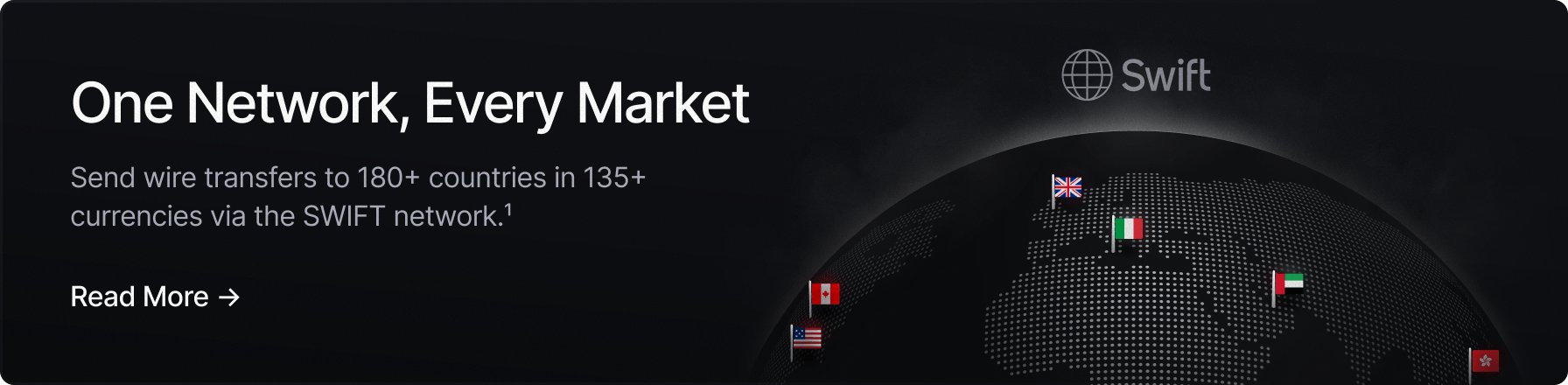
Quick answer: If you run a growing US business, you may want to pick Airwallex if you hold and pay in foreign currencies, Mercury if your payments are mostly in USD and you want a term loan that Mercury says needs no personal guarantee, and Slash if you want banking¹, corporate cards, bill pay, accounting sync, and working capital⁵ in one account. Slash Working Capital offers both lines of credit and term loans on 30-, 60-, or 90-day terms, though a personal guarantee may be required. Slash also allows users to send SWIFT wires to 180+ countries in 135+ currencies for $25, at $0 or $25 a month per entity. Airwallex doesn't list business loans in the US, and Mercury doesn't offer its loan to businesses operating in California.
This comparison is about the two things that separate these three platforms: how you move money across borders, and how you borrow. For startup banking more broadly, see Mercury vs Brex vs Ramp vs Slash.
Competitor details were checked November 18, 2026, on each provider's own site. “Not listed” means the pages we checked don't publish it.
Fees, limits, and eligibility are subject to change. Confirm current terms with each provider before you open an account.
Slash business banking
Works with cards, crypto, plus cards, crypto, accounting, and more.
Which should you pick?
- Pick Slash for one US account that covers banking, cards, bill pay, accounting sync, and working capital: The card pays up to 2% cash back, Bill Pay runs through multi-step approval policies, NetSuite and Sage Intacct sync are on the $0 plan, and Working Capital draws usually land in your Slash account within minutes.
- Pick Airwallex if you earn or spend in foreign currencies: Holding euros or pounds and paying over local rails means you don't have to convert twice, and its cards charge no foreign transaction fees.
- Pick Mercury if you're USD-first and a personal guarantee is a dealbreaker: Mercury doesn’t charge for USD international wires, and their working capital term loan doesn't require a personal guarantee, as long as you qualify and don't operate in California.
How do Mercury and Airwallex compare for working capital without a personal guarantee?
Mercury is the only one of the three with a US working capital product that it says doesn't require a personal guarantee. Airwallex's US site doesn't list business loans, and its own comparison with Bluevine lists Airwallex's lending access as “Not available.” Slash offers both lines of credit and term loans, but a personal guarantee may be required. All three offer a corporate card without a personal guarantee.
Mercury Working Capital
Mercury Working Capital is a term loan, not a revolving line: you receive a lump sum and repay it in fixed weekly payments, typically over 4 to 11 months, with a flat fee set upfront as a percentage of the advance and no prepayment fees. Mercury says it underwrites the business rather than you personally, and applying doesn't affect your credit scores. Funds go to a Mercury account. Applicants should be aware that it isn't available to businesses operating in California, Mercury requires at least $250,000 in annual sales and six months of trading history, and they only consider a new offer after you've repaid at least 50% of the loan.
Airwallex
Airwallex's approach to working capital is about the cash you already have: collect in the currency your customer pays, hold it, and spend it without converting. Its US corporate cards spend from your balances. Its pricing page also lists a credit line for corporate cards, and its help center describes card credit balances as a beta for selected customers. If you need a loan, plan on a separate lender.
Slash Working Capital
Slash Working Capital, serviced by Slope, offers both lines of credit and term loans; the line of credit is issued by Lead Bank. Each draw is repaid over 30, 60, or 90 days, with no collateral and no early repayment penalty. Applying uses a soft credit pull, decisions usually take 1–2 business days, and draws usually land in your primary Slash account within minutes. Fees vary by draw size and credit profile and appear in your offer, along with whether a personal guarantee is required. Minimum-revenue requirements apply. See Slash Working Capital and how to apply to learn more.
How do Mercury, Airwallex, and Slash compare for international payments?
Airwallex wins on foreign currency. It holds 20+ currencies with local account details, makes local transfers to 120+ countries, and converts major currencies at 0.5% above interbank rates (1% for others). Mercury is cheapest for USD: USD international wires are $0, but non-USD wires carry a 1% conversion fee, and Mercury accounts hold USD only. Slash sends SWIFT wires to 180+ countries in 135+ currencies for $25 each, in USD or the recipient's currency, and shows the exchange rate and converted amount before you confirm.
Paying suppliers abroad
If a supplier invoices in USD, Mercury's $0 USD wires are hard to beat. They also offer an optional $15 flat fee so intermediary bank fees aren't deducted from what your supplier receives. Meanwhile, Slash charges $25 on both plans. If the supplier invoices in euros or pounds and you already hold that currency, Airwallex lets you pay without converting. Slash also offers outbound payments over local rails such as Faster Payments, SEPA, SPEI, Pix, and Bre-B; on US accounts, those rails appear only after approval for stablecoin access.
Card spend abroad
Airwallex charges no foreign transaction fees and spends from currency balances you hold. Slash charges 1% (minimum $0.40) on purchases from merchants outside the US, including USD purchases, and foreign purchases under $50 don't earn cash back. Mercury charges 3% on non-USD card transactions.
Below, we’ll look at an example: a US company pays four euro invoices of $10,000 each to suppliers in Europe and puts $5,000 a month of euro-priced spend on company cards. Here’s how that would look across the three platforms:
Estimated monthly cost, based on each provider's published pricing as of November 2026; actual pricing can vary.
Plan fees aren't included; all three have a $0 plan, though Airwallex charges per user on Grow once you need more than 10 spend users or its NetSuite sync. Within this example, Airwallex can cost the least and Mercury the most. If the same suppliers invoiced in USD, Mercury's wires could cost nothing, Slash's are $25 each, and Airwallex lists $15 to $25 per SWIFT transfer.
How do cards, bill pay, and accounting sync compare?
Slash: The Slash Visa® Platinum Card is a charge card that settles daily from your Slash account, pays up to 2% cash back on eligible expenses, and comes with unlimited virtual cards, card groups, and merchant and category limits. Bill Pay extracts invoice details and routes payments through approval policies with multi-step chains. QuickBooks Online, Xero, NetSuite, and Sage Intacct sync on both plans, and NetSuite sync imports subsidiaries, so each entity can post to the right one. One login holds unlimited entities, each on its own plan.
Mercury: The IO card pays 1.5% cash back, with limits based on your Mercury balances and daily repayment until your balances reach $15,000. Bill Pay is free with approval rules. NetSuite bank feeds are on every plan, but categorization for NetSuite is listed on Pro, and Sage Intacct isn't listed. Each additional business is a separate Mercury account linked to your login profile.
Airwallex: Corporate cards spend from your multi-currency balances, and expense management, reimbursements, and bill pay are on the free Explore plan. NetSuite sync, including an hourly bank feed for each currency balance, starts on Grow, and adding multiple legal entities requires Accelerate, which includes up to three.
For more on running several companies, see fintech platforms for multi-entity banking.
What are the trade-offs?
Slash
Slash accounts hold USD, so there are no foreign-currency balances, and international wires cost $25 on both plans. The card's foreign transaction fee is 1% (minimum $0.40). Working Capital terms top out at 90 days, and a personal guarantee may be required. Sole proprietorships aren't eligible, and on Free, same-day ACH is $1 and domestic wires are $6.
Mercury
Mercury holds USD only, charges 3% on non-USD card transactions and 1% on non-USD wires, lists NetSuite categorization on Pro, and doesn't list Sage Intacct. Its working capital loan isn't revolving and isn't offered to businesses operating in California.
Airwallex
Airwallex doesn't list business loans in the US, and deposit insurance is up to $250,000 per depositor through partner banks. Teams with more than 10 spend users, or that need NetSuite sync, move to Grow at $12 per user a month plus a platform fee. If you run multiple legal entities, you’ll need Accelerate.
Verdict: Mercury, Airwallex, or Slash?
For a growing US business that sells and spends mostly in USD and pays some suppliers abroad, Slash is the best fit of the three: banking, a high-cashback charge card, Bill Pay with approvals, NetSuite and Sage Intacct sync, and working capital as a line of credit or a term loan. It’s all available at $0 or $25 a month per entity, with FDIC insurance up to $200M through Column N.A. and the IntraFi sweep network.
Choose Airwallex as your main account if much of your revenue or costs is in foreign currencies; it's the strongest of the three for multi-currency balances and FX. Choose Mercury if a working capital loan without a personal guarantee matters most and you qualify outside California.
Head-to-head detail: Slash vs Airwallex, Airwallex review, Airwallex fees, Slash vs Mercury, and Mercury vs Ramp vs Slash.
Apply in less than 10 minutes today
Join the 10,000+ businesses already using Slash.
Frequently asked questions
How does Mercury compare to Airwallex for working capital and business banking without personal guarantees?
Mercury offers a US working capital term loan that it says doesn't require a personal guarantee, repaid weekly over typically 4 to 11 months, but not to businesses operating in California. Airwallex doesn't list business loans in the US; it focuses on multi-currency accounts and FX. Both offer corporate cards without a personal guarantee. Slash offers lines of credit and term loans on 30-, 60-, or 90-day terms alongside its banking, though a personal guarantee may be required.
Is Airwallex or Mercury better for international payments?
Airwallex is better for foreign currencies: it holds 20+ currencies, makes local transfers to 120+ countries, and converts major currencies at 0.5% above interbank. Mercury is better for USD, with $0 USD international wires, but charges 1% on non-USD wires and 3% on non-USD card spend. Slash sends SWIFT wires to 180+ countries in 135+ currencies for $25 each.
Does Airwallex offer business loans in the US?
Airwallex's US site doesn't list business loans or lines of credit, and its own comparison with Bluevine lists Airwallex's lending access as not available. Its pricing page lists a credit line for corporate cards, which its help center describes as a beta for selected customers. Mercury and Slash both offer working capital to eligible US businesses.
Can a business get working capital without a personal guarantee?
Mercury says its working capital loan doesn't require one. Slash Working Capital may require a personal guarantee based on underwriting, and your offer shows whether before you accept. The Slash corporate card, Mercury's IO card, and Airwallex's corporate cards don't require a personal guarantee.
What are the best Airwallex alternatives for US businesses?
Slash and Mercury are the closest US alternatives. Slash suits businesses that want banking, a card with up to 2% cash back, bill pay, NetSuite or Sage Intacct sync, and working capital in one account, with SWIFT wires to 180+ countries for $25. Mercury suits USD-first companies that want $0 USD international wires. Neither holds foreign-currency balances the way Airwallex does.
Leading Airwallex Alternatives for Global Businesses in 2026

Which has lower FX fees: Mercury, Airwallex, or Slash?
Airwallex lists 0.5% above interbank for major currencies and 1% for others, and its cards have no foreign transaction fees. Mercury charges 1% on non-USD wires and 3% on non-USD card transactions. Slash charges $25 per international wire and a 1% card foreign transaction fee, with a $0.40 minimum.
Do Mercury, Airwallex, and Slash integrate with NetSuite?
Yes. Slash includes NetSuite and Sage Intacct sync on both plans, and each entity can post to several NetSuite subsidiaries. Mercury imports NetSuite bank feeds on every plan and lists NetSuite categorization on Pro. Airwallex includes NetSuite on Grow, listed at $12 per user a month plus a platform fee.
What Is Oracle NetSuite? Features, Benefits & Use Cases

Read more from us


