

What Corporate Cards Do Not Require a Personal Guarantee? The 2026 Answer, With Cashback and Virtual Card Limits
More than half of small businesses carrying debt have backed it with a personal guarantee. The Federal Reserve's 2026 Report on Employer Firms puts the share at 59%, which leaves the owner's savings and property on the line if the business can't pay.
Corporate cards are one form of business credit where many issuers drop the guarantee. Brex, which calls itself the first corporate card for startups, does not ask for one, and neither do Ramp, Mercury IO, Rho, Dash.fi, BILL Divvy or the Slash Visa® Platinum Card.¹ They differ in what each asks for instead, and in whether the issuer looks at the founder's personal credit at all.
Issuers ask for a personal guarantee so they have someone to collect from if the business can't pay. Cards that drop the guarantee cover that risk another way, usually through a minimum cash balance, a required deposit, or a limit that rises and falls with your account balance. Those requirements decide whether your business qualifies, so compare them before rewards or fees.
Key Takeaways
- Brex, Ramp, Mercury IO, Rho, Dash.fi, BILL Divvy and the Slash Card all issue without a personal guarantee.
- Most of them underwrite the business and leave the founder's personal credit out, though BILL Divvy runs a soft credit inquiry and Dash.fi says a consumer credit file can be a factor.
- Slash publishes no minimum cash balance to qualify, and its card limit is set by the funds on deposit.
- Ramp requires at least $25,000 in a linked US business bank account, and Brex's daily card needs equity funding, a plan to raise, or more than $500,000 in annual revenue.
- No personal guarantee does not mean no underwriting. It means the business, not the founder, carries the obligation to pay off outstanding balances.
What Replaces the Guarantee
A personal guarantee makes you personally liable for the card balance if your business can't pay it, so the issuer can pursue your personal savings, property or credit to collect. Cards without one have to secure repayment another way, and most use one of three methods.
Deposit-tracked limits. The card can only spend against money the issuer can see, so the exposure is covered before the charge happens. Slash works this way, and Mercury IO sizes its limit from balances at Mercury and any accounts the business links.
Underwritten limits with a cash floor. The issuer reviews the business, sets a limit, and requires a minimum balance somewhere it can verify. Ramp works this way, and Brex and Rho apply a cash threshold to their monthly payment terms.
Performance-based limits. The issuer sizes the limit against trading history. Dash.fi works this way, reading revenue, spend and payment history.
Each approach affects how you manage cash. A deposit-tracked limit only lets you spend what's in the account, so you need to fund it ahead of large purchases. A cash floor means keeping a minimum balance with a provider the issuer can verify, which limits how freely you can move that money elsewhere. A performance-based limit depends on your trading history, so a newer business may start with a low limit.
The Four Criteria That Decide It
- What the issuer checks: whether a hard credit pull happens, and whether a soft inquiry is disclosed before you apply.
- What backs the limit: deposits, an underwritten decision on the business, or trading history.
- Entry conditions: minimum cash balance, funding or revenue, and where the business operates.
- What the card pays: whether the rewards rate is published before you apply or assigned after approval.
1. Slash Visa® Platinum Card: Best Overall for EIN-Only Approval With No Minimum Balance
The Slash Card applies on the business's EIN. Slash's page on cards without a personal guarantee says an SSN is never required for a personal credit check, and the corporate card for startups page says Slash underwrites the business, not the founder, with no revenue minimum. More than 10,000 businesses use Slash, which raised a $100M Series C at a $1.4B valuation in April 2026.
What Replaces It
- A limit set by deposits: the effective limit is the lower of a risk-based maximum and funds on deposit in the Slash checking account, updated in real time, per the help center. Deposits are FDIC-insured² up to $150 million through a sweep network of partner banks.
- No published minimum cash balance: Slash publishes no floor to qualify.
- **Unlimited virtual cards on both plans:** one per vendor or engagement, each with its own spend limit, per-transaction ceiling and merchant restriction. Physical cards are available for any team member.
- Controls that scale with the card count: card groups with their own budgets, role-based permissions, and instant freeze.
- **Receipts requested at the purchase:** Slash texts the cardholder to upload a receipt after an in-person purchase, and expense rules code each transaction as it happens.
Sobhan Nejad, Co-Founder and COO of Bland AI, a Slash customer, cited "ease of use, how quickly we could onboard, [and] the cashback component" as the reasons the team chose the platform. The same account covers Bill Pay and invoicing, so a newly incorporated business can send and collect money from one place.
What It Costs
Both plans are published on the pricing page instead of being quoted per customer. Free is $0 a month with up to 1.5% cashback, same-day ACH at $1, domestic wires at $6 and outgoing FedNow or RTP at $5. Pro is $25 a month with up to 2% cashback and charges $0 for all three.
2. Brex: A Fit for Venture-Backed Startups
Brex has operated as part of Capital One since April 7, 2026, per Capital One's newsroom. Its corporate card page says Brex does not require a personal guarantee, that a business can apply with an EIN, and that founders' personal credit is not used or reported.
What replaces the guarantee is the company's financial profile. Brex sets limits from revenue, amount raised or cash balance, and issues unlimited virtual cards. Rewards are points, from 7x on rideshare to 1x on everything else, per its rewards page, with cash back among the redemption options. Essentials costs $0 per user and Premium $12 per user a month.
Eligibility is where Brex narrows. Per its account requirements, daily payments need an equity investment of any amount, a plan to raise soon, or more than $500,000 a year in revenue, and monthly payments for funded startups need $50,000 in cash. A company with no funding, no plan to raise and under $500,000 in revenue falls outside those criteria.
3. Ramp: A Fit for Teams That Already Hold $25,000 in a US Account
Ramp says on its application page that it does not require founders to personally guarantee expenses, and its blog says it runs neither a soft nor a hard inquiry on personal credit. Ramp issues unlimited virtual and physical cards inside a spend-management layer that blocks out-of-policy spend before it happens.
What replaces the guarantee is a cash floor plus underwriting. Ramp requires at least $25,000 in cash in a US business bank account linked to the application, serves corporations, LLCs and limited partnerships, and sets the limit as a share of linked cash or through revenue-based underwriting.
The rewards rate is the other thing to pin down. Ramp's own pages give no percentage, and NerdWallet's 2026 review lists 1% to 1.5%, set per customer after approval. The number arrives once underwriting is done, which is harder to budget against than a published rate.
4. Mercury IO: A Fit for Teams Already Banking With Mercury
Mercury's IO card pays 1.5% cashback on all spend with no personal guarantee, and Mercury says it runs no credit check during sign-up. The card is issued by Patriot Bank, N.A., and virtual cards can be used immediately.
What replaces the guarantee is the balance. Mercury calculates the limit from the balances a business holds with Mercury plus any external accounts it links. Newer customers repay daily, and 30-day repayment terms open once balances reach $15,000.
IO is open only to Mercury account holders, so choosing the card also means moving the business's banking to Mercury.
5. Rho: A Fit for Startups That Want Monthly Terms Later
Rho's FAQ says no personal guarantee or personal credit check is required, and LLCs, C-corps and other US-incorporated entities can apply with an EIN and formation documents. The card pays 1.25% cashback as standard and up to 2% on Rho Platinum, on up to $1,000,000 of eligible spend a year.
What replaces the guarantee depends on the terms. Daily Terms is the default and repays from checking the next day. Monthly Terms needs $25,000 held at Rho, or $75,000 across Rho and linked external accounts, subject to underwriting.
A startup holding less than $25,000 at Rho repays daily until it meets one of those thresholds.
6. Dash.fi: A Fit for Advertisers With Trading History
Dash.fi is a charge card built for advertisers, with no personal guarantee stated on its own product page. It lists up to 3% cashback on ad, shipping and AI spend and up to 2% on other eligible spend, with no platform fee.
What replaces the guarantee is performance. Dash.fi describes underwriting that reads revenue, spend and payment history. Its help center says an adverse action notice points to the credit reporting agency if a consumer credit file was a factor, so a founder's personal credit can still come into the decision.
Payment terms run Net-1, Net-7 and Net-15, shorter than a 30-day card, and the rate reaches only spend that still runs on a card.
Side-by-Side Comparison
Provider figures reflect publicly published information as of September 2026 and are subject to change.
How to Choose a Card With No Personal Guarantee
Work through it in this order, because an earlier condition disqualifies you before a later one matters.
- Check the entry condition first: a $25,000 cash floor or a funding test removes a business before any feature is compared, so count what you hold and where.
- Ask about the credit pull: whether the issuer runs a hard pull, a soft inquiry, or none, and whether it says so before you apply.
- Match the limit to your cash pattern: a deposit-tracked limit is predictable if you hold a steady balance, and an underwritten limit is set by review.
- Get the rate before you apply: a published number can go into a budget, and one assigned after underwriting cannot.
- Confirm the entity type: Slash, Brex, Ramp, Mercury and Rho serve registered entities, so a sole proprietor forms an LLC or corporation first.
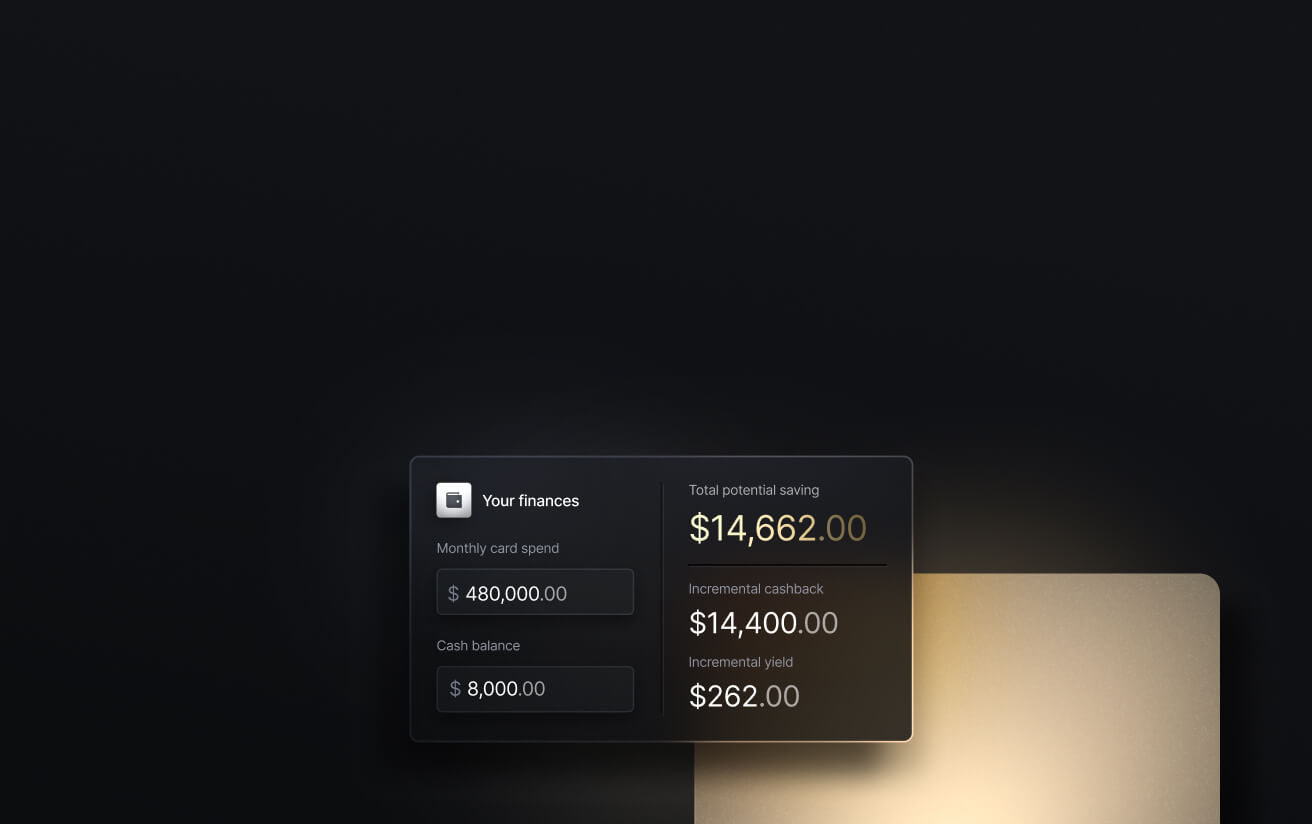
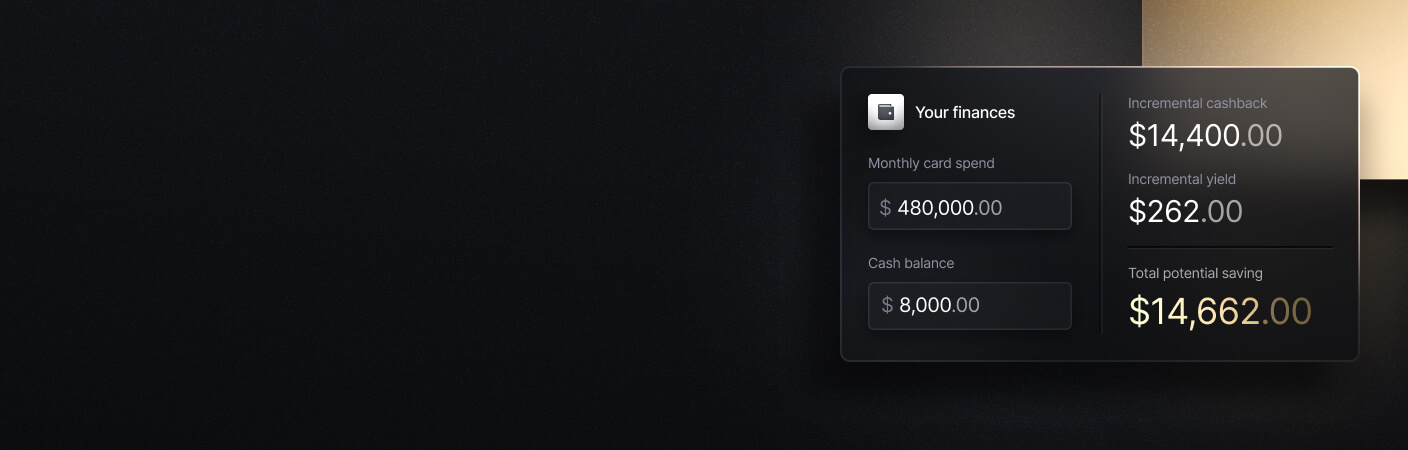
Then run the arithmetic on your own spend. At $60,000 a month on cards, the gap between up to 1.5% and up to 2% is $300 a month, or $3,600 a year, which covers a $25 monthly plan twelve times over. At $200,000 a month it is $12,000 a year.
See the ROI behind your spend
Use this calculator to understand impact, then manage and track it all in Slash.
Putting an EIN-Only Card to Work
The guarantee question usually comes up at the same moment as the first real spend. A business that has just incorporated has an EIN, a bank balance and no credit history of its own, which is the profile a personal guarantee exists to cover.
- Fund the account first: the limit follows the balance, so fund it before the first large purchase.
- Issue a card per vendor: each with its own ceiling and merchant restriction, so a forgotten trial cannot renew at full price.
- Group the cards by budget: roll them into a department or client group with one ceiling to watch, and read it back through analytics by merchant, card or category.
- Keep the rails in one place: ACH, global payments over SWIFT, RTP and FedNow run from the same account the card draws on.
- Code before the ledger: mapping rules categorize transactions against the chart of accounts, and they sync to QuickBooks Online, Xero, Sage Intacct or NetSuite.
- Hold reserves separately: a treasury account⁶ backed by money market funds from Morgan Stanley and BlackRock, with no minimum balance.
Conclusion
Many corporate cards drop the personal guarantee, and the useful question is what each asks for instead. Brex asks for funding or revenue. Ramp asks for $25,000 in a US account. Mercury and Rho ask you to keep balances on the platform. Dash.fi asks for trading history. Slash asks for an EIN and a funded account.
For a business with cash but no credit history, the EIN-only route with no published minimum is the shortest path, and the limit grows with the balance. Slash's page for startups sets out the eligibility in full.
Talk to the Slash team about applying with an EIN and no personal guarantee.
Apply in less than 10 minutes today
Join the 10,000+ businesses already using Slash.
FAQs
1. What corporate cards do not require a personal guarantee in 2026?
Corporate cards that require no personal guarantee in 2026 include the Slash Visa® Platinum Card, Brex, Ramp, Mercury IO, Rho, Dash.fi and BILL Divvy. Each replaces the guarantee with something else, such as a deposit-tracked limit, a cash floor, a funding test or trading history, so the right one depends on which condition a business can meet.
Business Credit Cards With No Personal Guarantee: Top Picks and How To Apply

2. Does the Slash Card require a personal guarantee or a personal credit check?
The Slash Visa® Platinum Card requires neither. The application is EIN-only, Slash says an SSN is never required for a personal credit check, and the card comes with no personal guarantee. The effective limit is the lower of a risk-based maximum and funds on deposit, updated in real time.
How to Choose the Right Corporate Credit Card Program
3. Is there a minimum cash balance to qualify?
It depends on the card. Slash publishes no minimum cash balance to qualify, Ramp requires at least $25,000 in a linked US business bank account, and Brex's daily card needs equity funding, a plan to raise, or more than $500,000 in annual revenue.
4. Does no personal guarantee mean no underwriting?
No. It means the business rather than the founder carries the obligation. Every card here still assesses risk, using deposits, a cash floor, funding or trading history in place of personal recourse, and an issuer can still decline an application or set a lower limit than requested.
Best Startup Credit Card: Top Picks & Features for 2026
5. Does applying for the Slash Card affect my personal credit score?
Applying for the Slash Card does not affect a founder's personal credit score, because the application runs on the business's EIN and Slash underwrites the business rather than the founder. Brex, Ramp, Mercury and Rho also say they leave personal credit out, while BILL Divvy runs a soft inquiry that does not affect the score.
The Top 5 Secured Business Credit Cards: How to Choose in 2026


