


How AI Is Transforming Corporate Finance: Applications and Trends
For years, AI felt like a technology that could be brushed off as “a problem for the future.” Today, AI is becoming an integral part of how corporate finance teams work. Advances in machine learning, generative AI, and agentic AI help businesses automate repetitive tasks and improve forecasting, enabling faster, more informed decisions.
The shift to AI is happening as finance teams face pressure to do more with less. As businesses process more transactions and follow stricter compliance rules, they are turning to artificial intelligence. AI tools can help finance teams streamline accounting and expense management tasks, reduce risk through advanced fraud controls, and improve decision-making in FP&A.
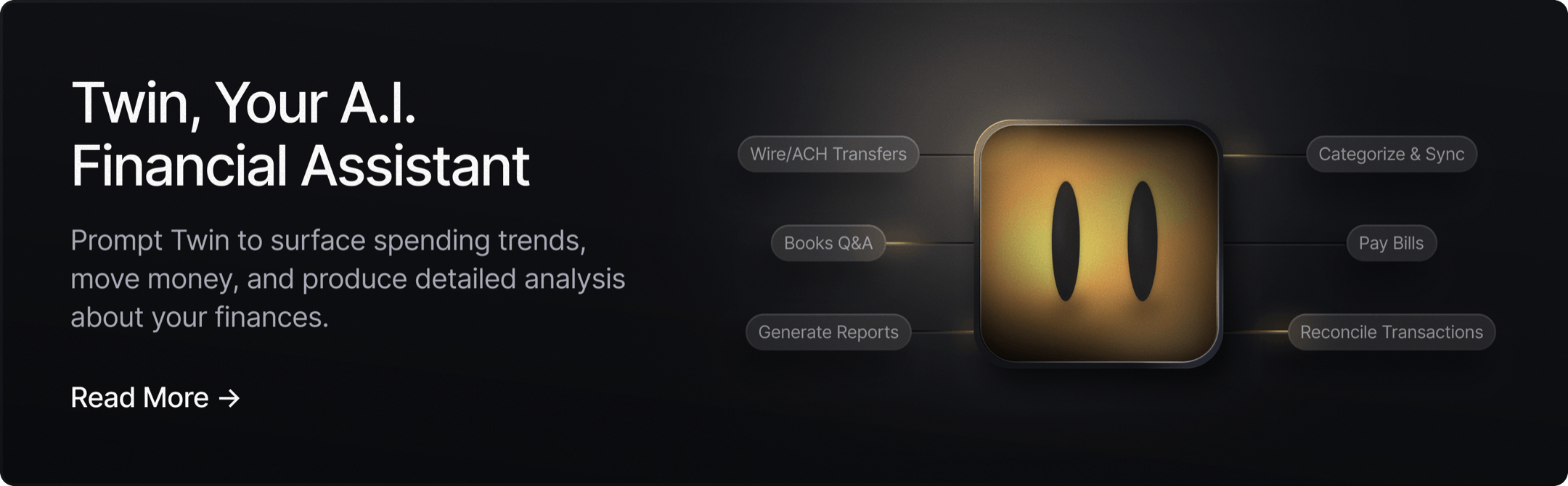
At Slash, AI is embedded in everyday financial workflows with our built-in AI agent, Twin. Twin is an AI financial assistant, not just a chatbot. It answers questions using live data from a company’s Slash account, and it can act on those requests: checking balances and transactions, breaking down spending, issuing or freezing cards, moving money, and placing purchases, all from a conversation.¹ Continue reading to learn more.
Understanding the Different Types of AI
AI is an umbrella term that covers many different tools, models, and functions. Most people picture large language models, the systems that answer prompts based on training data and pattern recognition, but in a finance setting the bigger opportunity often sits with other approaches like OCR and agentic systems. Here’s how the different models and tools compare:
- Machine Learning (ML) and Deep Learning: ML models learn from historical data and apply patterns to new information. Deep learning is a more advanced part of ML. It uses neural networks to process large amounts of data and spot subtle relationships.
- OCR, Computer Vision, and Document Understanding: Optical character recognition (OCR) is the technical term for how AI can read documents from a photo. Recently, advances in deep learning have helped AI better recognize document layouts and understand context; as OCR has improved, it’s been increasingly used to speed up invoice processing, receipt collection, and various AP/AR tasks.
- Generative AI and Large Language Models (LLMs): LLMs can understand and generate human language which helps with communication, reporting, and analyzing. Generative AI is becoming more useful for finance teams. It helps them query internal policies and follow accounting procedures. It can also create contracts and update past records.
Unlike most AI tools that follow set workflows and wait for instructions, agentic AI can understand a goal and achieve it. Imagine your CFO receives an alert that a department is about to exceed its quarterly travel budget. If prompted to look into it, an agent like Twin can pull the department’s recent spending, compare it against budget and policy, and recommend a response, then carry that response out: tightening a card limit, routing an approval, or issuing a one-off card scoped to the trip. In short, agents can take action instead of just answering a question.
Rather than treating every transaction, invoice, or payment in isolation, AI can identify patterns across your financial activity. That lets systems like Slash surface relevant insights and flag anomalies. It also lets Twin turn that data into a custom chart on request, so a finance lead can ask for spend broken down by category, or cash position over time, and get a visual built from their own account data rather than a generic template.
How to Use AI for Expense Monitoring and Spend Control
Expense management can be one of the most time-consuming aspects of corporate finance. As organizations grow, spending can become harder to monitor: employees submit receipts through different channels, transactions occur across dozens or even hundreds of corporate cards, and policy checks are pushed back to reconciliation, sometimes weeks after the violation occurred.
However, AI is revolutionizing how businesses manage expenses, either through better tools for receipt collection or credit card monitoring. Here’s how:
Automating Receipt Capture and Categorization
Using OCR, AI systems can now automatically extract information from receipts, invoices, and supporting documents. The system can identify merchants, numbers, tax information, dates, and categories directly from uploaded documents, eliminating the need for employees to manually enter transaction details.
From there, machine learning models analyze historical spending patterns to classify new transactions. Over time, the system learns how your organization typically categorizes expenses, guiding transactions to their respective ledger accounts, departments, projects, or cost centers. For example, a software subscription purchased by the marketing team may be automatically coded differently than a similar purchase made by engineering, as the AI system understands the context behind the spend.
Real-Time Spend Monitoring and Policy Enforcement
Instead of waiting for month-end reconciliation, AI can evaluate spending activity in real time. Across hundreds of corporate cards, AI can quickly identify duplicate charges, purchases from restricted vendors, unusual spending patterns, or other sorts of transactions that fall outside company policy.
For example, when a company’s expense policy requires a receipt for purchases over $75, Twin texts the employee to submit one for the charge on their Slash card, then attaches that receipt to the transaction record automatically. For teams on Slash corporate cards, the same monitoring can go a step further and recommend a tighter limit or an extra approval before a maverick spend problem escalates.
How AI Fits into Accounts Payable and Receivable
Plenty of software assists with accounts payable (AP) and accounts receivable (AR), but much of the work inside it stays manual: invoices arrive as PDFs, vendor bills come in as email attachments, remittance advices are lost in inboxes, and finance teams spend hours validating information and chasing down discrepancies.
As businesses grow, inefficiencies compound. More vendors, customers. and transactions create more forces that finance teams need to counterbalance. This leads to more time spent on administrative work handling today’s issues instead of planning ahead for the future. A benefit of AI in corporate finance is the ability to automate the most time consuming parts of the AP and AR lifecycle, with capabilities like:
Invoice Processing and Validation
The first challenge in accounts payable is turning unstructured documents into usable data. OCR and deep learning computer vision systems can extract information from invoices, purchase orders and vendor documents with high accuracy. They pull the specifics that matter: invoice numbers, due dates, payment terms, line item details. Once extracted, the system can validate the data and information before payment is approved. Invoice data can be cross-checked against purchase orders, vendor contracts, historical pricing records, or previous invoices to identify discrepancies.
AI-Powered Accounts Payable Automation
After an invoice is scanned by OCR, an AI agent can check it against the purchase order and the receipt of goods. Invoices that match move toward payment; the ones that don't go to a person to review. In some systems, an agent can draft the bill, code it to the right account, and suggest a payment date that captures an early-payment discount or avoids a late fee. With an agent handling the first pass, the matching invoices can be approved on their own while your team focuses on the few hundred exceptions that need a closer look.
Smarter Collections and Receivables Management
Accounts receivable presents a different challenge: getting paid faster without damaging customer relationships. Machine learning models can analyze historical payment behavior to predict which invoices will be paid on time, which customers may delay payment, and where collection efforts should be allocated. Smarter collections and receivables management with AI means finance teams can focus on where it will have the greatest impact rather than treating every invoice equally.
Generative AI streamlines collections by auto-generating personalized reminder emails, follow-up communications, and payment summaries. This reduces administrative effort while maintaining consistent customer communications, resulting in improved collection efficiency, lower days sales outstanding (DSO), and better customer experiences.
The standard in finance
Slash goes above with better controls, better rewards, and better support for your business.


Using AI to Forecast Cash Flow and Working Capital
For many CFOs, forecasting cash flow is one of the most important, and sometimes the most difficult, responsibilities. AI-powered forecasting provides a window into future cash positions, which is essential for managing liquidity, optimizing working capital, and supporting growth for medium and large businesses. Traditional forecasting methods are heavily reliant on spreadsheets and manual adjustments, which can create unnecessary problems when adapting to changing business conditions.
How AI Forecasting Models Work
AI forecasting platforms use iterative machine learning algorithms to give predictions that go beyond straight-line trends. These models analyze historical accounts payable and accounts receivable activity, sales data, seasonality, competitor activity, and external drivers like economic conditions and supply chain volatility to create a pattern-driven forecast of what’s likely to happen and why.
AI-Powered Treasury Recommendations
AI systems can analyze projected cash position, expected inflows, upcoming obligations, and liquidity requirements to recommend actions such as maintaining liquidity reserves, moving excess cash into high-yield treasury accounts, or making adjustments to optimize working capital. With Slash, AI can help surface projected cash runways, identify periods of excess or constrained liquidity, and recommend treasury actions that balance yield opportunities with operational flexibility.⁶
Scenario Planning with Agentic AI
Agentic AI can also run scenario analysis, simulating several business outcomes at once instead of producing a single forecast. Finance teams can compare accepting early-payment discounts against standard terms, delaying customer payments, adding headcount, or a shift in revenue, then weigh the tradeoffs before committing.
AI for Fraud Detection and Risk Controls in Corporate Workflows
As financial systems become more digital, fraud schemes are getting more complex. Corporate card fraud, account takeover, and synthetic identities have grown more sophisticated, and the tactics behind them shift faster than static rules can keep up with.
Traditional fraud prevention technologies rely on hard-coded logic such as transaction limits and geographic restrictions. While these controls are important, they can struggle to detect subtle behavioral changes or adapt to rapidly emerging fraud tactics. Artificial intelligence offers a new dynamic approach to address the growing complexity of fraudulent behavior:
- Deep Learning and Real-Time Anomaly Detection: Establishes a baseline for what normal activity looks like across users, merchants, devices, IP addresses, transaction amounts and payment patterns. When activity deviates significantly from expected behavior the system can respond immediately.
- Multi-Layered Protection Across Payment Systems: At Slash, AI can help monitor activity across corporate cards, ACH and wire payments, and stablecoin transactions, watching transaction and account patterns to flag activity that looks unusual before funds move.
- Balancing Security and User Experience: AI models continuously refine their understanding of normal behavior, helping reduce unnecessary alerts while maintaining strong protection against high-risk activity. This creates a security barrier that improves fraud detection while minimizing disruption to employees, vendors and customers.
The standard in finance
Slash goes above with better controls, better rewards, and better support for your business.


Get Started with AI in Your Financial Workflows with Slash
Whether you’re managing expenses, processing invoices, forecasting cash flow or protecting against fraud, AI can help your business spend less time on the repetitive tasks that come with managing your money and more time on building your business. As finance keeps changing, the teams that make good use of intelligent automation will outpace the ones that don't.
With Slash, AI is built into the financial infrastructure businesses use every day. An AI agent is only as good as the data it can reach: ask one to weigh in on a payment when cards, banking, and treasury live in separate tools, and it sees a fraction of the picture. Because Slash keeps banking, cards, payments, treasury, and operations in one place, Twin can work from a complete view rather than a partial one. It can answer questions from live account data and act on them, from issuing a card to moving money to placing a purchase.
Here’s what else you get when you make the switch to Slash:
- Slash Visa Platinum Card: Set customizable spend controls and issue unlimited virtual cards for team expenses, vendor payments, subscriptions, and more. Earn up to 2% cash back on eligible purchases
- Diverse payment methods: Slash supports a wide range of payments, global ACH, international wire transfers to 180+ countries via SWIFT, and real-time domestic payments through RTP and FedNow.
- Native cryptocurrency support: Send and receive USD-pegged stablecoins USDC and USDT across eight supported blockchains for payments that are often faster and lower-cost than international wires.⁴
- Accounting & ERP integrations: Sync transaction data with QuickBooks Online, Xero, Sage Intacct, or Netsuite to streamline reconciliation, reporting, and month-end close.
- Global USD: The Slash Global USD Account enables non-U.S. businesses to access, hold, receive, and send U.S. dollars without forming a U.S. entity.³ Customers can move funds through ACH, domestic and international wires, and supported stablecoin networks.
As AI reshapes corporate finance, businesses need infrastructure built for evolving financial operations. Sign up for Slash to modernize how your business moves money.
Apply in less than 10 minutes today
Join the 10,000+ businesses already using Slash.
Frequently asked questions
Can AI prevent fraud in corporate finance?
AI can help prevent fraud by identifying unusual transaction patterns, duplicate invoices, suspicious vendor activity, account takeover attempts and other anomalies in real-time. Machine learning models learn from new data and detect emerging threats faster with fewer false positives.
Business Fraud Prevention: A Guide for Protecting Your Company

A New Wave of Card Fraud Is Testing Business Defenses

How does Slash use AI in financial operations?
Slash integrates AI into banking, payments, treasury, corporate cards and spend management workflows. Businesses can use Slash to automate expense management, streamline invoice processing, monitor spending in real-time, forecast cash flow, get treasury recommendations and strengthen fraud controls. Slash corporate cards also offer up to 2% cash back with intelligent spend controls and visibility across company finances.
AI Solutions for Banking: Use Cases, Insights, and Benefits
Will AI replace finance teams?
AI is meant to support finance teams, not replace them. By automating data entry, reconciliation, invoice processing and transaction monitoring AI frees up finance professionals to focus on planning, forecasting, treasury and decision making.


