

Wise Business Alternatives for Global Payments and Financial Management
From user-friendly mobile apps to sprawling ERP systems, today’s businesses have plenty of options for sending money across borders. The tricky part is figuring out whether these systems allow you to hold foreign currency, how employees can spend it, whether you can reconcile it cleanly, and which countries are supported in the first place.
One of the more well-known options companies have for cross-border payments is Wise Business. The platform combines multi-currency balances, local receiving details, business debit cards, batch transfers, and more features built to help businesses operate internationally. However, Wise’s coverage varies by country, and it can’t exactly replace most parts of a modern finance stack.
In this guide, we’ll explain how Wise Business works, which teams it’s built for, why you might look at alternatives, and what those alternatives are. One of those options is Slash, a financial platform that supports SWIFT transfers to 180+ countries and stablecoin payments to anyone with a crypto wallet.¹,⁴ Slash also supports several local payment rails, including Faster Payments, Pix, and SEPA.
Key Takeaways
- With Wise, you can accept payments in 22 currencies, hold a multi-currency account in 98 countries, and make payments to 140+ countries.
- The Wise card is a debit card funded from your balance. There’s no revolving line and no charge-card float, so it just provides simple spending access.
- Payoneer’s conversion fee is higher than most global money transfer services (up to 3.5% over the mid-market rate), and a $29.95 annual fee applies to accounts that receive less than $6,000 over 12 months.
- OFX and Mangopay offer Spot FX, which lets you lock in a live rate and settle it within 48 hours.
- Wise’s FDIC coverage is opt-in only and caps at $250,000 through its Interest feature.
What Is Wise Business?
Wise Business is a multi-currency payment account for companies that send, receive, convert, and spend money internationally. If you run a U.S. business, you’ll pay a one-time $31 setup fee to unlock local account details that let you receive payments in 22 currencies. Wise’s transfer and conversion fees vary by currency and currently start at 0.23%, while customers spending more than $25,000 in a month can qualify for lower rates.
Using Wise Business, users can hold and convert supported balances, send international payments, and use physical or digital debit cards. Wise calls their transfers “instant payments”, which is roughly accurate; according to their site, 78% of instant payments take under 20 seconds, while 96% take less than 24 hours. Their BatchTransfer tool can send money to as many as 1,000 recipients at once, which is useful for contractor or payroll-style payments.
The account includes team permissions, approval workflows, receipt capture, invoices, payment links, and API access. You can also sync balances and transactions through quite a few accounting integrations, including QuickBooks, Xero, Sage, NetSuite, Wave, and Zoho Books.
As is the case with most financial platforms, Wise isn’t a bank. In the United States, it operates as a money services business and safeguards customer funds separately. If you want FDIC insurance, you can opt-in to their Interest feature, which allows users to earn 3.4% APY on their balances and keep their deposits protected up to $250,000. While helpful, these numbers fall below the sweep network insurance and treasury interest offered by platforms like Slash.²,⁶
Why Users Look for Wise Business Alternatives
While Wise’s business platform can generally help companies work across borders, it has a few shortcomings and gaps that lead some teams to turn elsewhere for international payment solutions. For instance, consider the following:
- Wise’s account availability is narrower than their transfer reach: Wise can send money across a broad network, but its published hold-money list covers fewer than 100 countries and territories. Companies outside that list may be able to make transfers, but they won’t receive the full multi-currency account.
- Accounting tools are mostly about syncing: While Wise integrates with a good number of accounting platforms, its workflow mostly centers on importing transactions, balances, receipts, and documents. If you need deeper AP automation, multi-entity close controls, or advanced expense policies, you might need a more complete finance platform.
- The card provides spending access, not credit: Wise issues business debit cards funded from available balances, meaning you don’t get a revolving credit line or short-term float from a charge card. Teams that need a bit more flexibility from their card spending won’t get that with Wise.
- Features surrounding held balances are underwhelming: Through Wise Interest, users can get 3.4% APY on held balances and FDIC insurance of $250,000. Most fintechs offer deposit insurance in the millions through sweep networks, and some offer higher interest on balances through treasury and/or savings accounts.
- Transaction-based pricing is tough to forecast: Wise doesn’t add an exchange-rate markup, but businesses still pay a variety of transfer and conversion fees, plus fixed fees for some incoming wires. If you’re working with a bunch of currencies, payment types, and destinations, it’d be easier to use a platform with flat pricing or a subscription model.
The 5 Best Wise Business Alternatives in 2026
If your team needs straightforward currency conversion and international transfers, Wise Business is a good pick. Its alternatives, however, set themselves apart by solving additional problems. Let’s take a look at Wise’s five top competitors and assess them based on their features and drawbacks:
Slash
Slash is a business banking platform that combines corporate charge cards, invoicing, expense management, a treasury account, and accounting automations with international payments and a business checking account. U.S. teams can send ACH, SWIFT, RTP/FedNow, and even stablecoin payments from a real-time dashboard. If your business resides in one of 130+ other countries, you can instead use the Slash Global Account to access U.S. account details without forming a U.S. entity.³
The platform also recently introduced support for a wide variety of key local payment rails. Slash users can now send payments in Euros over SEPA, Reais over Pix, Mexican pesos over SPEI, Colombian pesos over Bre-B, and British pounds over Faster Payments.
With Slash’s Free plan, you pay $1 for same-day ACH, $6 for domestic wires, and $25 for international wires. Slash Pro costs $25 monthly and waives those fees. Both plans come with Slash’s main financial features, including unlimited Slash Visa® Platinum Cards and real-time expense tracking.
- Key Strength: Slash is the only option here that carries traditional USD payment rails, foreign payment rails, corporate cards, accounting integrations, and stablecoin on/off ramps in one financial platform.
- Weakness: At this time, Slash doesn’t support sole proprietorships.
- Best For: Businesses paying overseas suppliers and collecting from international marketplaces, as well as crypto-native companies that need fiat and stablecoin rails in one account.
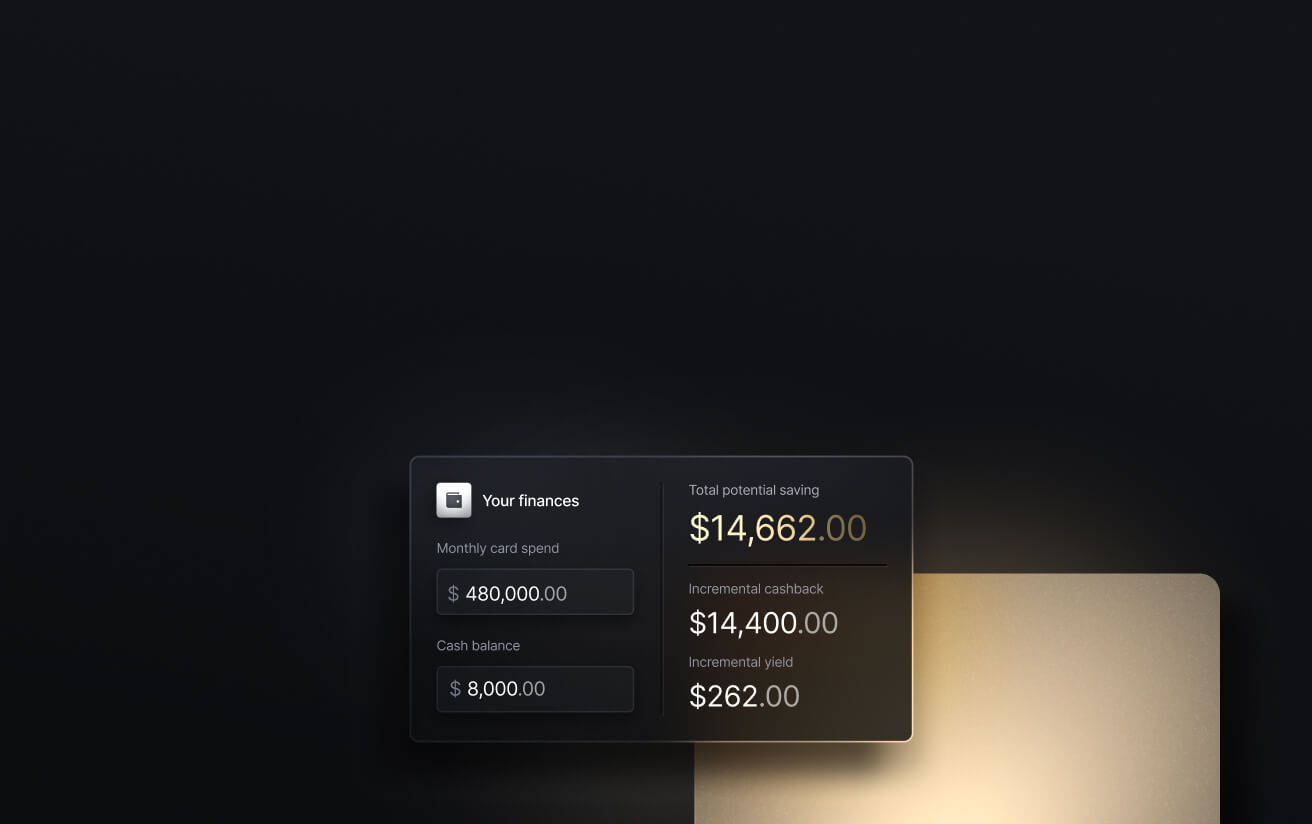
See the ROI behind your spend
Use this calculator to understand impact, then manage and track it all in Slash.

Airwallex
Airwallex is a global financial platform designed for businesses managing multi-currency accounts and cross-border payments. Businesses can collect and hold more than 20 currencies, then make payouts to bank accounts in over 200 countries/regions and over 90 currencies. Outside of its international payment tools, it offers invoicing, bill pay, corporate cards, expense management, and multi-entity support.
The Explore plan starts at $0 and includes the core account and spend management tools, with two higher tiers ($12 per-user-per-month and custom-priced) adding features like accounting integrations and 3-way matching. Airwallex also makes money on extra fees, charging 0.50% above the interbank rate for its listed major currencies and 1.00% for other currencies.
- Key Strength: With embedded finance capabilities through APIs and a wide breadth of regional support, Airwallex is one of the more robust international payment platforms on the market.
- Weakness: You’ll miss out on several key features with the Free Plan, and the combination of per-user costs and per-transfer fees with higher plans can add up quickly.
- Best For: Ecommerce and SaaS companies with revenue and expenses across several currencies.
OFX
OFX started in 1998 as an online money transfer service and has since expanded into a broader Global Business Account. Businesses can manage payments in 33 currencies across over 180 countries, obtain local receiving details for selected currencies, issue corporate debit cards, and use AP automation and accounting integrations.
The platform comes with three plans: Standard at $0/mo, Full Suite at $75/mo, and a custom quoted tier. With the free plan, you miss out on features like bill automation, accounting integrations, and multi-entity support. Regardless of the plan you pick (save for special circumstances with the quoted tier), it costs $20 to send cross-border wire/SWIFT payments and $5 to receive international funds into your Global Business Account.
- Key Strength: Along with solid cross-border tools, OFX offers Spot FX, which allows you to lock in a real-time FX rate and settle the funds within 48 hours. In practice, this means you can secure a low rate without the worry of it shifting up before settlement.
- Weakness: OFX transfers typically take 1 to 2 business days, which is slower than other options offered by competitors.
- Best For: Importers, exporters, and established companies that make international payments and want to be tactical about FX fees.
Payoneer
Payoneer is mainly built around international receivables, marketplace collections, and global payouts. Whereas options like Airwallex come with a business account, Payoneer instead offers local receiving accounts. These accounts come with local bank details in thirteen currencies including USD, EUR, JPY, and MXN, with roughly nine more currencies supported for holding and receiving through its broader network. In other words, a business can be paid as if it had an account in the payer's market, then hold, convert, spend, or withdraw the money in 190+ countries.
Receiving from another Payoneer balance or through local-currency account details can be free, but non-local receiving details cost 1%. Card-funded customer payments can cost up to 3.99% plus $0.49, and a $29.95 annual account fee may apply when an account receives less than $6,000 over 12 months’ time.
- Key Strength: One of the platform’s more unique features is “Payoneer Checkout” which gives users a hosted checkout that accepts cards and local payment methods in more than 120 currencies.
- Weakness: Payoneer charges a currency conversion fee of up to 3.5% over the mid market rate, which is higher than most other global payment solutions.
- Best For: Freelancers, agencies, marketplace sellers, and businesses paying international contractors or seller networks.
Mangopay
Mangopay provides wallet-based payment infrastructure for marketplaces and platforms handling multi-party transactions. Through their service, businesses can create wallets, collect payments, split funds, manage FX, verify users, and issue global payouts. Mangopay also comes with built-in fraud detection and KYC/AML compliance tooling, which isn’t as common as you might think.
While Mangopay’s pricing is quote-only, they do let you know that the higher your payment volumes are, the lower your fees are going to be. Like OFX, they also support Spot FX, which means you get a bit more control over your FX fees than you would with some alternatives.
- Key Strength: Mangopay’s key feature is its programmable wallets, which are built for holding, splitting, and routing money among multiple buyers and sellers.
- Weakness: Mangopay is more of an enterprise infrastructure product than a platform an ordinary small business can use for routine transfers.
- Best For: Marketplaces, travel platforms, SaaS platforms, and embedded-finance products managing complex multi-party fund flows.
Manage Your International Payments With Slash
Whether you want to choose a platform with low transfer fees or wide regional support, you’ll almost always need to add extra tools alongside it to form a tech stack. Wise Business doesn’t come with deep accounting automations, unlimited virtual accounts, or stablecoin support. Slash does.
Slash helps teams manage the finances that surround global operations, including cross-border vendor payouts and non-U.S. accounts. Along with wide support for international rails, Slash allows users to send money through local rails like Faster Payments, Pix, SEPA, and American options like RTP/FedNow.
Our platform comes with a Global Account that gives users U.S. account and routing details without requiring a U.S. entity. It’s available to businesses in more than 130 countries, and allows users to send and receive funds through available bank transfer and stablecoin rails. Accounts are backed on Bridge by a balance held in USDC, which is designed to maintain a one-to-one value with the US dollar.
Slash users that operate globally can also take advantage of the following features:
- Multi-entity support: Slash offers multi-entity account management tools without separate logins, allowing businesses to track spending, manage accounts, and download statements across all subsidiaries in one place.
- Business banking: FDIC-insured business checking, protected up to $150M through Column N.A.'s insured cash sweep network.²
- Accounts payable and receivable: Create invoices, track payment status, and collect payments via multiple methods all in your dashboard. For your bills, Slash can parse an uploaded invoice, route each bill for approval, and track its status from pending to paid, so payables don't slip through the cracks.
- Integrated treasury: Earn up to 4.03% annualized yield on idle cash through money market funds from BlackRock and Morgan Stanley, managed directly inside your Slash account rather than at a separate custodian.
- MCP connections for agents: The Model Context Protocol is an open standard for connecting AI agents to software tools. Through MCP, agents can connect to Slash directly.
Apply in less than 10 minutes today
Join the 10,000+ businesses already using Slash.
FAQs
How are FX fees calculated?
Most providers start from the mid-market rate, which is the midpoint between what buyers and sellers are quoting at that moment. Then, they add a margin. Some disclose that margin as a percentage, while others fold it into the rate they quote so you never see it explicitly.
What's an FX Fee? Everything You Need to Know to Save on International Payments

When should I use SWIFT instead of a local rail?
Local rails are almost always cheaper and faster when one exists for the destination, since a SEPA transfer in euros or a Pix payment in reais settles domestically without intermediary banks taking a cut. If no local rail is available to you, your currency pair is unconventional, or the recipient’s bank sits outside a common network, SWIFT might be the right choice despite its fees.
SWIFT Cross-Border Payments: How They Work and Key Uses
Do any of these services offer free wire transfers?
Under Slash’s $25/mo Pro Plan, wire fees, same-day ACH fees, and RTP/FedNow fees are waived entirely. OFX also offers free wire transfers, though there’s reportedly a minimum amount of $1,000.


