

Credit Cards for Meta Ads: What to Look For and What to Avoid
Meta takes the largest share of ad spend on Slash cards by a wide margin.¹ Over the past three months it has accounted for more than 80% of tracked advertising spend on our cards, more than Google, TikTok, and every other tracked platform combined. When that much of a budget runs through one platform, the card it runs on is worth some thought.
Start with how Meta bills. A small business running two ads on Instagram has different needs from a full-time agency, and Meta bills them differently. From there, look at the card details that marketing pages tend to bury: spend controls, whether it is a charge card or a credit card, how card numbers are issued, and what security features come with them. Rewards come last, once you know the card can handle the way you actually spend.
The Slash Visa Platinum Card is used by thousands of agencies and marketing teams to run ads on Meta, Google, AppLovin, and more. It earns up to 2% cash back on ad spend, lets you tie a dedicated card number to each ad budget, and sends real-time alerts on out-of-policy charges. If you’re looking for a new business card to run your ads, continue reading to learn more.
The standard in finance
Slash goes above with better controls, better rewards, and better support for your business.

Introduction to Meta Advertising
Meta sells ad inventory across Facebook, Instagram, Messenger, and its Audience Network through an auction. You set a daily or lifetime budget for a campaign, and Meta spends against it as it wins impressions, charging you for the results you optimized toward: impressions, clicks, or conversions. Nothing is billed up front for a set placement the way it would be in a media buy from a publisher.
Most advertisers use automatic billing. Meta tallies your spend during a set period and charges your payment method whenever you hit a billing threshold or reach your monthly bill date, whichever comes first. Thresholds typically start low on a new account, often around $25, and step up as you build payment history, so charges arrive more often and in larger amounts as an account grows. Some advertisers prepay instead, adding funds to a balance that spend draws down. This is the default in certain markets.
Larger advertisers can apply for monthly invoicing, where Meta extends a credit line based on account history and bills once a month on standard terms. Invoiced accounts settle by bank transfer or direct debit, not by card. That distinction matters for rewards: a card paying 3 points per dollar on advertising earns nothing on an invoice paid by ACH, because the charge never touches the card.
What changed for Meta advertisers in 2026
Advertisers have long treated Meta spend as one of the most reliable ways to earn business credit card rewards, since it is high volume, recurring, and often falls into a bonus category. That became less dependable this year.
Beginning in early 2026, Meta notified a set of advertisers, reported to be primarily higher-spend and direct-to-consumer accounts, that card payments would no longer be supported on those accounts and that they would need to move to monthly invoicing or direct debit, with a transition deadline at the end of March 2026.
How to Choose the Right Credit Card for Meta Ads
Advertising spend puts different demands on a card than travel or office expenses do. The volume is high, the charges are frequent, and the card number often sits inside a platform other people can access. A few features to look for in a card tuned for ad spend:
- Virtual card issuance: The ability to generate card numbers on demand, ideally without a cap on how many. Keeping different ad campaign cards separate can save you hours of busywork when accounting season comes around, and it can make it easier to spot if a card begins tallying up unusual charges.
- Rewards that fit your spend: Cash back is simple and predictable. Points can be valuable if you reliably redeem them through travel partners, but it can be harder to stretch the value without optimizing redemptions. Check whether advertising is a bonus category, whether there is an annual cap on it, and what the rate drops to past that cap if you anticipate high volume.
- Spend tracking: Real-time transaction visibility, with merchant and card-level detail you can filter, beats reading a monthly statement for both bookkeeping and fraud. Look for automatic capture of transaction details, receipt matching, and an accounting sync so ad spend lands in the right expense account without manual coding.
- Card control: Per-card limits, merchant and category rules, and role-based permissions determine who can spend what. Check whether you can set a card limit to match a campaign budget and have charges above it decline automatically.
- Fraud detection and fast freezing: You want alerts on unusual activity and the ability to freeze or cancel a card yourself, in seconds, rather than having to do it through a support call. Killing one card without reissuing every card on the account is the difference between an annoyance and a stalled campaign.
Top 6 Credit Cards for Meta Ads in 2026
Slash Visa Platinum Card
The strongest fit for a team running more than one ad account. Slash is a business banking platform, and the Slash Visa Platinum Card earns up to 2% cash back with no bonus categories to track and no caps that halves the rewards rate partway through the year. Every campaign, client, or ad account can get its own virtual card with its own limit, and the spend lands in the dashboard as it happens rather than in a statement at the end of the month.
- Rewards: Up to 2% cash back
- Fees: No monthly fee on the free plan, $25 per month for Pro. 1% (min. $0.40) foreign transaction fee.
- Requirements: No hard credit check or personal guarantee required. A registered business entity is required; Slash is not available to sole proprietors.
Downsides: Charges settle daily against your account balance, so the card spends money you already hold.
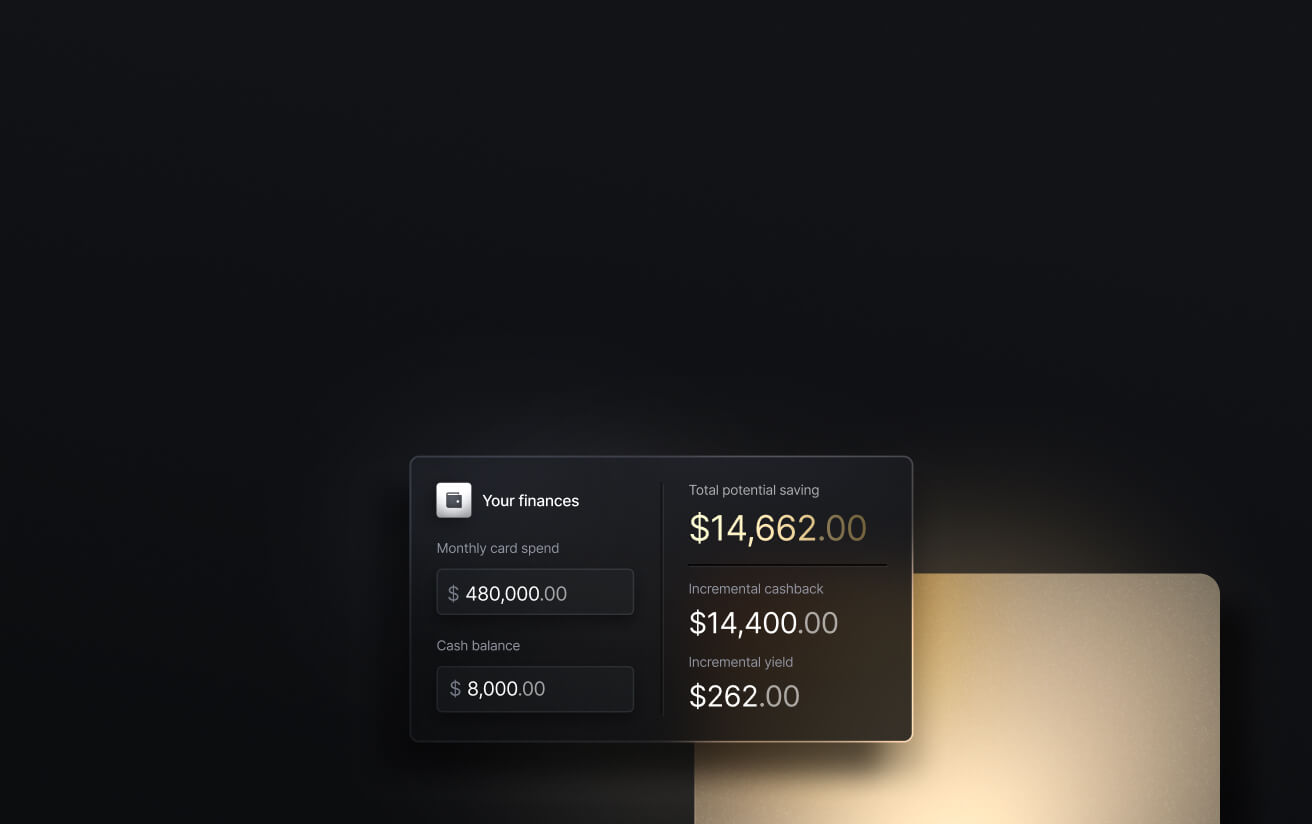
See the ROI behind your spend
Use this calculator to understand impact, then manage and track it all in Slash.

Capital One Spark Cash Plus
A reasonable default for a business that wants one rate on everything and would rather not think about categories. It is designed to be paid in full each month and carries no preset spending limit, which handles a large ad month better than a fixed credit line would.
- Rewards: Unlimited 2% cash back on purchases.
- Fees: $150 annual fee, refunded each year you spend at least $150,000, and no foreign transaction fees.
- Requirements: Business credit approval; the balance is meant to be paid in full each cycle, though Capital One allows carrying a balance with interest.
Downsides: Capital One charges a 2.99% late fee if the balance is not paid in full by the due date, which at volume can cost more than a month of cash back earns. "No preset spending limit" also means no disclosed ceiling; the limit adjusts based on payment history rather than on a line you negotiated.
American Express Blue Business Cash
The low-commitment option, and a sensible fit for a business spending a few thousand dollars a month on ads that would rather not justify an annual fee. With no minimum spend to make the math work, it can also sit alongside a primary card and catch spend outside other bonus categories.
- Rewards: 2% cash back on eligible purchases on the first $50,000 per calendar year, then 1%.
- Fees: No annual fee.
- Requirements: Business credit approval; Expanded Buying Power may let you spend above your credit limit, with the amount varying based on your use of the card, payment history, and financial profile.
Downsides: A business spending $20,000 a month on ads will hit the cash back cap quickly, and after that earn half the headline rate. Additionally, Amex states that Expanded Buying Power is "not unlimited" and does not publish the ceiling in advance.
Chase Ink Business Preferred
The card most often recommended to advertisers, because Meta and Google spend falls squarely into its bonus category. Whether 3 points per dollar actually beats a 2% cash back card depends on how you redeem: through Chase Travel or transfer partners the points can be worth more, while redeemed for cash the gap narrows considerably.
- Rewards: 3 points per dollar on the first $150,000 in combined purchases each year across advertising with social media sites and search engines, shipping, internet, cable and phone services, and travel, then 1 point per dollar.
- Fees: $95 annual fee, no foreign transaction fees.
- Requirements: Business credit approval, with an established personal credit profile typically expected.
Downsides: The $150,000 cap is shared across all four bonus categories and resets on your account anniversary rather than January 1, so an account opened in spring can run dry right as Q4 ad budgets peak.
American Express Business Gold
An option for a business whose spending is concentrated and shifts month to month, since Amex applies the bonus rate to your top two categories in each billing cycle rather than to fixed ones. Advertising with U.S. media providers is one of the eligible categories, so a heavy Meta month can pull the higher rate, though the card carries the second-highest annual fee here to get it.
- Rewards: 4 points per dollar on your top two eligible categories each billing cycle, on the first $150,000 in combined purchases per calendar year, then 1 point per dollar.
- Fees: $375 annual fee, no foreign transaction fees, offset in part by statement credits Amex values at up to $845 a year across specific merchants.
- Requirements: Approval depends on credit and account history; it is a charge card with no preset spending limit, with Pay Over Time available on eligible charges.
Downsides: The category covers U.S. media providers for advertising in select media, so buying through an agency, a reseller, or a non-U.S. entity may not qualify.
Chase Sapphire Reserve for Business
The most expensive card here at $795 a year, and worth considering only if the travel benefits get used heavily. It earns 3 points per dollar on social media and search engine advertising with no stated cap on that category, which makes it the stronger Chase choice for a business whose ad spend alone would pass the Ink Preferred's shared $150,000 limit, but it may be hard to justify for anyone else.
- Rewards: 3 points per dollar on social media and search engine advertising, 8 points per dollar on Chase Travel, 4 points per dollar on flights and hotels booked directly, and 1 point per dollar on everything else.
- Fees: $795 annual fee, no foreign transaction fees, with annual credits for travel and other business expenses.
- Requirements: Business credit approval, with an established personal credit profile typically expected.
Downsides: Below roughly $150,000 in annual ad spend, the Ink Business Preferred earns the same 3 points per dollar on ad spend for $700 less in annual fees. Point redemption into Chase Travel can be strong, but point redemption into statement credits may struggle to meet the effective value of cash back.
Tips for Effective Credit Card Management
Getting the card right is the easy part. The process around it is what separates a clean advertising operation from a messy one:
- Issue a virtual card for each campaign or ad account: When a campaign has its own card number, you can see what it spent without picking through a statement. If that card number is stolen, only that campaign's budget is exposed, too. Set each limit a little above the planned budget so a charge above it gets declined instead of going through unnoticed.
- Keep separate cards for separate budgets: Client work, brand campaigns, and testing budgets should each run on their own card. Mixed together, it is hard to tell which one is overspending, and if you buy ads on behalf of clients, separate cards make billing them straightforward.
- Make sure you can freeze a card in seconds: Confirm you can freeze or cancel a card quickly from the dashboard or app without calling support. Meta will retry charges that are declined, so a stolen card number left active can keep collecting charges for days.
- Keep a backup payment method on file. When a charge is declined, Meta pauses the campaigns on that account, and a restarted campaign does not always return to its previous performance right away. A backup card or bank account costs nothing to add and keeps an expired card from taking your ads offline.
- Reconcile ad spend weekly, not monthly: Meta charges arrive in many small amounts, so a full month of them is a lot to sort through at once and errors are easy to miss. Automatic receipt capture and a connection to your accounting software, which Slash offers for QuickBooks Online, Xero, Sage Intacct, and NetSuite, means most of the categorizing is done before you look at it.
- Raise your card limits when you raise budgets: Meta increases the amount it bills at one time as your account builds payment history, so charges get larger the longer you advertise. A limit you set six months ago may be too low for what Meta now charges in one transaction, so check it whenever you increase a budget.
Maximize Your Advertising Spend with Slash
Most corporate cards are built around rewards or around controls. Slash is built for teams that need both, and for the volume of small, frequent charges that ad platforms generate.
Each campaign can get its own virtual card, funded from a dedicated account holding that campaign's budget. Every transaction syncs to your accounting software, so ad spend is categorized to your marketing budget before you open the books.
Here’s what you get when you make the switch to Slash:
- Business banking: FDIC-insured business checking, protected up to $150M through Column N.A.'s insured cash sweep network.²
- Accounts payable and receivable: Create invoices, track payment status, and collect payments via multiple methods all in your dashboard. For your bills, Slash can parse an uploaded invoice, route each bill for approval, and track its status from pending to paid, so payables don't slip through the cracks.
- Multiple payment methods: Send and receive funds via same-day ACH, wires on SWIFT to 180+ countries, RTP, FedNow, and stablecoin transfers in USDC or USDT.⁴
- High-yield treasury: Earn up to 3.85% annualized yield on idle funds with money market investments from BlackRock and Morgan Stanley, managed directly within your Slash account.⁶
- Accounting & ERP integrations: Sync transaction data with QuickBooks Online, Xero, NetSuite, Sage Intacct, or DualEntry to streamline month-end close.
Apply in less than 10 minutes today
Join the 10,000+ businesses already using Slash.
Frequently Asked Questions
Can I use multiple credit cards for Meta Ads?
Yes. Meta lets you add several payment methods to an ad account and set which one is primary, and businesses running multiple ad accounts can assign a different card to each. Many advertisers use this to route spend to whichever card offers the better rate for that campaign, and to keep a backup method on file in case the primary declines.
How do rewards programs work with Meta Advertising?
Rewards are earned by your credit card, not from Meta itself. Cards that treat advertising with social media sites and search engines as a bonus category typically apply that rate to Meta charges, though eligibility depends on how the transaction is categorized.
What happens if I exceed my credit limit on Meta Ads?
The charge is declined, and Meta will usually retry it and pause delivery on the affected campaigns until a valid payment goes through. Campaigns can often be restarted quickly once the balance clears, but the pause itself can affect performance while the campaign re-enters the auction.
The 7 Best High Limit Credit Cards for Businesses in 2026

Is a charge card or a credit card better for ad spend?
It depends on whether you value flexibility or control more. A credit card gives you weeks between the charge and the payment, which can provide more cash flow .., while a charge card requires paying the balance in full yet may have no preset spending limit. Businesses with predictable cash flow or operating larger ad budgets may prefer the higher capacity of a charge card.
Business Charge Card vs Credit Card: 6 Key Differences You Should Know


