

How to Sell Wholesale on Amazon: Step-by-Step for Beginners
The ecommerce market isn't oversaturated, even on the biggest marketplaces. More than 60% of Amazon's sales come from independent sellers, and over 11,000 independent U.S. sellers grew their sales tenfold in 2025. On a marketplace that size, a working knowledge of wholesale is one of the most reliable ways to keep fulfillment steady and sourcing costs low.
If you're wondering how to buy wholesale and sell on Amazon and want a clear view of the Amazon wholesale business model, this guide will help. We'll walk through setting up your business and Amazon Seller Central accounts, finding and vetting suppliers through directories or outreach, and buying and listing your first products. Then, we’ll go over tips for managing inventory, negotiating better terms, and scaling your operations.
Ecommerce sales can require a unique financial toolkit: you need different cards for your ad accounts, you may be running different subsidiaries for multiple stores, you're receiving payouts from different places, and you're constantly moving money to suppliers. With Slash, all of that runs from a single dashboard built for the financial complexity of an ecommerce operation, no matter how many stores, products, or supplier accounts you're handling.
The standard in finance
Slash goes above with better controls, better rewards, and better support for your business.

Introduction to Selling Wholesale on Amazon
Selling wholesale on Amazon means buying branded, established products in bulk from a manufacturer or authorized distributor, then reselling those exact units on Amazon's marketplace at retail. You're acting as an authorized reseller of someone else's brand, listing your inventory against a product listing (an ASIN, Amazon's internal product identifier) that already has reviews, ranking, and demand. That differs from the three other common methods of ecommerce sales:
- Private label: A seller develops their own product with a manufacturer (usually overseas) and creates a new listing from scratch.
- Retail or online arbitrage: A seller buys clearance or discounted inventory from other retailers and flips it for a markup, without any supplier relationship.
- Dropshipping: A seller lists a product they don't hold and ships it from a third party when it sells.
- Wholesale: You own the inventory, you buy it directly from the source, and you sell it against a listing that isn't yours.
Many wholesalers use Fulfillment by Amazon (FBA), Amazon's warehousing and shipping service. You ship inventory into Amazon's fulfillment centers, and Amazon stores, packs, ships, handles returns, and manages customer service on your behalf. The alternative is Fulfillment by Merchant (FBM), where you handle all of that yourself. FBA carries fees but earns the Prime badge, which affects whether shoppers buy from your offer or a competitor's.
Two mechanics from Amazon's marketplace shape how wholesale works for the seller:
- Featured Offer: Commonly called the Buy Box, this is the "Add to Cart" and "Buy Now" panel on the right of a product page. When multiple sellers offer the same ASIN, Amazon rotates one of them into the Featured Offer at any given moment. The Buy Box captures roughly 82% of sales on any given listing, so competing for it (and understanding how Amazon awards it) is important.
- Gating: Amazon restricts many brands, categories, and individual ASINs so that only approved sellers can list them. Getting "ungated" typically means producing invoices from an authorized wholesaler (Amazon explicitly rejects retail receipts, packing slips, and pro forma invoices) showing a minimum quantity of the product purchased from a verifiable source. Roughly 70% of first-time ungating applications are rejected, usually because the documentation isn't the type Amazon accepts.
The core appeal of wholesale is that the demand is already there. You're selling products people are already searching for on listings that already convert. There's no product development cycle, no brand launch, and no long wait for reviews. If you list at a competitive price with FBA, units can move within days of inventory landing at Amazon.
Getting Started with Wholesale: Setting Up Your Business
The account setup is boring but every piece matters when a supplier or Amazon asks for your information later. Four things to do before you get started:
Step 1: Register a business entity
An LLC or corporation is standard. Amazon and most suppliers won't extend wholesale terms to individuals (sole proprietors), and a formal entity separates personal finances from the business to maintain the corporate veil.
Step 2: Get an EIN and a resale certificate
The EIN (Employer Identification Number) is issued by the IRS and identifies your business for tax purposes; it's free and takes minutes to get online. Once you have one, you can acquire a resale certificate from your state, which is what a supplier needs to sell to you at wholesale prices without charging sales tax.
Step 3: Open a business bank account
Keep supplier payments and Amazon deposits separate from personal accounts. This is a Seller Central requirement (Amazon only deposits to a business account matching the legal entity on file) and it makes bookkeeping and taxes much simpler. With Slash, you can open unlimited virtual business accounts from your dashboard to separate cash by store, brand, or subsidiary without applying for a new bank account each time.¹
The standard in finance
Slash goes above with better controls, better rewards, and better support for your business.


Step 4: Set up Amazon Seller Central
The ASC Professional plan is $39.99 per month and is the plan wholesalers need: it's required for Featured Offer eligibility, bulk uploads, and access to Amazon's advertising tools. The Individual plan has no monthly fee but costs $0.99 per item sold and can't win the Featured Offer. Its breakeven against Professional is about 40 units per month.
Using Wholesale Supplier Directories to Find Suppliers
There are two paths to finding suppliers, and most experienced wholesalers use them together: subscription directories that aggregate pre-vetted suppliers, and direct outreach to brands you find through your own research. The strategy you rely on most will have an effect on your margins, so choosing your sourcing method isn't arbitrary. Here's how they work:
Wholesale Supplier Directories
Directories are databases of pre-vetted suppliers. As a starting point for wholesale sourcing for Amazon, wholesale supplier directories can help you map the landscape before you build direct brand relationships. Although they charge a subscription, they can be useful for exposing you to brands you’ve never heard of.
However, the suppliers listed on big directories are the ones actively looking for new resellers, so their products tend to already have many competing offers on Amazon. That's fine for volume on lower-margin items, but the products with real pricing power usually come from elsewhere.
Direct Brand Outreach
Direct brand outreach is where you can really strengthen margins. You're buying without a distributor's markup on top of the wholesale price, and brands you find through your own research tend to have fewer authorized Amazon resellers on their ASINs, which means less Featured Offer competition once you're approved.
The standard channels are trade shows, supplier lists on brand websites, industry associations, and cold email to brands whose products you've already researched and want to carry. A pitch that names the brand's specific products, your Amazon seller status, and your value as a channel partner (listing quality, PPC advertising, brand-standard image handling) is what will get your foot in the door.
How to Buy Wholesale Products to Sell on Amazon
Once you have a supplier interested in working with you, you'll want to vet them against this checklist:
- Authorization: Ask directly whether they're the brand owner or an authorized distributor. Amazon won't accept invoices from anyone else, which includes retail chains (Walmart, Target, Costco receipts get rejected), liquidators, gray-market resellers, or third-party arbitrage sellers. Only the brand or its authorized distributor produces documentation that will survive an ungating review or an authenticity complaint.
- Paperwork: Real business address, working phone, and they should ask for your resale certificate before quoting prices.
- Amazon-side check: Use Keepa to see how many sellers are on the listing, whether the price is stable or declining, and how the sales rank is trending.
- Terms in writing: Price, MOQ (minimum order quantity), MAP policy, and payment schedule, all on a quote or contract.
Optionally, consider suppliers that report your payment history to business credit bureaus. A stronger business credit profile makes it easier to negotiate better net terms with future suppliers and gives you access to larger credit lines and working capital loans down the road. Ask directly whether they report; it's not the default.
Handling the first few orders
Your first order will almost always be prepaid. After a few orders, you can usually ask for net 30 payment terms (receive goods, pay the invoice within 30 days), which frees up cash for reordering.
Suppliers vary in what they accept: some want a domestic wire, some prefer ACH, international manufacturers usually require a SWIFT wire, and a growing number of overseas brands now accept USD stablecoins because they settle faster and cost less than a wire. Slash's business banking platform runs ACH, domestic and international wires (via SWIFT to 180+ countries), RTP, FedNow, and USD stablecoin payments, so whichever rail a supplier prefers, you don't have to open a separate account or use a third-party service to send funds.⁴
After payment, the supplier either ships to you or directly to an Amazon fulfillment center. Your job is to inspect and prep the units, create the shipment in Seller Central, book freight, and let Amazon receive it. Units often can start moving within a few days of your first inventory purchase.
Identifying Profitable Products
Product research is where wholesale sellers spend most of their time. The core question: after all fees, does this product make enough money per unit and have workable Featured Offer competition?
Three tools commonly used by sellers to help answer this question:
- Keepa: Price and sales-rank history; shows how many sellers have historically been on a listing.
- Helium 10 and Jungle Scout: Monthly sales estimates plus keyword and competitor data.
- SmartScout: Built specifically for wholesale; maps brands to reseller counts and ASIN-level catalog breakdowns.
Most wholesale operators target 15% to 30% net margin and a minimum ROI (return on investment) of 20% to 40%. Turnover matters as much as the math: a product with a modest margin moving 3,000 units a month across 12 sellers is a better position than a stronger-margin product at 30 units a month. The lower turnover isn't worth the shelf space.
Listing Your Wholesale Products on Amazon
Wholesale sellers list against existing ASINs, so there isn't a whole lot you can do about the listing. But listing quality decides how much traffic the ASIN pulls, which decides how much the Featured Offer competition is worth winning. Four elements matter most:
- Title: Up to 200 characters, but mobile cuts off around 60 to 80. Brand, product, primary keyword, and key differentiator go at the front.
- Bullets: Sell outcomes, not specs. A common framework leads each bullet with a claim, then the buyer benefit, then a proof point.
- Images: Seven or more high-resolution shots covering hero, lifestyle, scale reference, and feature callouts.
- A+ Content: Rich visual modules available to brand-registered sellers; typically lifts conversion 5% to 10%.
If you're partnering with a brand enrolled in Amazon Brand Registry, ask whether they'll coordinate listing edits with you or grant contribution rights. Brands remember resellers who flag outdated images or missing keywords. If traffic bottoms out and the brand won't act on suggested updates, that's a signal to reduce your position.
Before setting a price, it's a prerequisite to know what Amazon charges. The fees are one of the most important factors in determining whether a product is worth selling:
Build every fee into the landed cost from the start. A classic new-seller mistake is pricing off wholesale cost alone; do that, and your margins will disappear.
Managing Your Amazon Wholesale Business
With products live and moving, the day-to-day work becomes inventory discipline, sales metrics, supplier negotiation, and scaling without breaking what's already working.
Strategies for Inventory Management
FBA inventory is governed by the Inventory Performance Index (IPI), a 0–1,000 score based on excess inventory, sell-through, stranded units, and in-stock rate. The minimum threshold is 400; below it, Amazon caps how much you can send in. Above 500, you earn storage discounts. Practically, IPI is the ceiling on how much inventory you can hold.
Those caps can apply to your account overall or to specific products. A SKU (stock keeping unit) is the unique identifier you assign in Seller Central to each product variant you stock, separate from Amazon's ASIN, which identifies the listing itself. When Amazon flags a specific SKU as overstocked or slow-moving, it can restrict how many additional units of that SKU you're allowed to send in, even if your overall account still has capacity.
The workable middle is 30 to 60 days of cover per SKU (higher before Q4, lower on slow movers), reordering based on sell-through rather than the calendar. Amazon's Restock recommendations in Seller Central are a decent input but tend to be conservative on fast movers and generous on slow ones.
Analyzing Sales and Performance Metrics
Amazon exposes a lot of metrics, and they're often more granular than standard sales calculations. Five carry most of the diagnostic value:
- Featured offer share: 60% to 80% is typical for a well-run seller on a competitive listing.
- Contribution margin per unit: Sale price minus wholesale, freight, and Amazon fees. Tells you which products actually pay you.
- Inventory turnover: Annual revenue divided by average inventory value. 6 to 12 is healthy; below 3 usually means overbuying.
- Order Defect Rate (ODR): Amazon's headline performance metric. Featured Offer eligibility effectively requires it under 0.5%.
- TACoS (Total Advertising Cost of Sale): 10% to 20% is common for ad-running sellers. A falling TACoS while sales rise is the growth signal you want.
Sellers partnered with a Brand Registry-enrolled brand can ask for access to Amazon Brand Analytics, which shows top search terms driving to the ASIN plus demographic and repeat-purchase data. Useful context for listing or ad conversations with the brand.
Negotiating with Wholesale Suppliers
The best negotiating position comes from a track record. On a first order, you take the supplier's published wholesale price. Real negotiation comes later, once you've placed several clean orders and can point to consistent volume, at which point the supplier's incentives shift toward keeping you as a reliable distributor. Spots to push on:
- MOQ (minimum order quantity): The smallest number of units a supplier will sell in a single order.
- Volume tiers and rebates: Price breaks at higher case-pack or unit quantities (tiers), and discounts credited back once purchases cross defined thresholds over a year (rebates).
- Payment terms: The schedule for paying the supplier, ranging from prepaid to net 30, 60, or 90, sometimes with an early-pay discount for paying within 10 days.
- MAP (minimum advertised price): The floor price the brand allows resellers to advertise at on Amazon, and the enforcement policy that governs what happens when a reseller violates it.
- Reseller limits: A cap the brand sets on the total number of authorized Amazon sellers permitted to list its products.
Scaling Your Wholesale Operations
Growing a wholesale business comes down to three things: adding more products from the suppliers you already work with, signing on new suppliers, or buying more inventory of the products that are already selling. All three eventually run into the same constraint: cash.
Two levers help. Net terms with suppliers extend payables so you can sell inventory before paying for it; every supplier you move from prepaid to net 30 improves working capital. Short-term financing bridges gaps when a large reorder or Q4 buildup outruns cash on hand. Slash Capital lets you draw a short-term line of credit with 30, 60, or 90 day repayment directly from your dashboard, with no collateral required to qualify.⁵
Once you've got multiple products from several suppliers moving consistently, you may want to build out:
- A repricer that adjusts your Amazon price within set rules to defend the Featured Offer
- A prep workflow, often outsourced to third-party warehouses that receive shipments and forward to FBA
- Or a virtual assistant handling ASIN research, supplier communication, and Seller Central housekeeping
Power Your Wholesale Business with Slash
Wholesale on Amazon has a strange financial profile. Money goes out in a dozen directions and formats: a domestic ACH for one supplier, a SWIFT wire to Vietnam for another, maybe stablecoins for a third. You're paying suppliers weeks before Amazon pays you, issuing cards for ad accounts, prep services, freight forwarders, and software, and if you're running more than one brand, all of it happens across separate platforms.
Slash is a financial platform built for ecommerce operators. You can open a business account or issue a virtual card in seconds from your dashboard, which matters because wholesale operators open new accounts and cards constantly (a dedicated account per brand, a card per ad platform, a card per vendor). Doing that at a traditional bank means a new application every time. Multi-entity support lets multiple LLCs live under one login, so you aren't reconciling books across separate platforms.
Supplier payments go out on any rail the supplier accepts: same-day ACH, domestic and international wire, RTP, FedNow, and USD stablecoin. With Slash Pro, you pay no additional per-transaction fee for outbound domestic transfers, no matter the payment method. The Slash Visa Platinum Card earns up to 2% cash back, which on a mid-size wholesale operation can add up to five figures a year.
Here's what else you get with Slash:
- Flexible financing: Draw from a line of credit to support cash flow when you need it, with 30, 60, or 90 day repayment terms.
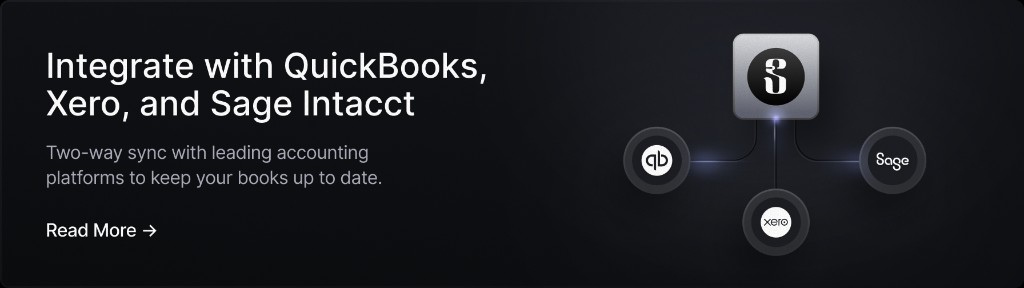
- Platform integrations: Two-way sync with QuickBooks Online, Xero, Sage Intacct, and NetSuite for accounting, plus specialized merchant connections for Amazon, Shopify, and WooCommerce.
- Expense management: Card controls (spend limits, rules, grouping) to manage vendor spend, automatic transaction capture, and AI-powered receipt matching that texts the cardholder for a photo and adds it to the expense report.
- Accounts payable: Upload vendor invoices for Slash to parse and prefill, route them through approval workflows, and track payment status from pending through paid.
- Accounts receivable: Generate professional invoices with auto-formatted line items, taxes, and discounts, send them with embedded payment links (bank transfer, card, or stablecoin), and set up recurring ACH debit authorization for repeat customers.
Apply in less than 10 minutes today
Join the 10,000+ businesses already using Slash.
Frequently Asked Questions
What are the key factors to consider when choosing wholesale suppliers?
Authorization, documentation, pricing, and channel policies. The supplier should be the brand or an authorized distributor and provide invoices Amazon accepts for ungating (not retail receipts or packing slips). Pricing should leave real margin after Amazon's referral and fulfillment fees, and the brand's MAP policy determines whether the listing holds price over time or degrades into a race to the bottom.
How the Vendor Payment Process Works (and How to Improve It)

Vendor Onboarding: How to Build a Faster Approval Process

Can beginners really succeed in selling wholesale on Amazon?
Beginners can build profitable wholesale operations, but the model rewards patience over hustle. Expect the first several months to be mostly research and outreach, with high rejection rates on supplier applications and ungating requests. Sellers who succeed treat wholesale as a repeatable system rather than chasing individual home-run products, and they start small enough that early mistakes are affordable.
What are the common mistakes to avoid in wholesale sourcing?
The most expensive mistakes are overbuying on a first order, skipping the Amazon-side product analysis (Featured Offer competition, price history, sales rank), and buying from unauthorized sources whose invoices won't survive an authenticity complaint. Underestimating Amazon's full fee stack and missing Q4 storage-fee spikes are close behind.
Ecommerce tools to simplify operations and increase revenue

How much money do I need to start selling wholesale on Amazon?
Most sellers start with $3,000 to $10,000 in inventory capital, plus a few hundred dollars for Seller Central, business formation, research tools, and inbound freight. The tighter the budget, the more selective you need to be on which products earn a second, larger order.
Wholesale Inventory Financing: A Complete Guide


