

Can Claude and ChatGPT Change the Future of Financial Analysis?
OpenAI and Anthropic are making a simultaneous push into professional finance.
ChatGPT for Financial Services, developed in collaboration with Morgan Stanley and Evercore, is a data analysis toolkit for investment banking and equity research released on September 10th. Claude for Financial Advisors, released on September 14th, is a set of skills and third-party plugins to assist advisors with research and documentation.
The new capabilities seem fairly similar: these are prepackaged skills specifically tuned for financial industry professionals. They handle the prep work involved in financial analysis and are capable of aggregating data from software already heavily used in the sector.
What neither company has built, however, is a financial assistant for the person running a business.
Both products serve professionals whose job is handling other people's assets. Neither serves the person handling their own company's cash, which is the most practical use case for the largest number of people: a financial assistant that plugs directly into your business bank account.
Inside the two launches
Anthropic’s product is organized around an advisor’s working day. Its skills include pre-meeting preparation, portfolio-rebalancing reviews, estate and tax briefs, prospect intake, and compliance checks. Claude can pull information from custodians, portfolio platforms, CRMs and planning tools, then turn it into material an advisor can review and use.
It does not replace the advisor. Investment recommendations, client communications and compliance decisions still require professional judgment.
Claude comes somewhat closer to a business’s operating finances through its Ramp connector. The connector gives existing Ramp customers read-only access to information including transactions, reimbursements, bills, purchase orders, cards and vendors. Claude can explain what the company spent, find pending bills and identify trends. Because the connection is read-only, it cannot pay a bill, issue a card or change a spending limit.
OpenAI’s launch addresses a different and, in some respects, narrower part of finance. ChatGPT for Financial Services is aimed squarely at institutional work such as company research, financial modeling, earnings analysis and pitchbook production.
Its most notable feature is built-in access to premium datasets from providers including Daloopa, PitchBook, LSEG News, Crunchbase and Fiscal.ai. OpenAI indexes and hosts the data so users can retrieve it quickly and trace figures back to their sources. Administrators can also publish Excel, Word and PowerPoint templates, allowing teams to produce models, research notes and presentations in their firm’s preferred format.
In both cases, the AI prepares information for a professional who remains responsible for the decision. It can assemble a recommendation, draft a document or identify something that deserves attention. It generally stops before taking consequential financial action on its own.
Where Anthropic has built around the financial advisor’s workflow, OpenAI has built something closer to an investment analyst’s workbench. They are products for people whose jobs involve analyzing companies or advising clients, not for the owner trying to understand and operate their own business.
Slash picks up where the others leave off
Most businesses do not need an investment-banking analyst on demand. They need something that always knows what is happening with the company’s money and can take the next administrative task off someone’s plate.
That is the larger opportunity for AI in finance: not merely making analysis faster, but making everyday financial operations require less effort.
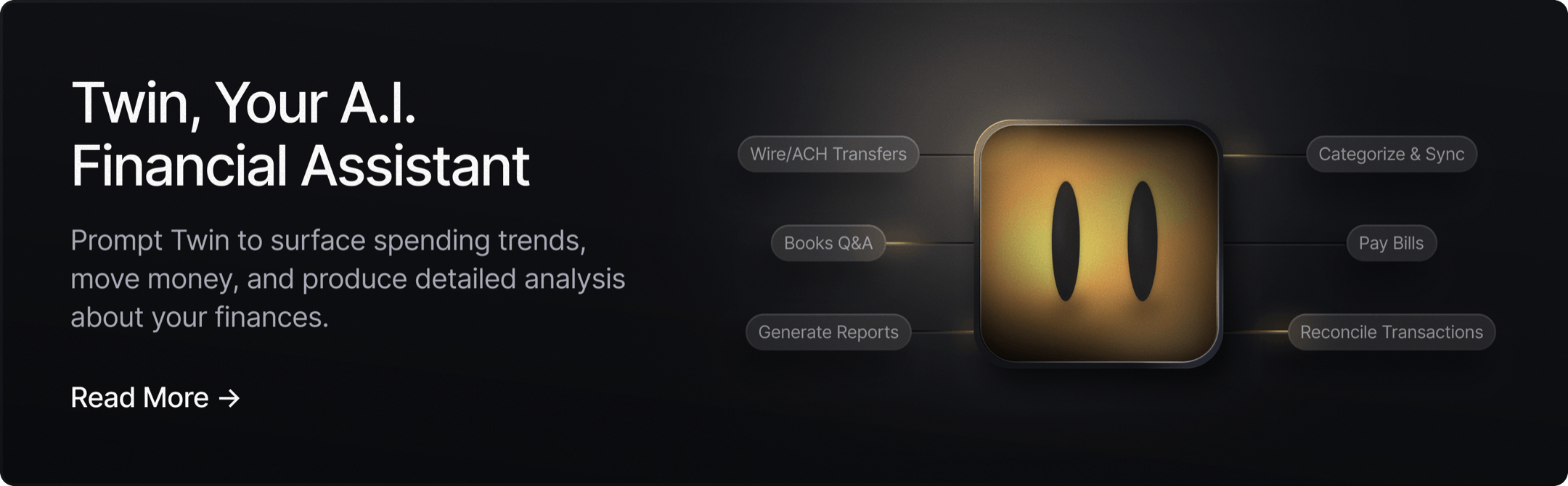
Twin, Slash’s AI financial assistant, is built for that job.
Twin operates inside Slash’s financial platform and is accessible through Slack. It works with the balances, transactions, cards and account details your business runs on.¹ The questions it can answer aren’t for a portfolio pitchbook, they’re for taking immediate action: What did we spend? Which transaction was that? What changed in the account since Friday? Can you issue a card for this vendor? Can you send this payment?
Twin is not limited to answering those questions. It can issue, freeze, and close cards; adjust spending limits; send payments; and make purchases from services such as Instacart. It can also analyze spending, model cash flow, and turn the results into charts and forecasts.
Those actions remain subject to the company’s existing permissions and approval rules. Twin acts with the authority of the person using it, and every action is logged.
The most consequential financial assistant may not be the one with the best view of the market. It may be the one that gives an owner back the time they used to spend managing it. To get started with Slash today, click below.
Apply in less than 10 minutes today
Join the 10,000+ businesses already using Slash.


