

How to Measure Opportunity Cost in Business: Key Strategies Explained
If you’ve ever had to make a decision between two high-value options, like cars, apartments, or universities, you know that the one you didn’t choose may come with a lingering “what if”. When you end up unsatisfied with your choice, you’ll probably regret not giving the other option a fair shot. In the world of business, they’ve created a formula that assigns a number to that kind of regret. This formula is called opportunity cost.
While choosing between apartments can be a subjective matter, deciding between projects at a company often means tracking specific long-term ROI. Opportunity cost measures the value of the one you didn’t choose. When you put your budget toward one project, other projects don’t get funded. If your team spends a couple months building one tool, they may be sacrificing another feature or initiative. Each option you don’t pick has value that can be measured and compared.
Overall, opportunity cost allows you to understand not just what a choice costs directly, but what it costs you by abandoning other options. In this guide, we’ll cover what opportunity cost is, how to calculate it, how to measure it, and how businesses can use it to make smarter decisions about where to put their resources. We’ll also take a look at Slash, a banking platform that gives finance teams live visibility into their business’s revenue and spending.¹ After evaluating opportunity cost, Slash users can weigh the total cost of an investment against their real-time liquidity and future cash flow.
The standard in finance
Slash goes above with better controls, better rewards, and better support for your business.
What is Opportunity Cost?
Opportunity cost is the value of the next-best option you give up when you make a choice. While most metrics track what you spent, opportunity cost essentially tracks what you missed.
If you invest $100,000 in expanding your warehouse, the opportunity cost is the return you could have earned by putting that same $100,000 somewhere else, whether that's a marketing campaign, a new product line, or a software upgrade. Oftentimes, you’ll have made the right choice, and the alternatives would deliver less value. You may not know the full picture, though, until you sit down and do the math.
This is the opportunity cost formula:
Opportunity Cost = Value of Best Foregone Option - Value of Chosen Option
When analyzing a potential project, you’ll have to consider both explicit costs and implicit costs. Explicit costs are any time where cash is spent, money is invested, or fees are paid. They can be simple to map out, especially if your company has done something similar before. Implicit costs are trickier. They're non-monetary “expenses” like time spent on labor, cash that’s not earning interest, and the attention given to this project over other pressing issues. While they’re hard to directly measure, their impact can be estimated ahead of time. Some investments with a small explicit cost can carry a large implicit cost if it ties up key employees or delays something more important.
Key Components of Opportunity Cost
None of the three concepts that define opportunity cost are easy to precisely calculate, but they can be easy to estimate. As you weigh your choices and put your opportunity cost formula together, keep the following in mind:
Time value of money (TVM)
A dollar available today is actually worth more than a dollar given a year from now, because money in hand can be used and invested immediately. When comparing two options with different timelines, the one that returns value sooner is generally worth more, as you can unlock capital more quickly and spend it elsewhere. This matters most when considering investments with faraway returns, as they can keep your money wrapped up for a long time.
Comparative advantage
Comparative advantage describes the leg up your company gets when it can produce a good or service at a lower opportunity cost than a competitor. In other words, it’s the reason a customer would choose you over someone else. Let’s say you and a SaaS rival both consistently upgrade your technology to compete with one another. If you focus your effort elsewhere for a brief time, you may lose your comparative advantage against the competitor. This is a piece of opportunity cost that should be considered if you’re in a crowded market.
Resource allocation
No matter what size company you manage, your budget, headcount, and time are all limited. Allocating more of these resources to Option A means giving a little less to everything else. That constraint is one of the main tenets of opportunity cost. To make your estimation more accurate, figure out the impact that taking manpower or money away from a different initiative would have.
How to Calculate Opportunity Cost in 5 Steps
The formula itself is pretty simple, but the hard part is getting accurate enough data for the result to be useful. Here are five steps that can make your opportunity cost calculation easier and more accurate:
- Explore available options: Start by mapping out all possibilities rather than just your top two options. Cutting your choices down to two immediately can cause you to overlook something better. If you're deciding how to invest $500,000, you might evaluate a product update, a marketing push, or an upgrade to your infrastructure. If you use Slash, you could also keep that money in a treasury account that earns up to 3.83% annualized yield.⁶ The more options you consider, the more confidence you’ll have in your final decision.
- Assess possible advantages: Remember to think about both monetary and non-monetary benefits. A new market entry might technically have a lower financial return than a product expansion, but it could open you up to a more diverse customer base down the road. Explicit returns certainly matter, but implicit advantages like flexibility, talent development, and brand awareness should be kept in mind as well.
- Identify the costs and benefits: Dive deep into each option's full cost, including its literal price, timeline, required headcount, and what gets delayed or deprioritized as a result. At the same time, map out the benefits and figure out how “worth it” the project will be over time. This step is the heart of your opportunity cost assessment.
- Use the opportunity cost formula: Once you’ve assigned values to your top picks, it’s time to use the formula. Let’s say a business has $100,000 to spend. Option A, a digital marketing campaign, projects a $200,000 return. Option B, a product update, projects $150,000. They choose Option B. The opportunity cost is $200,000 - $150,000 = $50,000, meaning they left $50,000 on the table by not choosing Option A. That number doesn’t necessarily mean the decision is wrong, however. It means the team now has a better idea of what this kind of product update costs in full.
- Choose the best option: The calculation gives you a number, but the final decision is up to you and your team. It’s important to note that a lower opportunity cost doesn't automatically make a choice correct. In reference to the example above, the company now understands that Option B comes with a $50,000 price tag that they wouldn’t have recognized without doing the formula. Even with that extra opportunity cost, a product update may simply be the better idea for the sake of their business.
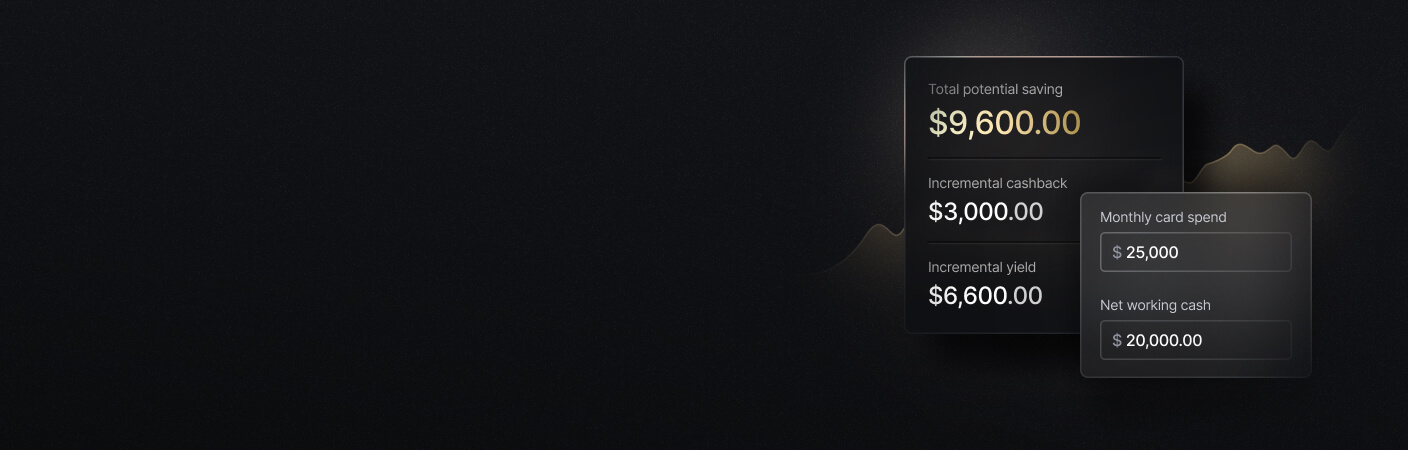
See the ROI behind your spend
Use this calculator to understand impact, then manage and track it all in Slash.

Measuring Opportunity Cost in Strategic Planning
While the opportunity cost formula was created to measure the financial impact of a decision, it can be just as helpful for business strategy. As you compare and contrast different choices, here are some higher-level strategic factors you may want to weigh:
Navigating risk and uncertainty
A project’s future returns are rarely completely certain. Option A might project a higher return than Option B, but its outcome may be more “boom-or-bust”. A $200,000 projected return with high variance might be worth less in practice than a $160,000 return that’s almost certain. When you account for risk, you should stress-test the assumptions behind each option. What does the return look like in a worst-case scenario as opposed to the expected one?
Considering the time frame
Opportunity cost analysis can look different depending on how far out you’re planning. In the short term, a fast, high-return option often looks like the obvious winner. Over a longer time frame, a slower-return option might turn into something more valuable. A business that consistently optimizes for short-term opportunity cost can end up forgetting about things that build durable value like talent, infrastructure, brand reputation, and relationships. As you start comparing your options, figure out how far into the future you want to look.
Implicit and explicit costs
Explicit costs are easy to measure, while implicit costs can take more strategic thinking. Things like organizational focus and team effort are finite, and overusing them on one initiative can have costs everywhere else. A project with a strong projected return can still carry a high opportunity cost if it ties down employees and leaders who could drive even more value elsewhere. The combination of implicit and explicit costs is what makes your calculation useful for decisionmaking.
Make the Right Financial Move with Slash
One of the most important parts of your opportunity cost assessment actually isn’t included in the formula: your company’s current financial standing. If your business has extra liquidity, some moves become more realistic than they would be if you were cash-poor. However, it’s tough to factor this in without an up-to-date picture of your cash flow. If you don't know how much capital is actually available, where it's currently deployed, or how current investments are performing, you may end up making an unwise choice even after using the formula.
Slash is a business banking platform that captures all this information on an integrated dashboard. Users can get a real time view of their incoming and outgoing payments, employee card spend, invoices, liquidity, treasury balances, and more. As you determine the opportunity costs of different decisions and compare it to your active cash flow, Slash can put your organization’s live financial data at your fingertips.
To make projections easier, our platform also comes with an agentic AI assistant named Twin that can help you map out different scenarios based on your typical cash flow trends. Simply give Twin plain-language prompts and watch it generate financial graphs and forecasts that can help you put different opportunity costs into perspective.
Slash also comes with a host of other financial tools and features, including:
- The Action Center: A one-stop spot for employees to see pending tasks assigned to them. These may include card requests, expense submissions, reimbursement reviews, and more.
- Working capital financing: Access short-term financing with flexible 30-, 60-, or 90-day repayment terms to help bridge cash flow gaps.⁵
- Native cryptocurrency support: Send and receive USD-pegged stablecoins USDC and USDT across eight supported blockchains for faster, lower-cost global payments.⁴
- Global USD: The Slash Global USD Account is designed as an alternative for foreign founders who want access to USD without forming a US entity.³ Balances are held in USDC on Base, a stablecoin designed to maintain a one-to-one value with the U.S. dollar.
- The Slash Visa® Platinum Card: The Slash Card is a corporate charge card that allows you to set customizable spending controls and issue unlimited virtual cards for handling team expenses, vendor payments, subscriptions, and more. Users can also earn up to 2% cash back on business purchases.
What’s the opportunity cost of missing out on a business banking platform like Slash? We hope you don’t have to calculate it. If you want to learn more about how Slash can help your finance team, reach out today.
Apply in less than 10 minutes today
Join the 10,000+ businesses already using Slash.
Frequently Asked Questions
What’s the difference between opportunity cost and risk?
Opportunity cost is the value of the best alternative you didn't choose. Risk is the uncertainty around whether a decision will deliver its expected outcome. A high-risk option might have a large opportunity cost if it fails to deliver, but the opportunity cost itself is measured before the outcome.
Smart Ways to Cut Business Costs and Boost Profitability

What’s the difference between opportunity cost and sunk cost?
A sunk cost is money or resources already spent that can't be recovered, while opportunity cost is the value of what you're giving up by choosing one option over another. The main difference is that sunk costs look backward at what's already gone, while opportunity costs are forward-looking and built to assess the value of alternatives that are still available.
How do implicit costs factor into opportunity cost?
Implicit costs are the non-financial losses that come with a decision, such as team time, delayed initiatives, and brand impact. While they don’t have an exact numerical value, they can be a big deal. For example, a project that ties up your best engineers for six months has an opportunity cost that includes whatever those engineers could have built instead.


