

Stablecoin Settlement for Interbank Transfers: What Businesses Should Know
Stablecoin transactions can be valuable for businesses that need to send large amounts of money quickly, especially when traditional banking hours would otherwise get in the way. Knowing how it all works is key to executing these payments correctly and navigating the risks that can arise along the way. In this guide, you will learn how stablecoin settlement works, its benefits for businesses, and the challenges that crypto payments currently face.
If you want to send stablecoins without having to join an exchange or open a wallet, look no further than Slash, a financial platform that allows users to send and receive USDC and USDT through its native on/off ramps.¹, ⁴
Key Terms Explained
We’re about to get a bit technical, so you may want to be familiar with the following terms before we dive into the mechanics:
- Stablecoins: Virtual tokens designed to maintain price stability, usually by being linked to an underlying fiat currency. The two most popular stablecoins in use today are USDC and USDT, which are both pegged 1:1 to the U.S. dollar.
- Blockchain: A decentralized ledger that records and verifies transactions across a network of computers rather than relying on a centralized authority. Once a transaction is confirmed and added to the blockchain, it becomes very difficult to alter. This structure allows payments to be verified and settled without relying on an intermediary like a correspondent bank.
- Digital wallet: Software or infrastructure that controls blockchain addresses through cryptographic keys. These wallets typically include role-based permissions, custody, and transaction policies meant to protect those keys.
- Fiat currency: Federally issued money that is declared legal tender, such as the U.S. dollar or the EU’s euro. The value of fiat currencies comes from their issuing government and central bank instead of a physical commodity like gold.
- Smart contracts: Self-executing contracts that automatically enforce agreements when predetermined conditions are met, such as terms agreed upon by buyers and sellers. This means human intervention and third-party verification aren’t required.
- Clearing: The process of validating transaction information and determining what each party owes. Normally, systems clear a transaction before actually moving the assets.
- Settlement and finality: Settlement transfers the asset that discharges an obligation, and finality is the point at which the transfer cannot be reversed.


What Is Stablecoin Settlement?
Stablecoin settlement refers to any transfer where a stablecoin is used as the asset that completes a financial obligation. The sender authorizes tokens to move between wallets, and the blockchain validates the signature and balance, records the transfer, and updates ownership. Once the transaction is finalized, the receiving party controls the stablecoins.
That's different from standard cross-border payments. A network like SWIFT primarily carries payment instructions, while banks move the money separately through correspondent accounts and settlement systems. With a stablecoin, the token itself carries the value, so no other institution has to be instructed to update an account.
Payment and settlement also aren't the same thing. A payment covers the full process from the first instruction to usable funds for the recipient, while settlement is the discharge of an obligation between specified parties. That's why "real-time settlement" needs context: on-chain confirmation can occur in minutes, but legal finality depends on governing law and scheme rules, and funds becoming available is a separate step. Stablecoins can shorten these timelines, but the stages may not happen simultaneously.
How the Stablecoin Payment Process Works
If you’re new to this type of technology, it can all feel pretty convoluted. To help break it down, let’s look at a stablecoin transaction step-by-step:
- Payment initiation: A customer or institution submits the amount, beneficiary, destination details, and payment purpose. When the sender begins with fiat, the provider also confirms available funds and obtains a conversion quote.
- Customer security checks: The institution applies KYC (Know Your Customer) controls, sanctions screening, wallet analytics, transaction monitoring, approval rules, and counterparty limits.
- On-chain confirmation: The transaction is signed and sent to the selected blockchain. Validators check it, include it in a block, and advance it toward finality while the provider monitors confirmations and network conditions.
- Stablecoin settlement: At the required finality threshold (in other words, when enough blocks on the chain confirm the transfer), the receiving wallet controls the tokens and the on-chain obligation is settled. If the arrangement requires fiat, a provider can then redeem or sell the stablecoin and initiate the local payout.
- Real-time availability: The recipient can use funds immediately when the stablecoins are accepted. Bank credits often take longer due to compliance, redemption, and foreign exchange factors.
Advantages of Using Stablecoins
You don’t need to grasp concepts like finality thresholds to understand how helpful a several-minute international transfer can be for businesses. Let’s take a look at the three main advantages that stablecoin transfers can offer:
Faster Speeds
While standard payments are beholden to banking calendars, public blockchains run continuously. You can initiate and confirm transfers during weekends, holidays, and after wire cutoffs. Stablecoin transactions can also skip the chain of intermediaries that normally comes with international SWIFT payments. Instead of waiting for several correspondent banks to update separate ledgers, participants can reference one on-chain transaction.
That said, a fast blockchain can’t make a manual compliance review or closed local payout system instant. Stablecoin settlement can be quick, but the time from initiation to fund access may occasionally take a little longer.
Cost Reductions
Given the fact that traditional wire payments involve an originating bank, correspondent banks, foreign-exchange spreads, and a receiving bank, the process can get pretty expensive. Where those transfers can cost between $25-50, stablecoin transactions typically cost $0.05-$5.00, depending on the blockchain.
Since network fees can fluctuate, gateways charge for processing, and converting funds into fiat may add another cost, the total price of a transaction may be a little higher. Even so, an expensive crypto transaction will almost always be cheaper than a traditional cross-border wire transfer.
Increased Transparency and Traceability
A public blockchain records the sending and receiving addresses, token, amount, timestamp, and transaction hash. You can then use that shared record to confirm whether the on-chain transfer occurred without having to wait for status messages from each intermediary.
Some smart contracts can connect a business’s transaction to an invoice, internal ledger entry, or treasury workflow. As helpful as that is, the data doesn’t reveal things like the legal entity behind the transfer or the purpose of it, so businesses should be sure to document those details when possible. That’s also why banks still need customer records, sanctions controls, and reliable links between blockchain addresses and real-world parties.
Slash business banking
Works with cards, crypto, plus cards, crypto, accounting, and more.
The Challenges of Stablecoin Adoption
Stablecoin adoption involves more than opening a wallet. Businesses must decide which assets and networks to support, how payments will be approved and recorded, and what happens when a transfer fails or loses value. Here’s what you need to keep in mind:
- Regulatory and compliance requirements: Rules vary from place to place and may involve customer identification, sanctions screening, anti-money-laundering controls, and different reporting/accounting guidelines. Obligations can also change based on whether a business accepts stablecoins, holds them, or processes payments for others. A regulated provider can help, but businesses are responsible for understanding their requirements.
- Depegging and counterparty risk: While stablecoins are meant to stay 1:1 to a fiat currency, problems involving issuers or banking partners can potentially push a token below $1. If you hold tokens with an exchange or payment provider, you also have some counterparty risk.
- Technical and operational risk: Blockchains use different networks, addresses, fees, and confirmation rules. If you send the wrong token or use the wrong network, your funds can actually be lost permanently. The same is true of stolen tokens, so security features like two-factor authentication and custom permissions are recommended.
Send Stablecoin Payments Quickly and Easily With Slash
If your company does a lot of business in other countries, you can save both time and money if your setup can handle crypto and fiat together.
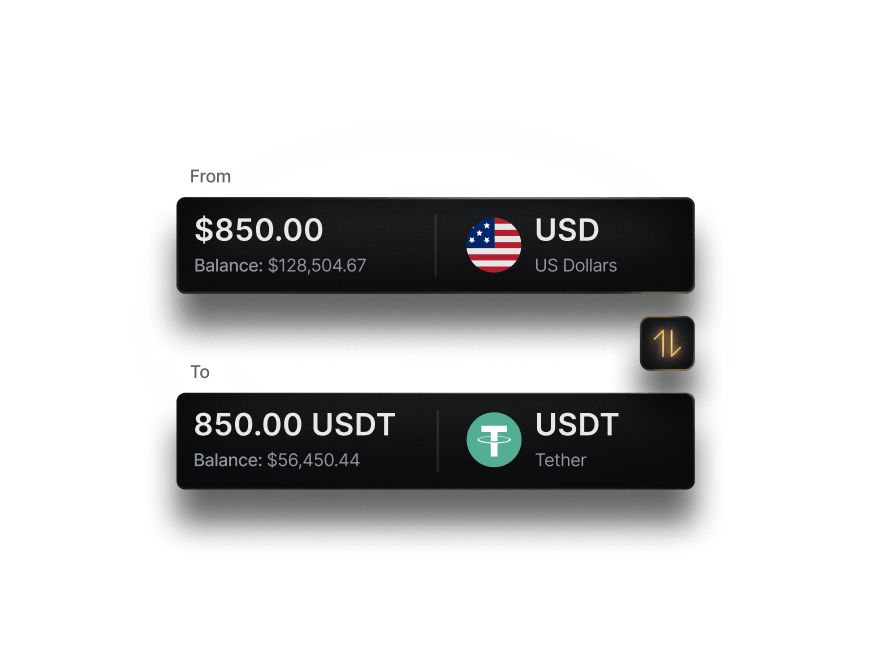
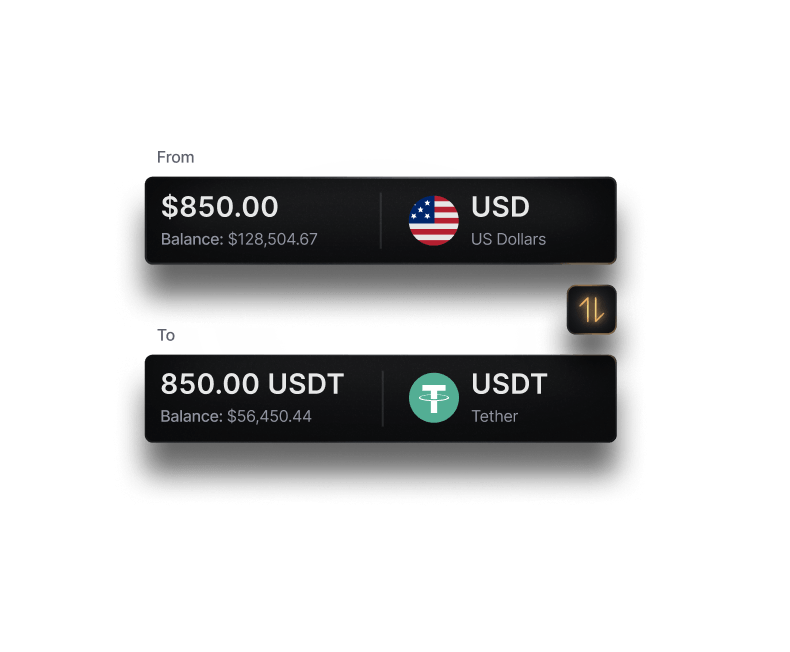
Slash is a business banking platform with a checking account and built-in stablecoin on/off ramps, so eligible businesses can send and receive USDC and USDT in the same place they manage their everyday payments. Convert dollars to stablecoins and send them to an external wallet, or receive stablecoins and convert the proceeds into USD, usually at a fraction of a SWIFT payment's fees.
Our standard fee for supported USDC and USDT on-ramps and off-ramps is a flat 1.5% of the converted amount, with the full amount and fee shown before confirmation. Slash covers the blockchain gas fee, so you don't need to hold a separate network token to complete a transaction.
Slash also comes with features outside of crypto, including:
- Global USD: An alternative for foreign founders who want access to USD without forming a US entity.³ Accounts are backed on Base by a balance held in USDC, which is designed to maintain a one-to-one value with the US dollar.
- Card controls and spend policy: Issue unlimited virtual and physical cards, set limits by card, team, or individual, and earn up to 2% cash back on eligible spend with the Slash Visa Platinum Card.
- Integrated treasury: Earn up to 3.91% annualized yield on idle cash through money market funds from BlackRock and Morgan Stanley.⁶
- Enterprise-grade protection: Business accounts are protected up to $150M through Column N.A.'s insured cash sweep network.²
- AI-powered finance: Twin, our built-in AI agent, can create cards, pay invoices, review your cash flow, and more from a natural language prompt.
If your business is ready to connect cryptocurrency with its current financial stack, Slash is here to tie it all together.
Apply in less than 10 minutes today
Join the 10,000+ businesses already using Slash.
Key Takeaways
- A network like SWIFT carries payment instructions, while banks move the money separately through correspondent accounts. Meanwhile, a stablecoin carries the value itself on-chain, removing the need to instruct another institution to update an account.
- Payment and settlement are not the same thing; payment refers to the wider act of a transaction, while settlement describes the discharge of an obligation between two parties.
- Traditional cross-border wires typically cost $25 to $50, where stablecoin transactions generally run between $0.05 and $5.00 depending on the network.
- A fast blockchain can't speed up a manual compliance review or a closed local payout system, so the gap between initiation and usable funds can outlast settlement itself.
- On-chain records show the addresses, token, amount, timestamp, and hash, but they don’t tell you about the legal entity or the purpose of a transfer.
Frequently Asked Questions
If stablecoins settle in minutes, why use RTP or FedNow?
For domestic US payments, the instant rails can be the better answer, since they settle in seconds, run inside the banking system, and involve no conversion step or exposure to a token issuer. Stablecoins are best for cross-border transfers, where the alternative is a chain of correspondent banks and a multi-day timeline. With domestic payments, you might just want to choose the one you and your partner are most familiar with.
What Are Real-Time Payments? How They Work and Network Comparison

What are the most commonly used stablecoins for businesses?
With market caps far above alternatives, the two most popular stablecoins in use today are USDC (Circle) and USDT (Tether). They’re both rather similar in structure, though USDC is welcomed in the EU while USDT isn’t.
USDC vs. USDT: Choosing the Right Stablecoin

What happens if I send to the wrong address or the wrong network?
Funds sent to a wrong address on a public blockchain are generally unrecoverable, since there's no central party who can reverse the transfer. Sending the right token over the wrong network is the more common mistake, and recovery is sometimes possible if the receiving address belongs to a custodial provider who controls that chain, though it usually requires their support team and isn't guaranteed.
How the Vendor Payment Process Works (and How to Improve It)


