

Rho vs Mercury: Comparing Features, Fees, and Use Cases
If you’re looking for an “all-in-one” business banking platform, you’re going to come across a lot of names that claim a lot of different things about their products. With solid financial management features attached to their business accounts, two of the most popular options in that space today are Rho and Mercury. The question remains, however: are either of them truly all-in-one?
Rho emphasizes subscription-free financial operations, with banking, corporate cards, expense management, and bill pay. Mercury pairs free banking with a broader startup-focused platform that includes AI assistance, debit & credit cards, invoicing, and working capital access. Keep reading to learn how Rho and Mercury’s features, fees, and main audience compare. As we break them down, we’ll also take a look at Slash, another financial platform that may prove to be a better pick than either of the two.¹ With stablecoin support, Global Accounts, and up to 2% cashback on card spend, Rho and Mercury have a hard time keeping up with Slash.³,⁴
The standard in finance
Slash goes above with better controls, better rewards, and better support for your business.

Key Takeaways:
- Rho’s 2% cashback rate requires you to be part of “Rho Platinum”, which asks you to run payroll through Rho, deposit revenue into Rho Checking, and hold at least half of your company assets there.
- Rho has no support for RTP or FedNow, while Mercury and Slash offer both to eligible users.
- Treasury access at both platforms is gated by balance. Rho requires $50,000 to open an account and reserves its 3.46% top rate for balances above $10 million, while Mercury doesn’t offer treasury at all until you hold more than $250,000.
- Neither platform actually holds foreign currency. Rho converts and sends through Wise, and Mercury converts incoming foreign wires to dollars before they reach your account.
- Mercury’s IO credit limit is set by the balance you keep in your Mercury account. That makes it closer to a secured line than an underwritten one, which is worth knowing if you were counting on credit to extend your runway.
What Is Rho?
Rho is a financial technology platform for U.S.-incorporated businesses of most sizes. It combines business checking, corporate cards, expense management, accounts payable (AP), invoicing, accounting automation, and treasury management in one system.
Through Rho’s AP workflow, a business can forward an invoice into Rho Bill Pay, have the document captured automatically, route it for approval, pay the vendor, and synchronize the bill with its accounting software. Rho also offers expense policies, receipt matching, vendor cards, reimbursements, and suggested transaction coding through Rho Close.
Rho’s corporate cards come with merchant restrictions, category controls, limits, and real-time transaction alerts. Their rewards rates are a little less straightforward than the rest of the platform; you get anywhere between 1-2% cashback depending on your repayment rates and a program called “Rho Platinum”. We’ll fully explore that a little later.
Rho is a good pick for U.S. startups and small/midsize businesses that want corporate cards and finance automation without having to pay high monthly or seat-based prices. The platform’s less suitable for a company that needs foreign currency balances or local account details in several countries. Rho can send payments to more than 200 countries and territories in over 20 currencies, but the account itself remains denominated in U.S. dollars.
It’s also important to note that, like most fintechs, Rho is not a bank. Their checking and card services are provided through Webster Bank and Lead Bank, while savings accounts use a network administered by American Deposit Management Co.
Rho Pricing and Fees
Rho doesn’t divide its core product into subscription tiers. Business banking, corporate cards, expense management, Bill Pay, and connected accounting automation carry no subscription or per-user fee. Domestic ACH transfers and wires are also free.
Foreign currency transfers are supported through Wise and carry a 1% conversion fee. International USD wires have no Rho-specific fee, although correspondent or receiving banks can deduct their own charges. Businesses can pay an optional $15 fee to cover SWIFT and intermediary costs, while recalling an international wire costs $30.
What Is Mercury?
Mercury is a fairly similar fintech platform that provides business checking and savings through Choice Financial Group and Column N.A., Members FDIC. Overall, the platform includes debit & credit cards, spend management, bill pay, invoicing, accounting automation, working capital loans, and AI-powered financial tools.
Mercury is known primarily for serving startups and technology companies, although its eligibility now extends to ecommerce businesses and a wide range of other U.S.-registered organizations. However, they won’t serve money services businesses or those operating in gambling, adult entertainment, or cannabis, per their terms.
One of Mercury’s more distinct features is “Command”, an agentic AI assistant that comes attached to your account. Users can categorize expenses, prepare payments, create invoices, freeze cards, update limits, or ask questions about their cash positions with natural language. In order to make sure everything stays above water, Command also keeps an audit trail.
Mercury is best for teams that value startup financing products, AI assistance, the choice between debit & credit cards, and the ability to add more sophisticated workflows over time. Like Rho, its account is USD-only, and businesses must be incorporated in the United States or a U.S. territory.
Mercury Pricing and Fees
Mercury’s standard business account costs $0 per month and has no required minimum balance or account-opening fee. It includes the basic features you’d likely expect, including checking, cards, bill pay, invoicing, and core accounting connections.
Mercury Plus starts at $35 per month, or $29.90 per month on the annual pricing schedule. It adds recurring invoices, ACH debit collection, more invoicing API capacity, and unlimited 1099 filings. Mercury Pro is a hefty $299 per month under annual pricing and adds a relationship manager, free ACH debit collection, unlimited invoicing API usage, and enriched NetSuite categorization.
ACH transfers, domestic wires, real-time payments, and checks are free. International wires are a little stickier; they’re free to send using the default SHA (shared) method, but if you want to make sure your recipient gets the full amount, you can pay an optional $15 fee to cover for intermediary bank deductions. Non-USD international wires carry a 1% conversion fee.
See the ROI behind your spend
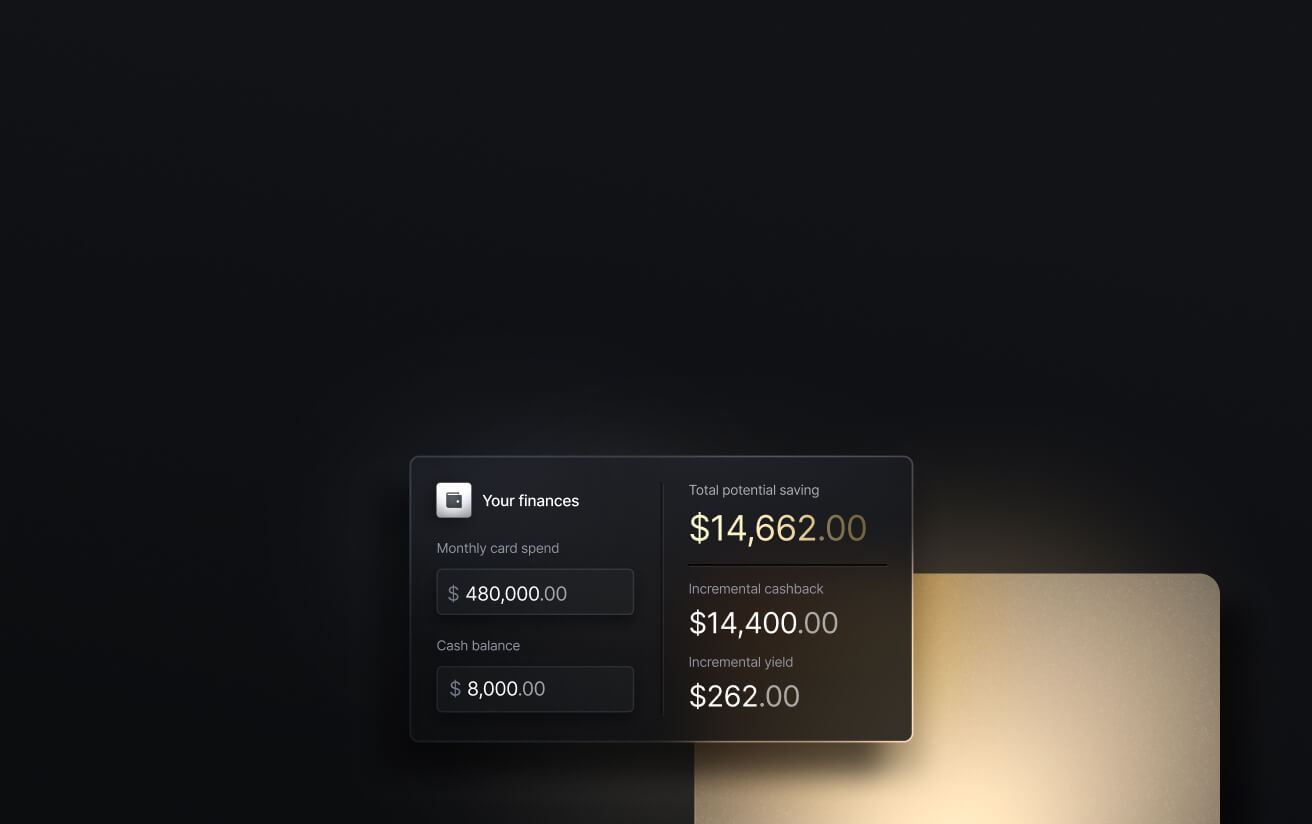
Use this calculator to understand impact, then manage and track it all in Slash.

Rho vs Mercury: Main Features Compared
Rho and Mercury both cover the standard financial stack. Some differences arise in how card rewards work, what payment rails you can access, how much yield treasury accounts generate, and more. Let’s take a look at how Rho and Mercury compare and what an alternative like Slash can offer instead:
Global Access
Rho serves U.S.-incorporated businesses with a U.S. operating address or at least one U.S.-based owner with a valid Social Security number. Sole proprietorships aren’t supported. Once onboarded, a company can send international and foreign currency payments to more than 200 countries and territories through Rho’s partnership with Wise.
Mercury also requires a company formed and registered in the United States or a U.S. territory, but it’s a bit more accommodating to internationally based founders. A company can use a U.S. or international principal business address, provided it has existing or planned U.S. operations and doesn’t fall within Mercury’s restricted countries or industries.
Neither platform provides true global accounts. Rho converts and sends foreign currencies, but it doesn’t hold them. Mercury can receive wires in quite a few foreign currencies, but the funds are converted into dollars before reaching the account. If you’re a founder without a foothold in the U.S., you’re likely out of luck.
Slash offers a smoother path for businesses incorporated outside the United States. Its Global Account is available to eligible companies in more than 130 countries and provides U.S. account details and cards without requiring a U.S. entity. Cards earn 1% cash back on eligible US-merchant spend, currency conversion runs at 1% with a $0.40 minimum, and there’s no required monthly fee.
Corporate Cards and Rewards
Rho offers physical and virtual corporate charge cards without annual, subscription, or per-card fees. Standard Daily Terms earn 1.25% cashback, while standard Monthly Terms earn 1%. If you’re a part of “Rho Platinum”, those rates rise to 2% and 1.75% respectively.
While Platinum is a free program rather than a priced tier, it does come with its own set of requirements. A business has to run payroll through Rho, deposit its revenue into Rho Checking, hold at least half of its company assets at Rho, and maintain an open Rho Corporate Card. Additionally, purchases outside the United States and several merchant categories are excluded from cashback.
Mercury offers both debit cards and the IO credit card, the latter of which earns unlimited 1.5% cashback on all spend. 1.5% is solid, but it falls short of both Rho’s top rate and the Slash Visa® Platinum Card’s top rate of 2% cashback on eligible purchases. As far as its credit mechanics go, your limits are based on the total balance you hold within your Mercury account.
Treasury and Yield
Both Rho and Mercury offer the potential for high treasury yield, but they come with a few asterisks. Through JPMorgan and Morgan Stanley funds, Rho Treasury can earn you anywhere from 3.24% to 3.46% annualized yield. However, it requires a $50,000 minimum balance, and you’ll only access the higher end of that yield if you have more than 10 million dollars sitting in your account. Annual management fees range from 0.60% below $2 million to 0.15% at $20 million or more.
Mercury Treasury only becomes available once a business maintains more than $250,000 across its Mercury accounts. Their highest possible yield is 4.32% through a U.S. Treasury Ladder, while their lowest (and more common) yield is 3.34% on accounts with less than $2 million deposited. Like Rho, its annual fee ranges from 0.15% to 0.60% depending on balance.
Meanwhile, Slash Treasury offers up to 4.06% annualized yield.⁶ Your money market investments from BlackRock and Morgan Stanley can be managed directly within your Slash account. Balances under $500,000 carry a 0.60% annual management fee, while the fee is waived at $500,000 or more.
These values are current as of November 4th, 2026, and are subject to change.
Automated Tools
Rho’s automation capabilities are mainly built around accounting and accounts payable. Their “Bill Pay” tool can create draft bills, route invoices through approvals, flag potential duplicates, and synchronize bills and payments with supported accounting systems. From there, “Rho Close” reviews previous coding decisions and suggests accounting attributes for bank and card transactions.
As usual, Mercury takes a more AI-centric approach. They also have a product named Bill Pay, which extracts information from invoices and organizes bills by approval status and due date. Via prompts, Mercury Command can answer questions and prepare financial actions using live account data. The platform also supports accounting rules, AI-generated transaction coding, automatic transfers, receipt policies, and recurring invoices.
Slash can automate everything from expense management to month-end close. Every purchase made with the Slash Card is captured with receipt prompts at the moment of spend, categorized against the appropriate account, and sorted on our financial dashboard. The system’s AI tools can parse invoices, create bill drafts, apply approval chains, schedule payments, and reconcile records. Slash’s native accounting integrations include QuickBooks, Xero, Sage Intacct, NetSuite, DualEntry, Rillet, and Campfire.
Payment Rails
Rho includes same-day ACH transfers, domestic wires, and checks without transaction fees. It also sends USD and foreign-currency payments internationally, charging 1% when conversion is required. However, Rho doesn’t support real-time payments like RTP/FedNow or stablecoin transfers. Mercury supports many of the same rails as Rho, with the addition of RTP/FedNow for eligible users.
Despite their mettle in most features, Rho and Mercury both come with gaps in support for crypto and local rails like SEPA and Faster Payments. This is where Slash stands out. Slash users can send and receive USD-pegged stablecoins USDC and USDT across 15 supported blockchains for faster, lower-cost global payments.⁴ Additionally, teams who need to send payments to different countries can take advantage of Slash’s support for key local rails within those countries.
Choose Slash For Your Business Banking Needs
Rho and Mercury are both fairly comprehensive banking platforms, but without support for things like stablecoin transfers and global accounts, they can’t truly call themselves “all-in-one.” Slash is a lot closer to that label.
Rather than targeting a single niche or use case, Slash functions as a complete financial operating system for both startups and enterprise companies. It combines corporate cards with best-in-class cashback, flexible working capital financing, multi-rail payment infrastructure, and native stablecoin on/off ramps for borderless transfers.⁵ You can also two-way sync your accounting app of choice with Slash, whether it’s QuickBooks Online, Xero, NetSuite, or Sage Intacct.
The clearest gap between Slash and Rho/Mercury is in the ways you can transfer your money. With Slash, you can send stablecoins around the world, make instant payments within the United States, and transfer funds to local rails like Pix and SEPA. Those two systems can’t say the same.
Slash also comes with the following tools and features:
- Reimbursements: Instead of managing reimbursements across multiple tools, teams can submit, review, and approve reimbursements directly inside the Slash dashboard. Connect your bank account, upload your receipt, and let Slash capture the details.
- Card controls and spend policies: Issue unlimited virtual and physical cards, set limits by card, team, or individual, and see every transaction post in real time. Slash texts employees for receipts and matches them automatically to transactions. Eligible business spend earns up to 2% cash back with the Slash Visa® Platinum Card.
- The Action Center: A one-stop spot for employees to see pending tasks assigned to them. These may include card requests, expense submissions, reimbursement reviews, and more.
- Separate virtual accounts: Create multiple business bank accounts to silo cash flows by project, department, or client with real-time analytics across each of them.
- Multi-entity support: Slash offers multi-entity account management tools without separate logins, allowing businesses to track spending, manage accounts, and download statements across all subsidiaries in one place.
Apply in less than 10 minutes today
Join the 10,000+ businesses already using Slash.
Frequently Asked Questions
What’s the difference between RTP and FedNow?
From a business’s perspective, not too much. Both move money between US bank accounts in seconds, around the clock, with immediate finality. RTP launched in 2017 and is operated by The Clearing House, a private consortium of large banks, while FedNow launched in 2023 and is run by the Federal Reserve. The main difference is the simple fact that not every bank has joined both networks, so you might be forced to use one over the other.
FedNow vs Fedwire: Which Payment System Should You Use?

Does the treasury management fee come out of the advertised yield?
No, platforms typically quote the fund’s annualized yield and charge the management fee separately against your balance, meaning your actual return is the quoted yield minus the fee.
Why might businesses want to use stablecoins?
Because stablecoins are pegged 1:1 to fiat currency like the U.S. dollar, they essentially function as digital versions of everyday money. That money can travel around the world in seconds 24/7, which certainly can’t be said of standard payments that move through rails like SWIFT.
Are Stablecoins the Future of Finance?


