


Ramp, Brex, or Slash: Which Fintech Platform is Best for Your Business in 2026?
Fintech platforms are becoming a staple in how businesses manage their money. Yet despite the growth of digital expense management platforms and neobank card issuers, many businesses still rely on outdated legacy banks for their financial operations, leaving them without the modern tools, workflow automation, and real-time visibility that can help cut out the manual work of running your business.
Three leading fintech providers today are Ramp, Brex, and Slash. On the surface, all three appear to tackle the same things: get corporate cards for your team, manage bills and invoices, hold funds in a treasury account, move money online.¹, ⁶
But the three have each developed in different directions: Brex was acquired by Capital One in early 2026 and now operates under the bank; Slash offers best-in-class rewards while pioneering crypto-native architecture and AI-powered tools;⁴ Ramp leaned into expense management to become a leader in how enterprises control AI spend.
So, while it may seem like it's apples to apples, it's more apples to oranges. In this guide, we're diving into the details to determine which fintech platform is best for your business: Ramp, Brex, or Slash. We'll consider the size of your company, what type of work you do, what you can expect from your financial tools, and the pros and cons of each platform.
The standard in finance
Slash goes above with better controls, better rewards, and better support for your business.
Ramp vs. Brex vs. Slash: Comparison at a Glance
Breaking It Down: What Sets Ramp, Brex, and Slash Apart?
All three platforms aim to simplify how businesses manage their finances, but the origins of each largely determine how they developed. Ramp and Brex are both, first and foremost, expense management platforms built around corporate cards. Slash, however, is a business banking platform. From that core difference, everything else follows:
What is Ramp?
Ramp launched in 2019 and has since grown into a broad finance operations platform, valued at around $44 billion by mid-2026. The platform’s focus is cost control. At heart it's an expense management tool for finance teams, centered on the corporate card and the automation around it, aimed at cutting overhead and enforcing budgets across departments.
What is Brex?
Brex started in 2017 as a corporate card for venture-backed startups that couldn't get one from traditional banks because they lacked credit history and didn't want to sign personal guarantees. Over time it moved upmarket toward enterprise customers and stepped away from the smaller businesses it once served; today, companies generally need to have between $400K to $1M in annual revenue or venture funding to qualify.
Like Ramp, Brex remains an expense management platform at heart. However, in April 2026 Capital One completed its $5.15 billion acquisition of the company. Brex keeps its brand for now, but its product direction is now tied to that of a large bank.
What is Slash?
Slash began in 2020 as a card issuer for digital operators, and it’s developed into something the other two aren't: a business banking platform built around the account itself.
That difference shapes who it serves. Where both Ramp and Brex moved upmarket and left smaller businesses behind, Slash is built for the operator running the business, not a corporate finance department, and it keeps the barrier to entry low – it also doesn’t require a lengthy credit history or personal guarantee to qualify, but nixes Brex’s high annual revenue or venture funding requirement.
Slash also pioneered unique features that neither Brex nor Ramp offer. The Global USD Account lets businesses outside the US hold and move dollars without setting up a US entity, and stablecoin payments run through the same platform as everyday banking, with no separate exchange or wallet. For a modern business that moves money across borders and on-chain – or for the everyday SMB – Slash is the most natural fit of the three.
Rewards Programs
Ramp
The Ramp Card's cashback is variable, from 0% up to 1.5% on purchases, with the exact rate set by Ramp based on your company's financial profile. You don't find out what you'll earn until after you apply, and it can land anywhere in that range, including the bottom. Rewards are redeemed as a statement credit for your Ramp Card or into a Ramp account.
Brex
The Brex Card rewards program is based on points, not cashback: 7x on rideshare, 4x on travel booking through Brex Travel, 3x on dining, and 2x on software, then 1x on everything else. However, two conditions can limit the value of Brex's rewards program. For one, point multipliers apply only when Brex is your company's primary card; split spend across another card and every category drops to 1x. Second, points are worth ~0.6 cents as cash, so it can be hard to match the effective value of cashback without heavily optimized redemptions.
Slash
The Slash Visa Platinum Card earns up to 2%+ cashback on eligible business purchases, with no earning caps or reward categories. It's the highest effective cash value of the three, plain and simple.
Summary: Ramp's cashback rate is variable and can be as low as 0%. Brex’s points reward travel-heavy teams willing to route everything through their cards, and they have a relatively low value as cash. Slash pays the highest cashback rewards rate, up to 2%+.
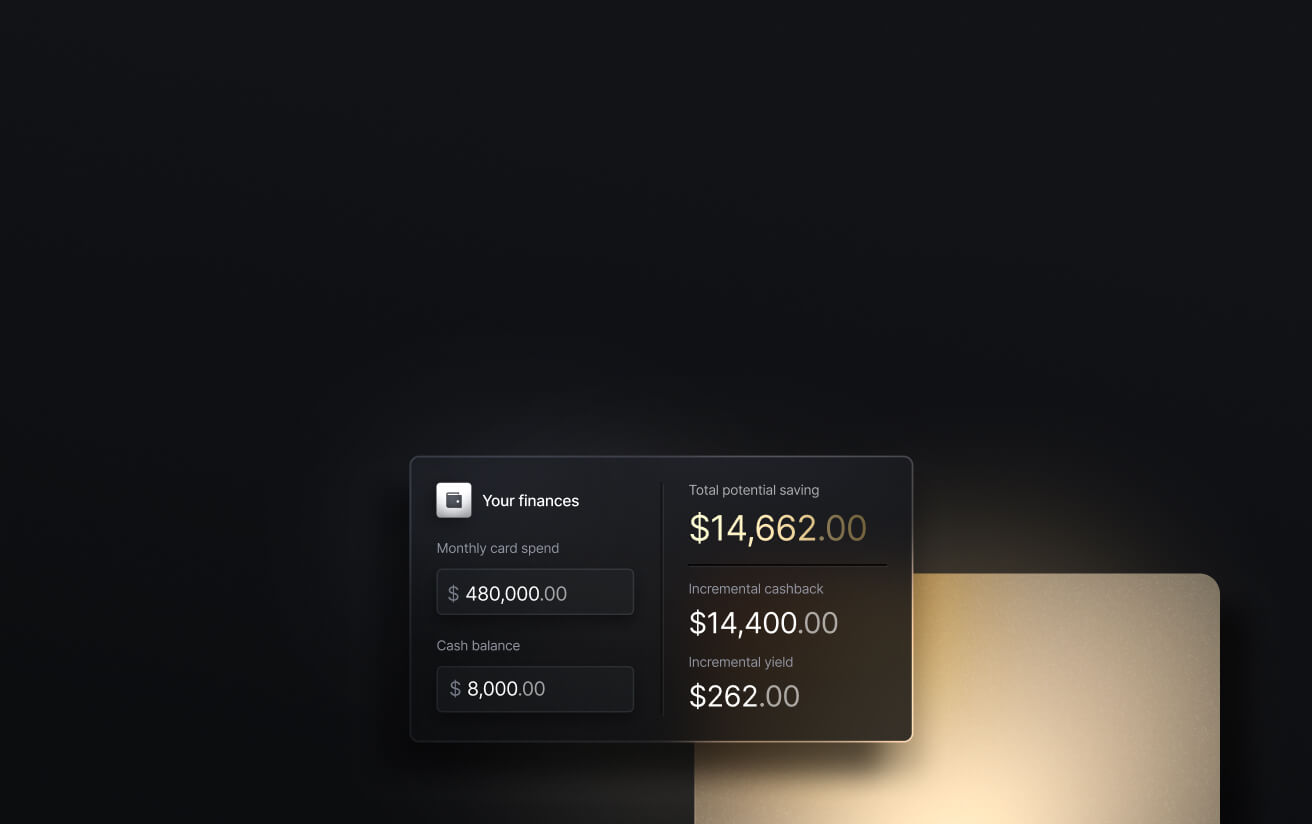
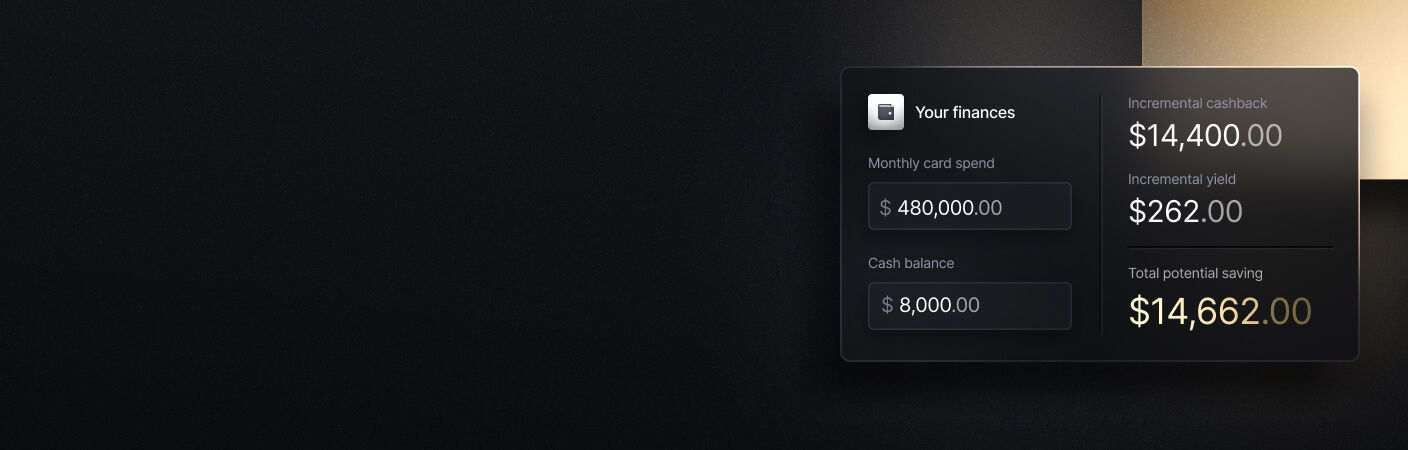
See the ROI behind your spend
Use this calculator to understand impact, then manage and track it all in Slash.
Expense Management
Ramp
Ramp Cards settle against a linked business checking account. Most companies that use Ramp would keep their operating cash at their existing bank and fund the card from there. In that setup, the platform managing your spend and the bank holding your money are two separate systems that get reconciled at close, which still leaves some room for improvement.
Besides the setup, Ramp handles the everyday expense work. Employees submit receipts by photo, text, or email, and Ramp matches them to transactions and codes each one to your general ledger. It runs expense reports, pays reimbursements to employee bank accounts, and checks spend against your policies automatically.
Brex
The Brex Card works the same way: a card and expense suite sitting on top of a business account you can fund internally or from an outside bank. Its depth runs toward multi-entity and global teams, but the structure is the same as Ramp's. Unless you move your cash fully in-house, card activity and your bank balance still reconcile across systems.
Brex also covers the same core expense management features. Employees submit receipts, Brex matches them to transactions, and spend runs through the approval and policy rules you set. It produces expense reports and pays employee reimbursements. Uniquely, Brex offers its own portal for travel booking.
Slash
With Ramp and Brex, you’re still managing an external bank account; with Slash, cards, banking, and expense management are all together.
Slash is a business banking platform, so the card and the operating account are the same balance. Card spend, reimbursements, and everyday banking all run through one account and land in a single ledger that syncs to your books. There's no month-end reconciliation between a spend tool and a separate bank, because they aren't separate; this also can make it easier to trust the cash flow analytics in the Slash dashboard, since everything is recorded in one place.
With Slash, employees can submit receipts by text right after a card swipe, and Slash matches and categorizes each transaction automatically. Employees can create expense reports, reimbursements are paid out directly to employee bank accounts, and spending is monitored against your preset policies.
Summary: On expense management features, the three are close. The difference is structural. With Ramp and Brex, your spend platform and your bank are usually two systems to reconcile; with Slash they're one.
Accounting Features and Integrations
Ramp
Ramp connects to QuickBooks, Xero, Sage Intacct, and NetSuite, and adds Oracle Fusion and Workday on its higher tiers. It codes transactions automatically, syncs them in real time, and can handle reconciliation and bookkeeping too.
Brex
Brex connects to the most tools. Along with those same four platforms, it works with Microsoft Dynamics, Workday Financials, HRIS systems, and extras like foreign VAT reclaim. It also maps GL accounts and custom fields for each entity, which is built for companies running multiple entities.
Slash
Slash connects to QuickBooks, Xero, Sage Intacct, NetSuite, and DualEntry. The platform categorizes transactions automatically, enables you to map to your accounting system with GL codes, location and department, and uses AI to help with coding. More ERP platform integrations and accounting improvements are on the way to better support the heavier needs of enterprises.
Summary: All three are close when it comes to accounting. For most businesses, each of the three platforms will connect to your preferred ERP and save you time reconciling accounts, generating reports, and adding transactions to your general ledger. Unless you have unusual or complex accounting needs, any of the three will get the job done.
Accounts Payable and Receivable
Accounts payable is paying your vendors. Accounts receivable is getting paid by your customers. All three handle payables, only two handle receivables, and only one supports modern capabilities like paying invoices with crypto or AI-enabled invoice management:
Ramp
On payables, Ramp captures invoices with OCR, builds vendor records from the invoice data, routes bills through approval workflows, and lets users pay vendors by ACH, card, check, or wire, with recurring payments and ERP sync. It also supports two- and three-way purchase-order matching and procurement for teams that run formal POs. However, Ramp does not support receivables management. There is no customer invoicing, so getting paid runs through a separate tool.
Brex
Brex also captures invoices, routes approvals, and pays vendors by ACH, wire, or card, funded from a Brex business account. On receivables, invoicing is built into the account: you send invoices with a payment link, set them to recur, and Brex matches incoming payments to the right invoice automatically. Invoices are USD-only, though, and customers pay by ACH or wire. Payment is fastest when the customer is also on Brex and pays from their Brex balance.
Slash
On payables, you forward an invoice to a dedicated AP inbox and AI parses the vendor, invoice number, dates, line items, tax, and totals into a draft bill. Bills run through approval chains you set by amount and approver, and you pay on whatever rail fits: same-day ACH, domestic or international wire, FedNow, or stablecoin in USDC and USDT.
For receivables, Slash lets you create professional branded invoices that customers can view and pay in one click from their email. You can send automated reminders, track invoices by status in your dashboard, and accept payments by card in multiple currencies, create recurring ACH debits for subscription-style customer billing, or collect payments in stablecoins.
Summary: Ramp only handles payables. Brex does both, but is limited compared to Slash, which supports the widest set of payment rails and billing options.
International Payments and Crypto Support
If your business pays overseas vendors and contractors, or operates in USD from outside the US, this is where the three separate most. More fintech providers are offering stablecoin support alongside other cross-border payment methods. Stablecoins are a form of cryptocurrency value-pegged to currency, typically the US dollar; they settle faster than traditional bank transfers and can be much lower cost, especially for smaller transactions. Here’s how the three stack up:
Ramp
Ramp added a Stablecoin Account that holds USDC and USDT and sends outbound stablecoin payments across several blockchains. The catch is who can open one: it's available only to US-based businesses. Beyond stablecoin, Ramp moves money internationally on traditional rails, sending wires for $20 each, or $0 when you pay from a Ramp Business Account. For spending overseas, the Ramp Card has currency conversion markup of up to 3%, the same ceiling as Brex and higher than Slash's flat 1%.
Brex
With Brex, you can send international payments via wire or ACH in 40-plus currencies. Wires from a Brex business account carry no per-transfer fee, which seems like a bargain; however, the cost is just harder to see: any wire sent in a non-USD currency is converted at an exchange rate Brex sets at its own discretion. Brex also has no crypto or stablecoin support, and the Brex card also carries an FX markup of up to 3%.
Slash
Slash supports international wires to 180+ countries in 135+ currencies at a flat $25 per wire. You can also send and receive USDC and USDT across eight blockchains, using built-in on and off ramps to convert funds into stablecoins without managing a crypto wallet yourself. The Slash Card also has the lowest FX fees of the three at just 1% (or $0.40 minimum).
The Global USD Account also extends crypto and international payments to businesses in 130+ countries. Where Ramp's stablecoin account is limited to US businesses and Brex stays on traditional rails, Slash gives businesses worldwide access to both crypto and cross-border payments.
Summary: Brex offers no crypto. Ramp's stablecoin account is US-only. Slash gives businesses in 130+ countries the broadest combined access of the three: international wires in 135+ currencies plus native stablecoin support, built in as a core feature rather than an add-on. Its card FX cost is also the lowest of the three, a flat 1% versus currency-conversion markups of up to 3% on both Ramp and Brex.
Make the Right Financial Move with Slash
Ramp, Brex, and Slash can look interchangeable from a distance, but the right choice comes down to how your business operates. Ramp is for finance teams; Brex is for larger, well-funded companies. Both are expense management platforms at their core.
Features converge over time, but architecture doesn't. Ramp and Brex keep adding features onto a card; Slash keeps adding tools onto a bank account. If you want your treasury, payments, cards, and spending to live where your money already is, only one of the three was built that way from the start.
Slash works for businesses of all sizes, with industry-specific tools that help operators manage money the way they run their business, plus the full modern toolkit: AI-powered financial management, metrics about your cash flow and transaction history, accounts payable and receivable, expense management, card controls, and cash flow analysis. And through the Global USD Account, it's available in more than 130 countries, so a business outside the US can hold and move dollars without setting up a US entity.
Here's what else you get with Slash:
- FDIC-insured business checking: Business accounts provided by Column N.A., with FDIC insurance up to $150M through an insured cash sweep network.²
- High-yield treasury: Earn up to 3.83% annualized yield on idle cash in money market funds from Morgan Stanley and BlackRock, managed directly in your Slash account, with no minimum balance to start.
- Working capital financing: Draw from a line of credit to cover cash flow gaps, with flexible 30-, 60-, and 90-day repayment terms.⁵
- Diverse payment methods: Send and receive same-day ACH, real-time payments via RTP and FedNow, and international wires over SWIFT to 180+ countries. No per-transaction fees on domestic payments with Slash Pro.
- Developer API: Automate transfers, payouts, and account management in code, with API access available on eligible plans.
Apply in less than 10 minutes today
Join the 10,000+ businesses already using Slash.
Frequently Asked Questions
What should I know about Ramp and Brex?
Ramp and Brex are financial technology companies that provide business cards and financial management services, with perks and rewards based on card spending. Slash is a comparable platform with competing features.
Leading Ramp Alternatives For Businesses in 2026

Top Brex Alternatives to Streamline Your Finance and Expense Management
What are the key differences between Brex and Ramp?
Ramp offers clean, automated financial tools, best for lean teams that want tight cost control. Brex offers travel-oriented rewards and enterprise integrations, suited to larger companies with complex, high-volume finances.
How do rewards differ between Ramp, Brex, and other solutions like Slash?
Ramp, Brex, and Slash each take a different approach to rewards, so the best fit depends on what you want to optimize. Brex offers points with category multipliers. If you want straightforward cash back, both Ramp and Slash offer it, with Slash paying the most of the three at up to 2%.
Are Points Better Than Cash Back?

Can I use a business card without a credit check?
Yes. Ramp, Brex, and Slash all approve business cards without a personal credit check or personal guarantee, underwriting your business’s financials rather than your credit history.
The 5 Best Business Credit Cards for Startups with No Credit
What if I want to pay vendors or contractors?
Ramp, Brex, and Slash all support vendor and contractor payments. Slash adds more options for global teams, including stablecoin payments and crypto off-ramping.
How to Pay International Contractors in 2026
Best Bill Pay Software for Small Businesses: Comparison
Which service best integrates accounting tools?
All three integrate with the major accounting platforms, so they land close here. Slash connects to QuickBooks, Xero, Sage Intacct, and NetSuite, plus Plaid for other connections.
Accounting Automation: What It Is, How It Works, and How It Can Streamline Your Business Finances
Read more from us


