

BILL vs Brex: Which Corporate Card is Best for Your Business?
In recent years, a growing number of digital banking platforms have begun serving startups and modern businesses looking for more automated financial tools. Two notable examples are Brex and BILL, both of which offer corporate cards alongside expense management and financial automation capabilities. While both companies emerged from the fintech space, they have taken different approaches to platform design and product focus.
Brex is designed primarily for venture-backed startups and larger enterprises, offering corporate charge cards in addition to expense management and other banking-related services. BILL takes a more operations-focused approach, centering its platform on accounts payable, accounts receivable, and spend controls, with Divvy serving as its corporate card product. Although both platforms aim to streamline financial operations, each reflects a relatively constrained view of how businesses manage money across different industries.
In this guide, we compare Brex and BILL by examining where the two platforms overlap and where they diverge. We’ll take a look at both platforms’ corporate card features, rewards programs, platform focus, core functionality, pricing, and more. We also evaluate how Slash compares as a vertical-specific business banking platform that combines industry-aware financial tools with broader accessibility.¹ Continue reading to learn how Slash addresses the limitations businesses may face with Brex and BILL.
What you need to know about Brex vs BILL: Key insights
Before comparing features side by side, it’s useful to understand the types of businesses Brex and BILL are built to serve and the problems each platform prioritizes. Identifying the core focus of each platform will help better explain their approval criteria, pricing structures, card programs, and overall feature sets.
Brex: An overview
Brex is a financial technology company founded in 2017 that offers corporate charge cards, expense management tools, and other financial services together on an integrated business banking platform. In 2026, Capital One aquired Brex, setting the stage for the fintech company to integrate into a broader legacy banking framework. The Brex platform primarily caters to VC-backed startups and larger companies with significant cash reserves, which is reflected in Brex’s approval criteria; generally, applicants are expected to have venture funding or $1M+ in annual revenue to qualify for the platform.
BILL: An overview
BILL is a financial operations software company originally founded in 2006. BILL also is sometimes referred to as Divvy, which is the name of its corporate card program. BILL’s platform focuses on accounts payable automation, accounts receivable processes, and general expense management, with integrations to major accounting and ERP systems. BILL’s products are positioned to serve businesses of varying sizes, including small and mid-sized companies.
Slash: An overview
Slash is a modern business banking platform designed as a more flexible alternative to Brex and BILL. Rather than optimizing for a single business profile or financial workflow, Slash is built to support a wide range of companies, from small teams to large, globally distributed organizations. Slash offers diverse payment methods, expense management tools, and more through our business banking dashboard, including:
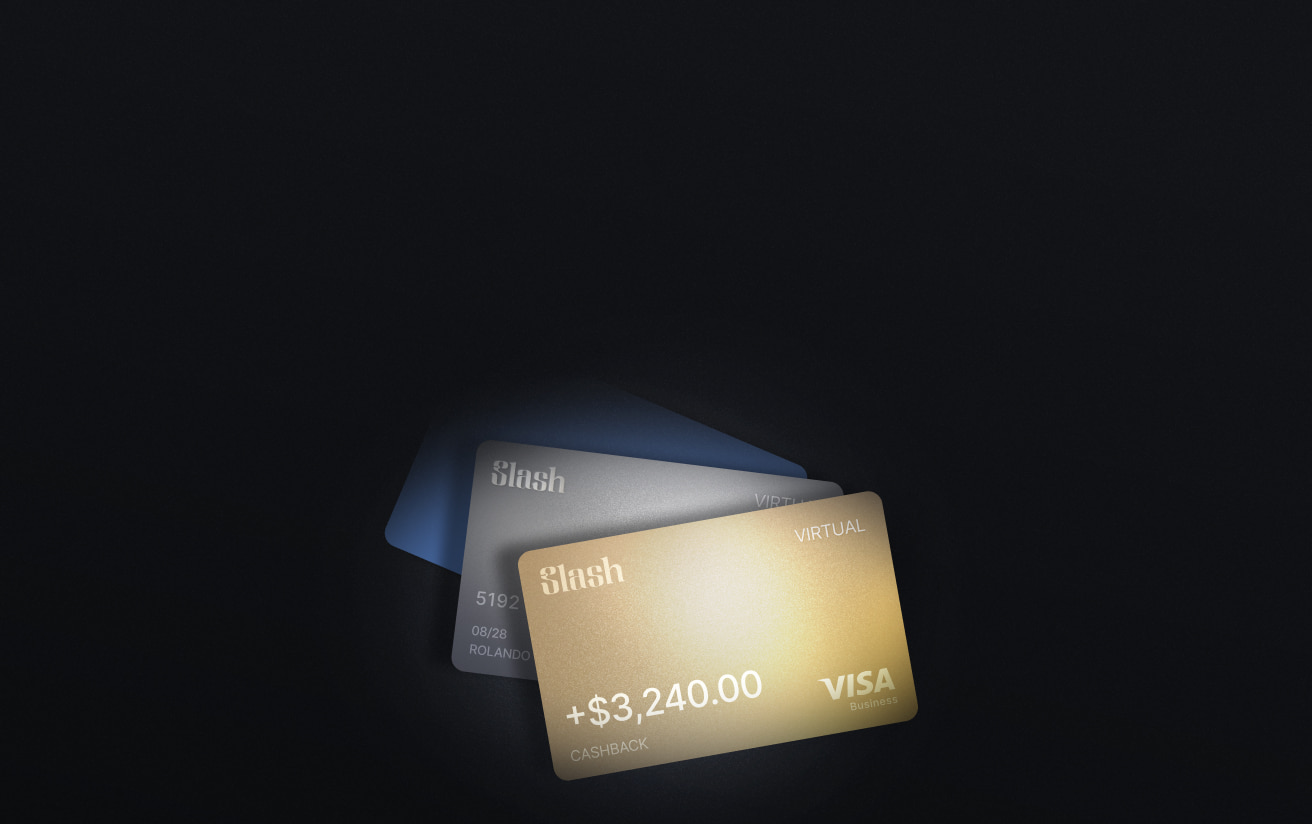
- Slash Visa Platinum Card: A corporate charge card that earns up to 2% cashback on company spending. Set granular card controls for different teams, access customizable spending limits, and capture transaction details automatically for inclusion in the expense management dashboard.
- Native cryptocurrency support: Hold, send, and receive USD-denominated stablecoins like USDC and USDT, which bypass the processing and FX fees associated with traditional bank transfers. On/off ramp funds from your Slash account and send crypto via 8 different supported blockchains.⁴
- Global USD Account: Founders located outside the U.S. can use Slash to send USD payments without needing a U.S. bank account or registered LLC.³
- High-yield treasury: Earn up to 3.79% annualized yield on your idle funds using Slash Treasury accounts backed by BlackRock and Morgan Stanley money market funds.⁶
The standard in finance
Slash goes above with better controls, better rewards, and better support for your business.

A comparison of the 5 top differences between Brex, BILL, and Slash
While Brex and BILL share surface-level similarities, the differences become clearer when you look at how each platform approaches cards, rewards, credit access, and core banking functionality. This section breaks down where the three platforms align and where they meaningfully diverge. These distinctions can have a real impact on cost, flexibility, and how easily each platform fits into your financial operations:
Card rewards
Slash uses a straightforward cashback rewards structure. Spending on the Slash Card earns up to 2% cashback, making the value of rewards clear, predictable, and immediately usable.
Brex and BILL rely on points-based rewards programs with category multipliers for certain purchases, such as travel or software subscriptions. Brex offers a more developed rewards ecosystem, including its own travel portal and discounts from brands like DoorDash, Notion, and others.
BILL, by contrast, partners with TravelPerk for travel bookings and does not offer brand-specific statement credit partnerships. BILL also reserves its highest category multiplier bonuses for users who pay off their Divvy card weekly rather than monthly. The drop-off is significant: 7x on restaurants falls to 2x on a monthly schedule, 5x on hotels drops to 1.5x, with similar reductions across other categories.
Generally, points-based rewards can inflate the perceived value of spending. Large point balances often feel more rewarding than they are in cash terms. Brex points, for instance, are worth approximately $0.006 each. Earning $1,000 in cashback with Slash requires $50,000 in spend. Achieving the same cash-equivalent value with Brex requires accumulating more than 166,000 points, making the return less transparent and more dependent on redemption mechanics.
Best for rewards value: Slash
Card issuance and payment structure
The Slash Card, Divvy Card, and Brex Card are all charge cards, meaning balances are generally due in full at the end of each billing cycle. This differs from traditional credit cards, which allow balances to roll over and accrue interest. Slash and Brex are largely aligned in the basics of card usage: both support unlimited virtual cards, offer physical cards, allow admins to set spending limits, and provide centralized visibility into company spend through their dashboards.
The BILL Divvy Card operates somewhat differently. While it draws from a credit line, it combines elements of charge cards, prepaid cards, and traditional credit cards. Businesses can choose billing cycles—weekly, semi-monthly, or monthly—with rewards structures varying by repayment schedule. Unlike Slash and Brex, Divvy typically requires employees to request funds from administrators before spending, a workflow that more closely resembles prepaid card programs.
Best usage structure: Slash and Brex (tie)
Access to credit products
Because charge cards can’t carry a revolving balance, it’s important that your card provider offers alternative ways to access flexible spending. Slash offers short-term financing options to give businesses access to credit beyond card spend. Slash’s working capital financing allows users to draw funds directly from the Slash dashboard when additional liquidity is needed, with repayment terms of 30, 60, or 90 days.⁵
Neither Brex nor BILL currently offers a standalone line of credit or financing product. As a result, users are limited to charge card spending that must be settled on the platform’s required repayment schedule without the ability to extend payment timelines or access additional capital.
Best for short-term financing: Slash
Accessibility and platform focus
Brex’s underwriting criteria, rewards structure, and overall product design are centered on venture-backed startups, technology companies, and larger enterprises. Many small and mid-sized businesses may find the platform difficult to access, as Brex typically expects applicants to have significant VC backing or approximately $1 million in annual revenue. Brex’s free Essentials plan is also limited, excluding features such as multi-entity support, advanced expense management, ERP integrations, and automated approval workflows.
BILL is primarily an accounts payable and accounts receivable platform rather than a full-stack business banking solution. While it covers bill payments and expense workflows, it does not offer core banking features such as treasury management, high-yield savings accounts, or capital financing products.
Slash is designed as a modern alternative to traditional business banking. Cards, payments, financing, and expense management are combined into a single platform, covering the core functionality businesses typically need from a bank—without relying on multiple providers. Slash also enables non-U.S. founders to access banking in U.S. dollars through the Slash Global USD Account, without the need for an institutional bank account or a registered U.S. LLC.
Most accessible: Slash
The standard in finance
Slash goes above with better controls, better rewards, and better support for your business.


Pricing plans and fees
Brex offers a free Essentials plan, but it comes with several meaningful limitations. Businesses are restricted to a single local card program, support for only two entities, and no ERP integrations. To unlock most of the platform’s functionality, companies need to upgrade to Brex’s premium plan at $12 per user/month. For growing businesses, this per-user pricing can add up quickly. Brex also charges a 3% foreign transaction fee on purchases made with the Brex Card, higher than some competitors.
BILL’s Spend & Expense plan is available at no cost and covers basic card issuance and expense tracking. More advanced functionality, including accounts payable and accounts receivable automation, payment workflows, and account analytics, requires a paid plan. BILL’s AP/AR pricing starts at $49 per user per month for the Essentials tier and increases to $89 per user per month for the Corporate tier, making costs scale alongside team size. BILL does not publicly disclose the foreign transaction fees associated with the Divvy card.
Slash takes a different approach by offering full platform functionality on its free plan, allowing teams to access cards, payments, expense management, and more without upfront software costs. Businesses that want to maximize rewards and payment flexibility can upgrade to the $25 per month Pro plan, which adds 2% cashback and unlimited free domestic bank transfers—priced as a flat monthly fee for the entire team rather than on a per-user basis.
Best value: Slash
How to choose the right corporate card for your business
Brex Card
The Brex Card offers solid expense management capabilities, but its tradeoffs are tough to ignore. For one, it can be hard to qualify for Brex; the platform generally relies on venture funding or $1M annual revenue to be eligible. Second, Brex's rewards program may not match the value of cashback, as it relies on a points-based rewards system with a relatively low effective cash value unless redemption is heavily optimized. Lastly, users can’t set up customizable expense policies or access certain key integrations without upgrading to their Premium plan.
While Brex may be a workable option for companies already committed to its ecosystem, its rewards structure and pricing limit may overall value for many businesses.
BILL Divvy Card
The BILL Divvy Card is effective for managing day-to-day spend, but it comes with even more pronounced limitations. Like Brex, BILL uses a points-based rewards system with low cash-equivalent value. Its rewards potential is further constrained by the card's unique repayment structure, which throttles point multipliers. While the Divvy Card itself is free with BILL Spend & Expense, unlocking the full value of BILL’s AP/AR platform can become expensive due to high per-user pricing, which ranges to $89/month or more with an enterprise plan.
Overall, BILL.com is a good accounts payable and receivable tool, but it is comparatively limited as a full banking stack or card provider.
Slash Visa® Platinum Card
The Slash Visa® Platinum Card is one of the strongest all-around options for businesses that want high rewards, lower fees, and modern financial controls without sacrificing flexibility. It combines transparent cashback, global usability, and deep spend management into a single card and platform. With the Slash Card, users get:
- Up to 2% cashback without the need to manage 2x points conversions.
- Low 1% FX fee, (min $0.40), the lowest of the three cards.
- Granular card controls that automatically enforce company spending policies, with custom card groupings by team, department, location, or use case.
- Real-time transaction visibility through the Slash dashboard, including cash flow insights and fraud alerts.
- Unlimited virtual cards that can be issued, managed, and frozen from your desktop and from your phone.
Streamline your financial management with Slash
Slash is built for businesses that want fewer constraints and more control over how they manage money. Rather than limiting access based on venture backing, company size, or rigid repayment structures, Slash delivers a full-stack business banking platform designed to support both SMBs and enterprises.
Slash consolidates core financial tools into a single platform, eliminating the need to manage multiple systems for everyday financial operations. This unified approach makes Slash a practical long-term solution for businesses operating both domestically and globally. Below are the core Slash features that support and optimize your financial operations:
- Full-stack business banking: Cards, payments, expense management, treasury tools, and more in one platform, with flat-rate pricing and full functionality available on the free plan.
- Slash Visa Platinum Card: Earn up to 2% cashback with clear, cash-equivalent value, plus customizable spend limits, automated compliance rules, and real-time spend visibility.
- Native cryptocurrency support: Send and receive USD-pegged stablecoins (USDC and USDT) across eight supported blockchains, bypassing traditional bank FX and processing fees.
- Dynamic payments: Global ACH settlement, international wires to 180+ countries, and access to real-time payment rails like RTP and FedNow.
- Flexible financing: Short-term working capital financing with 30, 60, and 90-day repayment options.
- Accounting integrations: Integrate with QuickBooks and Xero to automatically sync categorized financial data from your Slash account. This streamlines reconciling, tax preparation, and financial reporting, reducing manual work across your accounting workflows.
- Global accessibility: U.S. dollar banking for non-U.S. founders through the Slash Global USD Account.
Apply in less than 10 minutes today
Join the 10,000+ businesses already using Slash.
Frequently asked questions
Is it difficult to get approved for the BILL Divvy Card?
The Divvy approval process is generally more accessible than traditional corporate cards. Both Slash and BILL evaluate your business's financial health instead of a credit check, it neither requires venture funding or a minimum revenue threshold like Brex.
What are the Easiest Business Credit Cards to Get? Top Picks and How to Get Yours Approved

What credit score do you need to qualify for Brex?
Brex doesn't have a specific personal credit score requirement because it evaluates businesses based on company metrics rather than personal credit. Slash also doesn’t require a traditional credit check for our EIN-only application.
Who are BILL’s biggest competitors?
BILL competes with other financial platforms that focus on expense management, accounts payable and receivable workflows, and corporate card programs. Common alternatives include Expensify, Ramp, Brex, and Slash.
Does the BILL Divvy Card have foreign transaction fees?
Yes. The Divvy Card charges a foreign transaction fee, though BILL does not publicly disclose the markup applied over the mid-market exchange rate. By comparison, Slash charges a 1% FX fee on cross-border card transactions, which is lower than many competing corporate card programs.
Mastering Cross-Border Fees: Essential Insights and Strategies for Reducing International Payment Fees


