

Best Merchant Services of 2026: Fees and Features Compared
If you ever managed a lemonade stand when you were young, you probably remember that all you had to do was take your customer’s cash, give them a cup, and return a couple bucks to them in change. Accepting card payments is a lot more complex. Whether you’re selling drinks at a physical storefront or products through an online marketplace, you’ll need to look into merchant services to process other types of transactions.
Merchant services allow sellers to accept a wider range of electronic payments in exchange for a small cut of each purchase. In this guide, we’ll dive deep into how they work, the features you’ll need, and the leading merchant service providers of 2026.
Slash is a financial platform that offers both business banking and a payment processor on one dashboard.¹ Business owners can use Slash to accept card payments via invoice, build a custom checkout experience into their existing website, then connect them both directly to their checking account without a separate handoff.
The standard in finance
Slash goes above with better controls, better rewards, and better support for your business.
Key Takeaways
- As you evaluate providers, you’ll see three pricing models: flat-rate, subscription, and interchange-plus. This means you’ll have to do some math to figure out the cheapest option for your business and its volume.
- Stax adds no percentage markup to interchange at all, charging 8 cents card-present and 15 cents card-not-present on top of a subscription that starts at $99 a month.
- Slash, Square's free plan, Stripe, and Helcim carry no monthly platform fee.
- Helcim reduces its markup automatically as volume grows, beginning at interchange plus 0.40% and 8 cents in person or 0.50% and 25 cents online for merchants under $50,000 a month.
- Stripe charges $15 for a dispute received, $15 more to counter it, and 30% of the won amount through Smart Disputes, which can add up fast for businesses with frequent chargebacks.
What Are Merchant Services?
“Merchant services” is an umbrella term for the systems and tools that allow a business to accept and manage electronic payments. It can refer to card processing, payment gateways, merchant accounts, point-of-sale systems, mobile readers, virtual terminals, and more. In more practical terms, a merchant-services provider connects the customer’s payment method with the institutions responsible for approving the transaction and delivering the money to the business.
When a customer pays by card, the transaction information moves from a checkout page, terminal, or reader to the processor. The processor sends the authorization request through the card network to the issuing bank. Then, the issuer approves or declines the purchase, and the response travels back to the merchant. Approved transactions are later cleared and settled, after which the funds move toward the business’s designated account.
The payment gateway captures and securely transmits payment details, while the processor communicates with the card network and banks. Along with these two tools, a provider may also supply the terminal, merchant account, reporting dashboard, dispute tools, and integrations surrounding the transaction. As you assess different platforms, be mindful of how many features they come with natively.
What Features Should Merchant Service Platforms Include?
You’ll see a wide range of tools offered by different merchant service providers, but only a handful of them are absolutely necessary. These include:
A Payment Processor
The processor handles transaction data after a customer submits their payment. It sends the request through networks like Visa or Discover, receives the bank’s decision, and helps coordinate clearing and settlement. It should support the channels your business uses, whether those are card-present sales, ecommerce checkout, invoices, phone orders, mobile payments, or recurring charges.
It’s also important to understand the way processors price their services. Providers may use flat-rate, tiered, interchange-plus, or subscription pricing, then add other various fees on top. You should compare the total effective cost for your actual volume to figure out which pricing structure makes the most sense for you and which fees you’ll be most affected by.
A Payment Gateway
The gateway is the customer-facing bridge between a digital checkout and the processor. It securely collects card or wallet details from a website or app and sends them off for authorization.
A good gateway should support mobile-friendly checkout, stored payment methods, digital wallets, recurring payments, refunds, and relevant international or local options. It should also return approvals quickly and pass accurate transaction data through to the company’s other systems. With the help of Slash’s SDK (software development kit), business owners can build a custom gateway that connects transaction data directly to the financial dashboard that holds their checking account.
Security Features
Since you’ll be handling the sensitive payment information of each one of your customers, strong security features should be the backbone of your merchant services. Look for PCI DSS support, encryption, tokenization, fraud monitoring, address and card-verification tools, and controls for disputes and chargebacks. Your goal is to both reduce the amount of card data you store and make suspicious activity easier to detect.
While you do want your platform to come with good security tools, you’re also in charge of keeping data safe yourself. Businesses need to stay on top of staff training, controlled employee access, strong authentication, and internal procedures for refunds and account changes.
Built-In Analytics
Your average dashboard will show sales, refunds, processing fees, disputes, and payout timing. More advanced platforms can often break performance down by location, channel, product, employee, or payment method and make the data easy to export. With this kind of information, you can monitor declining authorization rates when they occur and investigate why deposits differ from gross revenue.
Integrations
The more financial apps your merchant services connect with, the easier it can all be to manage. Common integrations include ecommerce platforms, accounting software, inventory trackers, customer relationship management tools, and payroll systems.
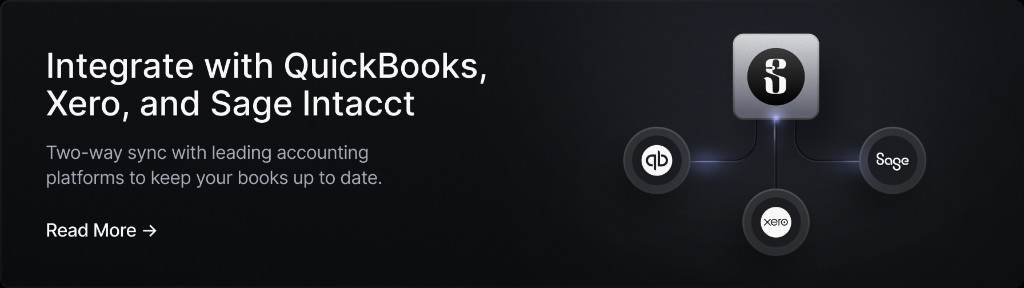
With a full suite of integrations and thoughtful setup, you’ll be able to keep your order, payment, inventory, and accounting records aligned. Before committing to any providers, however, it’s smart to make sure your specific programs are supported. If you use Slash, for example, your payment processor and business banking tools can sync two-ways with QuickBooks Online, NetSuite, Sage Intacct, and Xero.
Top 6 Merchant Service Providers of 2026
With the variety of features they offer and pricing structures they come with, leading merchant service providers can be pretty different when you evaluate them more closely. The right fit can depend on your transaction volume, sales channels, technical resources, and long-term goals. Let’s dive in to the top options of 2026:
Slash
Slash is a platform that offers both business banking tools and merchant services for online-native businesses like e-commerce companies and software providers. Whether you want to accept cards through Slash Invoicing or build custom web checkout and payment flows with the help of Slash’s SDK, you’ll be set up to accept more payments from your customers without having to add several extra pieces of software. All payments come with a flat fee of 3% plus 40 cents per transaction, with no monthly subscription cost.
The all-in-one nature of Slash means it gives business owners more visibility than most alternatives. Those that build a custom checkout can view both invoice and checkout payments, track the settlement of processed funds into accounts, and receive a breakdown of payment fees and the context associated with a given purchase.
- Strength: Slash is one of the only options available that ties merchant services together with a business checking account and corporate card program.
- Weakness: Currently, Slash doesn’t support payment processing for in-person purchases.
Stax
Stax Pay is an all-in-one merchant services platform for in-person, online, mobile, invoice, recurring, and ACH payments. Its main distinction is its subscription pricing: plans begin at $99 per month for businesses processing up to $150,000 annually, while higher-volume tiers cost more.
Stax doesn’t add a percentage markup to interchange costs, but it does charge 8 cents for card-present transactions and 15 cents for card-not-present transactions. Your subscription includes hosted payment pages, invoicing, recurring billing, fraud protection, accounting reconciliation, next-business-day funding, and unlimited users.
- Strength: Since it lacks a percentage markup, higher volumes of sales don’t cost you more money proportionally. This also makes monthly costs more predictable.
- Weakness: On the flipside, the monthly fee applies regardless of sales volume, making Stax harder to justify for new businesses that don’t move much product.
Square
Square combines payment processing with point-of-sale software/hardware, invoicing, inventory, customer management, and business banking products. One of its main perks is the range of ways it allows businesses to accept payments, including over the phone and via invoice.
Square Free has no monthly platform fee and currently charges 2.6% plus 15 cents for tapped or swiped payments and 3.3% plus 30 cents online. You may also choose between a $49/mo and $149/mo subscription plan that lowers those fees a bit.
- Strength: Square is easy to set up, especially for in-person storefronts that want a simple way to accept card payments.
- Weakness: Flat-rate pricing can become expensive at higher volume, and advanced retail, restaurant, appointment, and marketing features add extra fees.
Stripe
While Square leans towards in-person operations, Stripe is angled more towards online businesses and marketplaces that want control over how payments appear inside their website or app. With embeddable payment components and no-code Payment Links, businesses get to customize their online checkouts more than they would with other providers. In addition, Stripe does still offer physical POS hardware.
The platform supports more than 125 payment methods, cardholders in over 195 countries, and more than 135 currencies. Standard U.S. pricing has no setup or monthly fee, and charges 2.9% plus 30 cents for domestic card transactions.
- Strength: Stripe provides a broad combination of global payment-method coverage, APIs, subscription billing, platform tools, and customizable checkout.
- Weakness: Its large product catalog can create some implementation and pricing complexity. More importantly, Stripe charges $15 for a card dispute received, $15 for a dispute countered, and 30% of the won amount if it’s handled through their Smart Disputes tool.
Finix
Finix operates as a direct processor for merchants and as payments infrastructure for software platforms and franchises. Businesses can accept payments online, in person, or over the phone through hosted checkout, payment links, a virtual terminal, hardware, and APIs.
Direct-merchant pricing starts at a hefty $250 a month, along with small processing fees. Custom pricing is available for larger or more complex businesses. For this monthly membership, you get merchant onboarding, configurable fees and payout schedules, fraud monitoring, dispute management, and embedded payments.
- Strength: Finix gives you more control over checkout and embedded payments than most providers.
- Weakness: The $250 monthly minimum (as well as its configuration depth) may make it a poor match for very small or low-volume merchants.
Helcim
Helcim is a merchant services provider that uses interchange-plus pricing, passing through card-network costs and adding a published margin that declines automatically as processing volume grows. As a result, it has no account monthly fee, long-term contract, statement fee, or standard PCI fee.
The platform includes a virtual terminal, invoicing, online checkout, recurring billing, a card vault, 75 integrations, and in-person hardware. For businesses processing up to $50,000 monthly, Helcim’s published markup begins at interchange plus 0.40% and 8 cents in person or 0.50% and 25 cents for online transactions.
- Strength: Interestingly, Helcim is actually HIPAA-compliant, making it a good pick for those in the healthcare space.
- Weakness: Interchange-plus pricing changes depending on card type and transaction conditions, so monthly costs are less predictable than a flat-rate processor’s.
Payment Processing Built Into Your Business Account with Slash
Your merchant services provider may offer a bevy of tools outside of its standard payment processor and gateway, but if you need to toss it on top of a complex tech stack, it won’t help simplify much of anything. With Slash, you get expense management, corporate cards, accounts payable/receivable, and a lot more in the same place that houses your merchant services.
Qualifying Slash users can access payment processing in two ways: native card acceptance in Slash Invoicing, and a custom web checkout with the help of our SDK. If your transactions are largely B2B, you can create Slash invoices, enable card payment, and view the entire customer payment flow with ease.
Those who prefer to develop a custom checkout can view invoice and SDK-originated payments in the same dashboard, issue partial refunds, track processed funds into Slash accounts and business spend, and receive a payment’s fee breakdown and connection to the appropriate invoice or receivables context.
The following financial tools also come with the Slash platform:
- Business banking: Create multiple business bank accounts to silo cash flows by project, department, or client with real-time analytics across each of them. Up to $150M in FDIC insurance coverage from the Column N.A. insured cash sweep network.²
- Slash Visa® Platinum Card: The Slash Card is a corporate charge card that allows you to set customizable spending controls and issue unlimited virtual cards for handling team expenses, vendor payments, subscriptions, and more. Users can also earn up to 2% cash back on eligible business purchases.
- Multiple payment methods: Slash supports same day ACH, international wire transfers to over 180 countries via SWIFT, real-time payments through RTP and FedNow, and stablecoin payments in USDC or USDT.⁴
- Accounting automation: Transactions are categorized as they post and carry the accounting dimensions your ledger expects: GL codes, departments, classes, locations, subsidiaries, vendor details, cardholder memos, and receipts. Set your mapping rules once in Slash instead of reclassifying spend at close.
- Enterprise-grade protection: Approvals and controls are granular down to the individual card, and AI-assisted monitoring flags spend that falls outside your policy.
Apply in less than 10 minutes today
Join the 10,000+ businesses already using Slash.
Frequently Asked Questions
What is a merchant account, and do I need a separate one?
A merchant account is a holding account that receives card funds before they're deposited into your regular business checking account, which is why it's distinct from your operating account. Many modern providers bundle this function into their platform, so you can start accepting cards without opening one separately. Dedicated merchant accounts still exist and tend to make sense at higher volumes, where the underwriting buys you more stability.
Merchant Accounts: How Card Payments Work

What makes a business "high risk," and how does that change things?
Providers classify certain categories as higher risk based on chargeback rates, regulatory exposure, or the likelihood of non-delivery, which commonly covers supplements, travel, ticketing, subscription billing, and some health and wellness products. The practical consequences are higher rates, longer underwriting, rolling reserves that hold back a percentage of your sales, and occasionally outright decline. If you're in one of those categories, confirm your eligibility before building a checkout around any provider.
How long does it take to get approved and start accepting payments?
Providers that onboard you onto a shared merchant account can often approve you the same day, so you're accepting payments almost immediately. A dedicated merchant account involves real underwriting and can take several business days to a few weeks, depending on your industry and documentation. Factor in hardware shipping if you need terminals or readers, since that usually outlasts the approval itself.
What are the Easiest Business Credit Cards to Get? Top Picks and How to Get Yours Approved


