

How the Neobank Is Becoming What Businesses Wanted All Along
When the Federal Reserve surveyed small business owners for its 2023 Small Business Credit Survey, one respondent in Florida summed it up: "I just want to work with decent people at rates that I can afford." For years, a neobank could offer the second half of that sentence more easily than the first.
A neobank is a bank without branches. For a small business, choosing one used to mean giving up the banker who knew the account in exchange for better software.
It was a hard sell at first. The same survey found that customers of small banks and credit unions put more weight on attentive service and in-person banking than customers of larger banks and nonbanks, which is the kind of relationship neobanks were asking them to trade away.
But slowly, businesses started making the switch. The trade worked because of what neobanks did with the revenue they didn't spend on maintaining branches. Neobanks put their money, energy, and talent into the software customers use every day, and the software got good.
Now, as artificial intelligence becomes more central to the development of financial services, neobanks are getting closer to the relationship banking they lacked in the early years, without slowing down on software.
Why building a neobank is easier than it used to be
Building a neobank is easier now, mostly because the bank and the middleware have, in many cases, become the same company. Slash and several other neobanks partner with Column N.A., a nationally chartered bank that provides its own developer infrastructure, so there is no separate BaaS company between the platform and the charter.¹
Think of it like renovating a kitchen. Under the old model, a neobank was the homeowner hiring separate contractors for the plumbing, the wiring, and the cabinets, and every change meant getting all of them on the phone. Working with a bank that provides its own infrastructure is like hiring one general contractor who handles the whole job. The work gets done faster, there's less to coordinate, and the end result is more cohesive and higher quality.
The other big change is artificial intelligence. AI has made it possible for companies with a fraction of an institutional bank's headcount to ship products at a pace those banks often can't match, without building the layers of management and back-office staff that a large bank needs to function.
The fixed costs of running a bank haven't gone away. The compliance program still has to be staffed, audited, and kept current. Customers still need support when a wire is stuck or a card is declined. AI doesn't remove that work, but it shrinks the number of people needed to do it well, and that is what makes running a neobank at scale viable.


Most businesses still bank the old way, but that's starting to change
For the foreseeable future, legacy banks will be the default. They hold most of the deposits, the relationships, and the balance sheets. They're institutions with hundreds of years of history and trust. But they are also the ones investing in the technology neobanks built first. In January, Capital One agreed to acquire Brex for $5.15 billion.
The Federal Reserve found that 87% of employer firms had a relationship with a bank, and 26% had one with a nonbank financial company such as a payments processor. Among firms whose primary provider was a nonbank, only 14% kept a deposit account there.
There's a long way to go before neobanks become the default pick for a new business owner.
But as neobanks keep automating the processes that slow big banks down, more of their resources will go to the user. That shows up in pricing, in rewards, and in software that handles more of the work on its own. Calling a local account executive will start to feel like a chore rather than a benefit.
The gap between neobanks and legacy banks will keep widening, and more businesses will have to decide which side of it they want to bank on.
The next frontier: Artificial intelligence
AI changes three things for a financial platform: how much it can afford to build, how much it costs to run, and how much of the customer's own work it can take over.
Consolidating the financial stack
When shipping software gets easier, the right response is to offer more of it.
Slash has spent the last year unifying the products businesses used to get from separate providers. We launched payment processing, started offering crypto cards⁴, shipped an internal AI agent, overhauled our dashboard, and added invoicing and bill management, alongside the smaller improvements that go out every week.
The goal is a neobank so complete that it becomes hard to justify using anything else, and one that pays businesses back for consolidating their finances with us.
Running more efficiently and passing value back
For the past two years, our thesis has been simple: give businesses more for their money than a traditional bank typically does.
- Up to 2% cash back with the Slash Card
- Up to 3.42% annualized yield on treasury⁶
- Working capital financing at ~15% APR⁵
- Slash Pro for a flat $25 a month, with no per-user pricing and unlimited domestic bank transfers
For companies that do most of their banking with Slash, the subscription can pay for itself.
Those offers are sustainable because our team is a tenth the size of a traditional bank. Whenever AI produces a significant saving in product development, the first question we ask is how much of it can go back to users. That instinct is hard to replicate at a company carrying a much larger cost base.
Automating your finances
The tools we develop to automate our own back office become the foundation for automating our customers' finances.
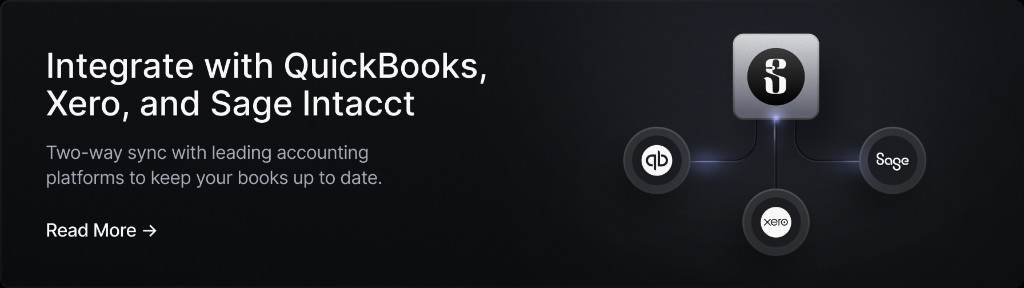
Receipt matching and transaction categorization once took hours of cleanup before every close. Now both happen as transactions post. Twin, our AI financial assistant, sits inside Slack with live account data and can act on cards, payments, and purchases on request. When our own financial controller started asking for the same improvements our users were asking for, we shipped automated categorization and coding for accounting entries and added more ERP integrations.
What's left is the part that always needed a person: calling a longtime customer to say thanks, sitting down with a new hire on their first day, or finally visiting the supplier you've only ever emailed.
Building the autonomous superbank
Our goal is to build a banking platform that does more of the work, so you do less of it. That means:
- Automating as much of our own operation as we can and passing the savings to customers,
- Providing every financial product a business needs on one platform,
- And taking the most tedious parts of finance off your plate, so the hours go to building your business.
The first generation of neobanks removed the branch. Slash is the first member of the next generation, which will use technology to redefine the relationship between the bank and its customers.
Relationship banking is moving from a banker who picks up the phone to a platform that's built with you in mind. That's the neobank Slash is building.
Apply in less than 10 minutes today
Join the 10,000+ businesses already using Slash.
Read more from us


