

Rho vs Brex: Business Banking Features and Fees Compared
As you research different banking solutions for your business, you’ll probably see Brex and Rho pop up alongside the multitude of names in the space. That’s for good reason: they’re two solid financial platforms that help thousands of founders and teams across the country optimize their day-to-day banking work.
However, they were built for somewhat different businesses. Rho emphasizes simple no-cost banking and accounts payable, whereas Brex places more weight on things like global spend management, travel, and multi-entity controls. They also both have shortcomings that users should be aware of before deciding to sign on.
In this guide, we break down the similarities and differences between Rho and Brex’s features in order to help you make your choice. If neither of these systems seem quite right, we’ll also discuss Slash, a leading alternative built for both early-stage and enterprise teams. As an all-in-one business banking platform, Slash comes with stablecoin on/off ramps, working capital financing, accounting automations, and other tools that Rho and Brex can’t easily compete with.¹,⁴,⁵
The standard in finance
Slash goes above with better controls, better rewards, and better support for your business.


Key Takeaways
- Brex’s points lose about 40% of their value outside travel. They’re worth one cent each through Brex Travel, but only 0.6 cents when redeemed for cash or a statement credit.
- Rho Platinum is a qualification rather than a paid tier. To reach “Platinum” status, you have to make Rho your primary financial platform, which means holding the bulk of your assets there.
- Brex’s entry barrier is pretty steep. Startups need $50,000 sitting in a business account, while mid-market companies need at least $400,000 in monthly revenue.
- Rho’s treasury carries a $50,000 minimum and only approaches the top of its 3.24% to 3.46% range at several million in balance.
- Slash carries quite a few features that neither platform offers, including working capital financing and Global Accounts for non-U.S. founders.³
What Is Rho?
Rho is a fintech platform that combines corporate cards, accounts payable, expense management, invoicing, and treasury tools. Like most similar platforms, Rho isn’t a bank in and of itself. Their checking and card services are provided through Webster Bank and Lead Bank, while their savings services are administered through American Deposit Management Co. and its partner institutions.
Rho’s “elevator pitch”, so to speak, is the amount of tools they give you without charging a subscription fee or per-user price. Most platforms (including Brex) gate some of their more advanced features behind monthly paywalls, while you get Rho’s corporate cards, expense management, and Bill Pay features for free. Domestic ACH transfers, wires, and checks are also free. Their international and foreign currency payments are supported through Wise, though those come with a 1% FX fee.
Rho also offers physical and virtual corporate cards with daily or monthly repayment terms. Like most corporate cards, they come with merchant restrictions, category controls, limits, and real-time transaction alerts. Their rewards rates are a little less straightforward than the rest of the platform; you get 1-1.25% cashback on the standard card, but up to 2% cashback on Rho Platinum. Platinum isn’t a priced tier, but a program you qualify for if you “make Rho [your] primary financial platform.” In other words, you have to hold most of your assets within Rho and maintain an open Rho Corporate Card.
Who Uses Rho?
Rho is a good fit for U.S.-based startups and small/midsize companies that want banking, accounts payable, cards, and expense management without having to pay lots of fees. It’s extra useful for businesses with frequent vendor payments, since you get access to domestic rails for free. Those users can take advantage of “Bill Pay”, which supports approval workflows, invoice processing, and accounting synchronization from the same account that holds the company’s cash.
While international vendors can use Rho, it isn’t a native multi-currency account. A business can send foreign currency payments to more than 200 countries and territories, but it can’t actually hold separate EUR, GBP, or other non-USD balances. Rho is therefore a stronger fit for companies based in the United States.
What Is Brex?
Brex is a financial platform that covers a lot of the same ground as Rho, with the addition of more international features. Its main strengths are corporate cards, expense management, reimbursements, travel tools, treasury, and global financial operations. Its business account includes checking through Column N.A., Member FDIC, along with separate Treasury and Vault products offered through Brex Treasury LLC.
The platform started as a corporate card platform for venture-backed startups, and while it’s expanded since, cards are still one of its main features. Companies can issue unlimited cards, create employee and team budgets, apply merchant and category restrictions, and track card expenses by individual and department.
Unlike Rho, Brex’s pricing is tiered. Essentials costs $0 per user per month and includes cards, basic expense management, bill pay, reimbursements, accounting integrations, travel booking, and support for up to two entities. Premium costs $12 per user per month and adds things like customizable policies, advanced approval chains, and AI compliance tools. Enterprise is custom-quoted and supports unlimited U.S. and international entities.
Who Uses Brex?
Generally speaking, Brex is best suited to venture-backed startups, mid-market businesses, and international companies with complex spending structures. However, there’s a big caveat: their minimums. To sign on with Brex, you’ll need at least $50,000 in a business bank account if you’re a startup and at least $400,000/month in revenue if you’re a mid-market company. That eliminates a large swath of startups and small businesses.
Brex’s higher tiers are overall designed for companies with dedicated finance teams that need advanced ERP connections, HRIS integrations, automated compliance reviews, and formal implementation support. In short, the platform’s more software-intensive than Rho. Smaller companies might not need its travel program, global policy engine, or per-user Premium plan. For a larger organization, however, those are precisely the features that separate it from a conventional business bank account.
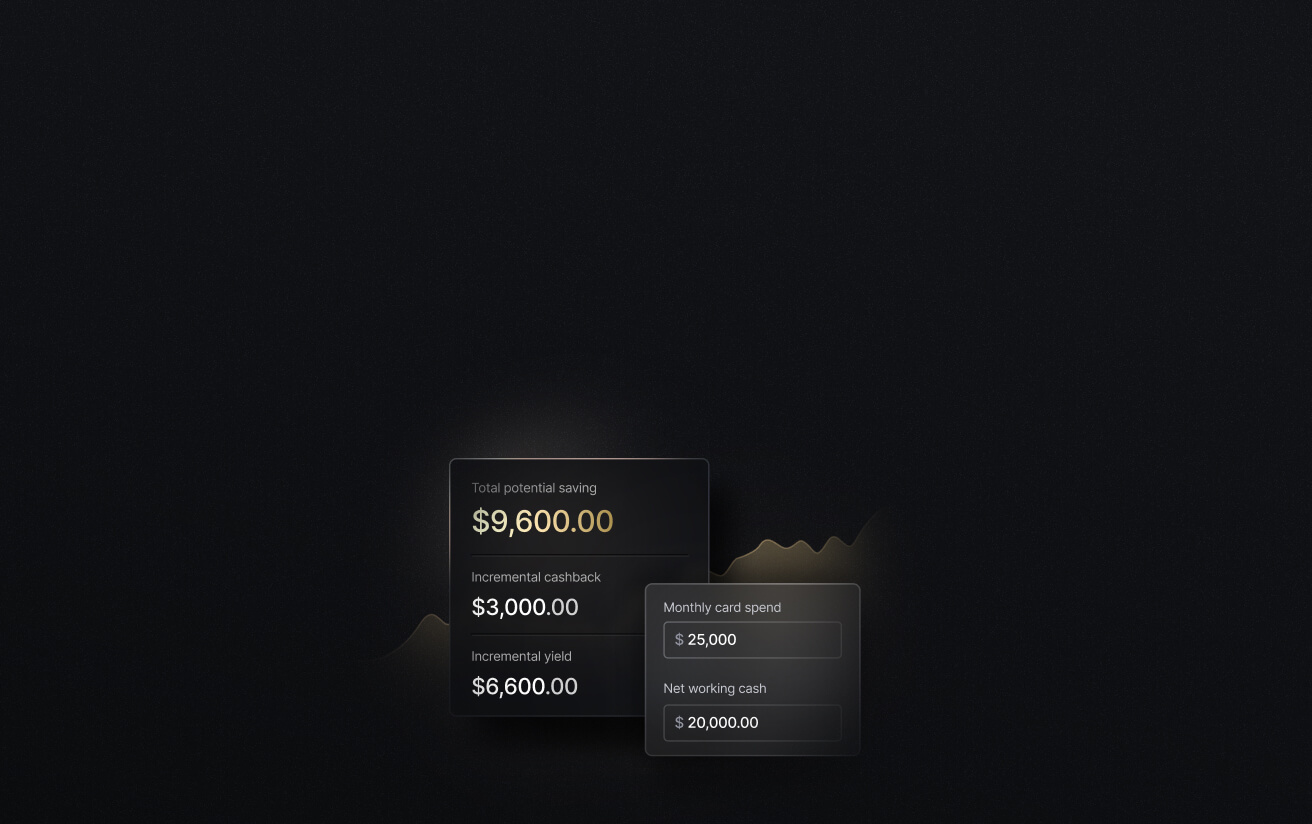
See the ROI behind your spend
Use this calculator to understand impact, then manage and track it all in Slash.

Rho vs Brex: Features Compared
Let’s evaluate Rho and Brex based around the business banking features that are most central to their platforms. Along the way, we’ll also take a look at what an alternative like Slash has to offer:
Corporate Cards and Rewards
Rho’s corporate charge card uses cashback rather than points. With Daily Terms (next-day repayment), businesses can earn up to 1.25% standard cashback or up to 2% through Rho Platinum. Monthly Terms earn up to 1% standard cashback or up to 1.75% with Platinum.
In contrast, Brex’s charge card uses points with category multipliers. Under its standard Brex Exclusive monthly payment schedule, companies can earn 7x on rideshare, 4x through Brex Travel, 3x at restaurants, 2x on recurring software, and 1x elsewhere. Points are worth one cent each through Brex Travel, but only 0.6 cents each when redeemed for cash or a statement credit. That penalty can prove pretty costly for teams that want a flat rewards structure.
So, Brex offers more upside for companies that spend heavily in its bonus categories, while Rho is simpler for businesses that prefer cashback and don’t want to manage redemption values. With up to 2% cashback on eligible purchases, the Slash Visa® Platinum Card aligns more closely with Rho than Brex.
Expense Management
Rho handles expense management without per-user or platform fees. Administrators can create rules for card purchases and reimbursements, require receipts or notes, route expenses through multilevel approval chains, and reimburse employees for purchases or mileage. Transactions can also be coded using accounting attributes before they reach the general ledger.
At face value, Brex’s capabilities are pretty similar. Its software can collect or generate receipts, create memos, categorize expenses, flag high-risk purchases, and automatically approve in-policy transactions. Policies can be configured by role, department, entity, merchant, category, or use case.
The difference is ultimately in depth versus cost. Rho handles the main expense workflow for free, as is the nature of its platform. Brex offers more advanced global policies, review chains, and AI audits, but several of those capabilities require the $12-per-user Premium plan or a custom Enterprise agreement.
Payment Rails and Crypto
Rho supports same-day ACH, domestic wires, checks, and international payments. Domestic transfers are free, while foreign currency payments carry a 1% conversion charge. Through its Wise partnership, Rho can send payments to more than 200 countries and territories in 22 currencies. It doesn’t, however, hold foreign currencies or offer native stablecoin payments.
Similarly, Brex includes free same-day ACH, domestic and international wires, checks, and global bill pay. Its business account can make payments in more than 30 currencies, while its global card programs support local currency cards and billing in more than 50 countries. Brex does get a leg up on Rho by supporting stablecoin payments in USDC, but not in the slightly more common USDT.
Slash offers a wider mix of domestic and international rails than either of those two platforms. In addition to ACH and wires, it supports RTP and FedNow for instant U.S. settlement, which Brex and Rho can’t claim. Businesses can also send and receive both USDC and USDT across 15 blockchain networks.
Teams who need to send payments to different countries can take advantage of Slash’s support for local rails, including SEPA, Faster Payments, and Pix. That means you can see the currency conversion fees up front, use a system your banks and vendors are already familiar with, and skip the delays and surprises that come with routing through correspondent banks.
Accounting Automations
Rho has native integrations with QuickBooks Online, NetSuite, Sage Intacct, and Puzzle, plus bank-feed connections for Xero and QuickBooks. Expenses can be coded using accounting dimensions, and Bill Pay can synchronize bills and payment status with QuickBooks.
Brex supports a broader integration list, even on its free “Essentials” plan. You get connections with platforms including QuickBooks Online, Xero, NetSuite, Sage Intacct, Puzzle, Rillet, Campfire, and Microsoft Dynamics 365 Business Central. Higher plans add HRIS connections and customizable workflows with certain ERPs. Some enterprise connections are sold as add-ons.
Generally speaking, you can use both Rho and Brex to create mapping rules, categorize transactions, import charts of accounts and vendors, and synchronize receipts and supporting details. The difference may depend on your accounting app of choice.
Treasury Accounts and Yield
Both Brex and Rho offer treasury accounts, which you won’t see among some alternatives. Through a JPMorgan government money market fund and a Morgan Stanley ultra-short fund, Rho Treasury can earn you 3.24% to 3.46% annualized yield. However, it requires a $50,000 minimum balance, and you’ll only access the higher end of that yield if you have several million dollars sitting in your account.
Brex Treasury works the same way, with slightly higher ranges. Balances under 500k earn 3.62%, while balances of over $20 million earn 3.97%. Slash offers up to 4.06% annualized yield⁶ through money market funds from BlackRock and Morgan Stanley. Each of these yield numbers are accurate as of November 2026, and are subject to change.
Side-by-Side Comparison: Rho vs Brex vs Slash
There’s still a lot more to these systems that we haven’t broken down. To make it all easier to analyze, we’ve laid out more of the three platform’s relevant features and tools on the chart below.
Make the Right Business Banking Choice With Slash
Rho offers a healthy mix of financial tools for free, but it lacks features like global accounts and crypto support. Brex technically has the edge on the capability list, but its per-user charges and convoluted card reward system can be an issue for some teams. With Slash, you don’t have to compromise.
Slash offers expense management, accounting automations, a corporate card program, AP/AR, and a lot more of the same tools that leading business banking platforms bring to the table. It doesn’t stop there, however; the platform also comes with working capital financing, support for international local rails, RTP/FedNow payments, and on/off ramps for USDC and USDT. Brex and Rho can’t match that.
Unlike Brex, Slash doesn’t gatekeep its strongest features behind any paid tiers. Slash’s $25/mo Pro Plan waives certain transfer fees, meaning teams can get their money’s worth after a handful of routine outgoing payments. Plus, when comparing Slash’s free features with Rho’s free features, Slash’s high-yield treasury and wide payment rail support come out on top.
There are even more Slash capabilities we haven’t touched upon yet, including:
- Reimbursements: Instead of managing reimbursements across multiple tools, teams can submit, review, and approve reimbursements directly inside the Slash dashboard. Connect your bank account, upload your receipt, and let Slash capture the details.
- The Action Center: A one-stop spot for employees to see pending tasks assigned to them. These may include card requests, expense submissions, reimbursement reviews, and more.
- Separate virtual accounts: Create multiple business bank accounts to silo cash flows by project, department, or client with real-time analytics across each of them.
- Multi-entity support: Slash offers multi-entity account management tools without separate logins, allowing businesses to track spending, manage accounts, and download statements across all subsidiaries in one place.
- Invoicing: With Slash’s invoicing and bill pay features, users can send customized invoices, collect payments, and manage vendor bills all in the same place.
Apply in less than 10 minutes today
Join the 10,000+ businesses already using Slash.
Frequently Asked Questions
What makes a charge card different from a credit card?
All three of the above platforms offer charge cards rather than credit cards. A credit card gives you a revolving line, so you can carry a balance between cycles and pay interest on whatever you don’t clear. A charge card has to be settled in full on a set schedule, which removes interest entirely, but also removes the option to stretch a payment down the road.
Business Charge Card vs Credit Card: 6 Key Differences You Should Know

How do sweep networks work?
A sweep network distributes your balance across many partner banks to bypass the standard $250k limit. Therefore, a single account can advertise coverage in the millions or tens of millions without any one bank exceeding the standard cap.
Don't Settle for Less When it Comes to Deposit Insurance

What’s the difference between USDC and USDT?
USDC and USDT are the two most commonly-used stablecoins in existence today, and they essentially function in the same way. Their main difference is in their international acceptance; due to MiCA regulations, the European Union doesn’t support USDT, but it does support USDC.
USDC vs. USDT: Choosing the Right Stablecoin
Read more from us


