

Leading Business Cards for Marketing Agencies Compared
Choosing the right business card is a more complex project than you may initially think. You have to consider rewards structures, platform integrations, security features, and whether you want a debit, charge, or credit card. This can get even trickier when you’re shopping on behalf of a marketing agency.
In this article, we’ll discuss what marketing agencies should look for in a business card, why the rewards structure matters, and which leading cards you should consider in 2026. Among those options, the Slash Visa® Platinum Card is the only one that offers qualifying agencies up to 5% cashback on eligible AppLovin ad spend.¹ It also comes with an all-in-one business banking platform that offers payment processing, stablecoin support, accounting automations, and more.⁴
The standard in finance
Slash goes above with better controls, better rewards, and better support for your business.

Key Takeaways
- A points multiplier is different from a cashback percentage. A point is typically worth a fraction of a dollar and its value depends on redemption, which means 3x isn’t necessarily the same as 3%.
- Since agency spending is service-driven and frequently rebilled to clients, per-card attribution matters about as much as the rewards rate itself.
- Category caps can hamper large ad budgets; both the Ink Business Preferred and Amex Business Gold cards stop bonus earning after the first $150,000 annually.
- Chase Sapphire Reserve for Business caps its 3x advertising at the first $1 million per anniversary year beginning November 15, 2026, which a large agency can reach well before the year ends.
- The Slash Card offers up to 5% cashback on eligible AppLovin ad spend, which is the highest advertising-specific cashback figure among the five cards compared.
What Should Marketing Agencies Look For in Business Cards?
Marketing agencies put company cards through a different workout than most brick-and-mortar businesses. A retailer with a storefront spends their money primarily on inventory and rent/utilities. Meanwhile, an agency may route large budgets through Meta, Google, TikTok, and other advertising platforms while also paying for software, travel, contractors, and content production.
That spending is then divided across several clients and campaigns. A shared card may work when an agency is small, but it probably won’t go well when you start expanding. With a single card, media buyers battle under a tight spending ceiling, subscriptions become difficult to attribute, and your finance team has to separate client expenses manually. To fix these problems, you may want a provider that offers unlimited virtual cards.
Another issue is the fact that agency spending is service-driven rather than inventory-driven. Much of the money passing through a card may later be rebilled to a client, making attribution and control especially important. In short, the right card should combine strong rewards with tools that keep spending visible and organized. Here’s a summary of the most important features to keep in mind:
- High rewards: Since advertising tends to be an agency’s largest spending category, a small difference in rewards can make a big impact on your margins. There are a few things to consider outside the raw numbers, such as caps to your category bonus or unintuitive redemption methods for points. We’ll expand upon that in a moment.
- Expense tracking: Real-time transaction data, receipt capture, automatic categorization, and accounting integrations are all features meant to save your team time and keep them on top of spending.
- Security features and spend controls: While a single physical card is tough to manage, a series of virtual cards can isolate subscriptions, ad platforms, clients, and campaigns. These cards should also come with per-card limits, merchant restrictions, a connection to a live dashboard, and the ability to be frozen instantly from anywhere.
- Connection to subaccounts: Similarly, cards that draw from dedicated subaccounts can keep one client’s budget separate from another’s operating funds. Agencies can assign a client or campaign its own balance, cards, transaction history, and permissions. Slash allows users to issue unlimited virtual cards, each with their own account numbers, that draw from selected subaccounts.
Cashback Rewards vs. Points-Based Rewards
As you explore different card options, you’ll run into both points-based rewards and cashback rewards. Which is better, 2% cashback or 2x points? That depends.
Cashback is calculated as a percentage of eligible spending, then deposited into an account or applied as a statement credit. A 2% rate on $500,000 of eligible annual spend is worth $10,000 without the agency needing to use a travel portal or transfer partner. It’s simple and consistent, especially if it doesn’t vary by category.
Points are a bit tougher to get used to. A singular point is normally worth slightly less than a dollar, and its value depends on how it’s redeemed. Travel bookings and airline/hotel transfers usually result in value above a dollar per point, whereas statement credits may be a lot less. A program advertised as “3x” is therefore not automatically equivalent to 3% cash back.
Points can certainly still suit agencies whose teams travel frequently and have the time to manage redemption rules. If a card offers a high points multiplier on ads, it can also potentially return more value over time than a flat cashback option. For most agencies, however, cashback is easier to forecast and use. It converts spending into a direct dollar return, requires no redemption strategy, and doesn’t arrive in your account as a lower number than you expected.
The Top 5 Business Cards for Marketing Agencies
Marketing agencies need cards that reward advertising, support large budgets, and keep client and campaign spending separate. The following five options were designed with those needs in mind:
#1: Slash Visa® Platinum Card
The Slash Visa® Platinum Card is a no-credit-check charge card built into Slash’s banking and expense platform. Agencies can issue unlimited physical and virtual cards, connect them to subaccounts, organize them into card groups, and set unique merchant restrictions and spending ceilings for each one. Since it’s a charge card, your balance settles automatically from your Slash account each day rather than revolving or turning into long-term debt.
As far as rewards are concerned, the Slash Card offers up to 2% cashback on eligible business purchases, which comes in above your average flat-rate card. Marketing agencies that advertise online, however, can get an even better deal. Eligible Slash customers can earn 5% cashback on qualifying AppLovin ad expenses made with the Slash Visa® Platinum Card.
- Rewards Rate: Up to 1.5% cashback on Free or 2% on Pro, 5% on AppLovin
- Annual Fee: No separate annual card fee; Free costs $0/mo and Pro costs $25/mo.
- Drawback: Slash does not support ATM access or cash deposits at this time.
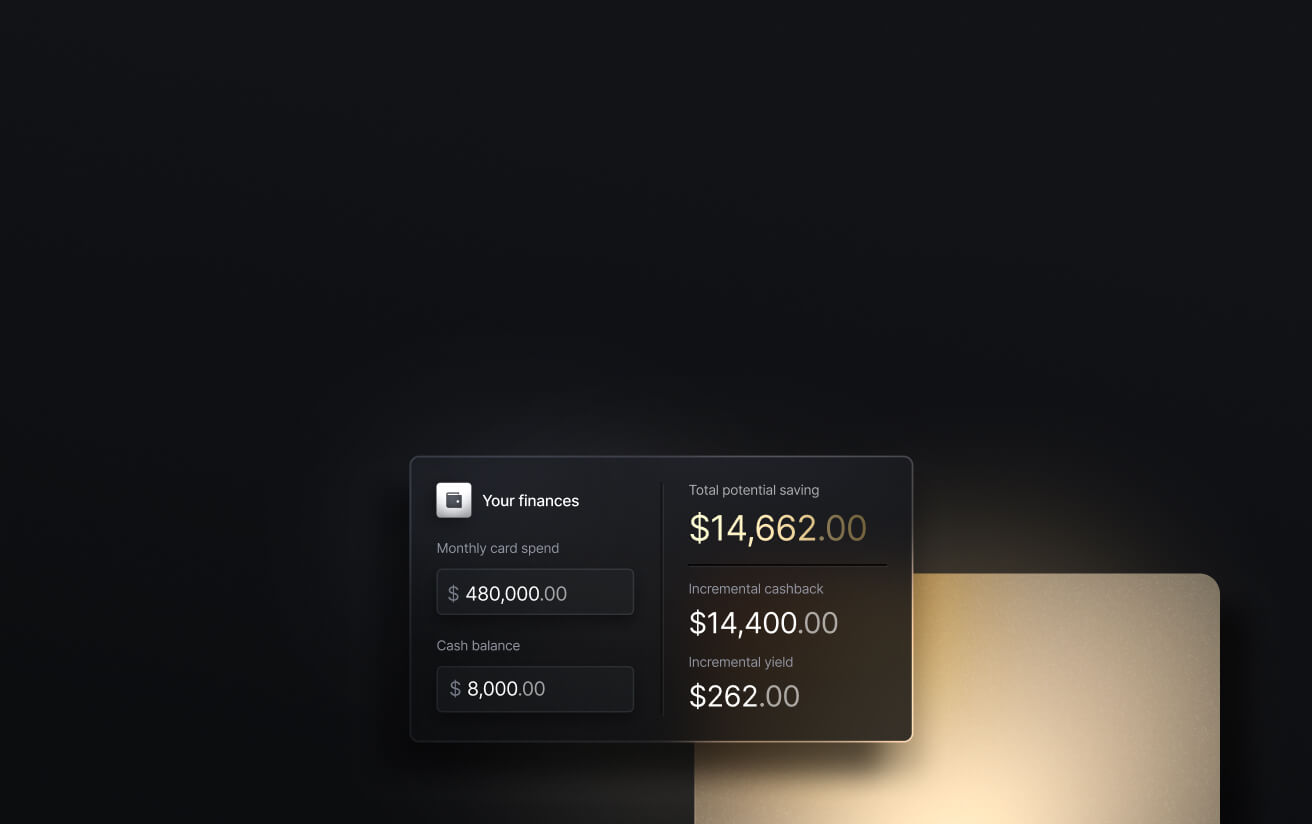
See the ROI behind your spend
Use this calculator to understand impact, then manage and track it all in Slash.

#2: Chase Ink Business Preferred Credit Card
Chase’s Ink Business Preferred card earns 3 points per dollar on the first $150,000 in combined annual purchases across social media and search engine advertising, travel, shipping, and internet, cable, and phone services. Other purchases earn 1 point per dollar. Employee cards are available without an added fee, and points can be redeemed through Chase Ultimate Rewards. Like a lot of other credit cards in this space, points are generally worth most when redeemed for travel through their portal.
- Rewards Rate: 3x in qualifying categories through the cap; 1x afterward
- Annual Fee: $95
- Drawback: Since advertising shares its $150,000 cap with three other categories, you might lose the 3x multiplier more quickly than you expect.
#3: The Opal Card
The Opal Card is a charge card built specifically for agencies and brands with large digital ad budgets. It offers up to 1.5% uncapped cashback on eligible advertising, an optional credit limit of up to $10 million, spend controls, and unlimited free virtual cards for individual clients and campaigns. Like the Slash Visa® Platinum Card, Opal doesn’t check your credit when you apply.
- Rewards Rate: Up to 1.5% on eligible ad spend, without an annual cashback cap.
- Annual Fee: $0.
- Drawback: 1.5% isn’t too impressive of a cashback rate, and you don’t get rewards outside of ad spend.
#4: Chase Sapphire Reserve for Business
The Sapphire Reserve for Business is a premium credit card that functions partially as a pay-in-full card and partially as a credit card through Flex for Business. At $795 a year, it’s a steep investment, but you can earn 3x on social media and search engine advertising, 4x on flights and hotels booked directly, and 8x through Chase Travel.
However, there’s a catch. Starting November 15, 2026, 3x advertising rewards only apply to the first $1 million spent in that category each anniversary year. Large agencies can bump into this ceiling fairly quickly.
- Rewards Rate: 3x on qualifying ads, 4x on direct flights and hotels, 8x through Chase Travel, and 1x elsewhere
- Annual Fee: $795
- Drawback: The high annual fee and ceiling on advertising rewards can make the Sapphire Reserve card tough to justify for some agencies.
#5: American Express Business Gold Card
The Amex Business Gold earns users 4x Membership Rewards points per dollar in the two eligible categories where they spend most each billing cycle. These categories can include U.S. media advertising, software and cloud providers, restaurants, gas, transit, and wireless service. Generally speaking, advertising will almost definitely be one of a marketing agency’s top two categories. Outside that structure, flights and prepaid hotels booked through AmexTravel.com can earn 3x.
- Rewards Rate: 4x in the top two eligible categories, 3x through AmexTravel.com, and 1x otherwise
- Annual Fee: $375
- Drawback: That 4x rate applies to the first $150,000 in combined annual purchases across those two categories, then falls to 1x.
Side-by-Side Comparison
Get More Cashback on Ads With the Slash Card
You don’t need to manage categories or redemption policies to earn up to 2% cashback with the Slash Visa® Platinum Card. If you do spend most of your money on digital advertising, eligible customers can earn 5% cashback on online ads purchased through AppLovin. That’s a rewards rate that’s higher than any of the other options on this list.
The Slash Card is also naturally built for how ad teams work. Admins can issue cards with their own limits and merchant rules, expenses are automatically categorized, receipts can be photographed and uploaded, and everything syncs two ways with QuickBooks, Xero, Sage Intacct, and NetSuite.
Slash Card users also get access to an all-in-one financial platform that includes tools and features such as:
- Payment processing: Let customers pay your invoices by card, add secure checkout components to your existing webpage, track payments from purchase to payout, and manage your incoming revenue from the Slash dashboard.
- Working capital financing: Access short-term financing with flexible 30-, 60-, or 90-day repayment terms to help bridge cash flow gaps.⁵
- High-yield treasury: Earn up to 4.01% annualized yield on idle funds with money market investments from BlackRock and Morgan Stanley, managed directly within your Slash account.⁶
- Invoicing: With Slash’s invoicing and bill pay features, users can send customized invoices, collect payments, and manage vendor bills all in the same place.
- The Action Center: A one-stop spot for employees to see pending tasks assigned to them. These may include card requests, expense submissions, reimbursement reviews, and more.
Apply in less than 10 minutes today
Join the 10,000+ businesses already using Slash.
Frequently Asked Questions
What’s the difference between a charge card and a credit card?
A credit card gives you a revolving line, so you can carry a balance from month to month and pay interest on whatever you don’t clear. A charge card has to be settled in full on a set cadence, which means you don’t have to deal with a revolving balance or growing interest. The spending limit is often tied to your account balance or company financials rather than a fixed credit line.
Business Charge Card vs Credit Card: 6 Key Differences You Should Know

Are business card cashback rewards taxable?
Rewards earned on purchases are generally treated as a rebate that reduces the price you paid rather than as income, which is why you typically don’t receive a 1099 for them. That said, reducing the cost of a purchase also reduces the deduction you can claim for it, so you have to keep that in mind as well.
Can Businesses Deduct Utility Bills? Tax Rules Explained

Do business cards affect the owner’s personal credit?
Sometimes, but it depends on whether the card required a personal guarantee. Cards underwritten on an EIN with no personal credit check and no guarantee generally stay off your personal report entirely, while most traditional business credit cards require the owner to guarantee the balance and may report activity or delinquencies to personal bureaus.
Read more from us


