

The recent fintech feud left out some convenient details
Over the past few weeks, fintech has been in a mud-slinging contest.
Ramp CPO Geoff Charles started it. He made an argument saying there should be no functional difference between a checking account and savings account in 2026. He called out Mercury, claiming it's unnecessarily difficult to press the few buttons required to move funds from Mercury checking into treasury to start earning yield.
Mercury CEO Immad Akhund responded, going for the jugular. He pointed out that Ramp sets cashback rates at its own discretion (which is true: they moved off a flat 1.5% cash back in May 2024), and claimed that many of their users are earning close to their lowest available rate.
Then, Airwallex CEO Jack Zhang chimed in. Ramp was advertising a 4.62% headline yield for its treasury account, he pointed out, while its plain money market funds were earning roughly 3.37% to 4.05%. Getting near the headline rate meant investing in a portfolio holding BBB+ corporate debt.
It's easy to point to a competitor's fine print and make their problems known. It's harder to admit that the entire spectacle is a symptom of a larger problem in fintech, and no one in the conversation is innocent: it's hard to pay out great card rewards and great yield at the same time.
Unless you’re Slash.¹, ⁶
Where’s the catch?
There are three things a fintech company can do to make sure their business is economically feasible past a certain growth stage: only let in well-established, high-spend businesses; cut back on rewards; or find new ways to generate fees. Ramp, Brex, Mercury and Airwallex each use some mixture of all three.
Strategy 1: Restrict access
Ramp requires U.S. applicants to keep at least $25,000 in a linked business bank account to be eligible, per its own blog. Canadian applicants face the same bar in local currency, CA$25,000, and Ramp sets your credit limit off your cash balance, per its help center. Sole proprietors can't apply at all.
Brex generally only accepts funded startups holding $50,000 in cash before it offers monthly card payments, according to its help center. Angel-funded companies need at least $100,000 raised, and the cash floor doubles to $100,000 if Brex underwrites you off bank statements. Bootstrapped commercial businesses need more than $500,000 a year in revenue, and mid-market companies need more than $400,000 a month.
Mercury's base platform is more accessible, but it won't let you access the Treasury account unless you hold $250,000 in your Mercury accounts, per its Treasury page. LLCs taxed as sole proprietorships and nonprofits are shut out of Treasury no matter how much they hold. The personalized Morgan Stanley portfolios start at $25 million.
Airwallex is the most accessible of the four, but it still has some snags. Its Explore plan has no monthly fee and no minimum balance, yet the free plan becomes unavailable with 10 spending users. The platform also supports businesses in 56 supported countries.
Meanwhile, Slash can be free for the whole team no matter the size, and the Global Account supports businesses in over 130 countries.³
The standard in finance
Slash goes above with better controls, better rewards, and better support for your business.


Strategy 2: Skimp on rewards
Ramp is the worst offender here. The Ramp card launched with a flat 1.5% back, went variable in May 2024, and in June 2026 explained that cash back can from 0% to 1.5%. Your rate depends on your business's creditworthiness, so you won't know whether you'll get the top rate until after you apply, per Bankrate.
Brex is the only option here that rewards points, and its points can be convoluted. Points are worth a full cent on Brex Travel but only 0.6 cents as cash or a statement credit. So 1x on everyday spend is only 0.6% back in actual cash. Brex's own example has a company spending $100,000 a month in its bonus categories earning 2.82 million points a year, which Brex calls a 2.35% rebate. That figure assumes you're enrolled in Brex Exclusive and book through Brex Travel. Take those points as cash and you get $16,920 – an effective rate of about 1.41% cash back.
Mercury's IO card pays a flat 1.5%, and 1.5% is the ceiling: no plan, tier or spend level gets you more. Spend in a foreign currency and Mercury adds a 3% conversion fee, which earns no cashback and isn't returned even if the purchase is refunded, per Mercury's help center. On a euro-denominated ad bill, you're paying 3% to earn 1.5%.
Airwallex has the boldest headline of the bunch. Its US pricing page advertises up to 2% cash rebates on local USD spend. Click through to the terms it links and the offer shrinks: up to 1.5%, only in months you spend at least $2,000 on the card, only on USD purchases of $25 or more at US merchants. The rebate is also a promotion. It's limited to new US customers Airwallex chooses to invite – first come, first serve – and ends Dec. 31, 2026, unless Airwallex extends it.
Strategy 3: Layer in new fees
The most obvious place where you'll pay a fee is your subscription plan. Per-seat pricing subscription pricing cranks up the cost as your team grows:
- Ramp Plus is $15 per user per month, plus a platform fee based on team size.
- Brex Premium is $12 per user per month.
- Mercury is $35 a month for Plus and $350 for Pro, then rations who you can reimburse: 5 active users a month on the free plan, 20 on Plus, 250 on Pro.
- Airwallex Grow is $12 per user per month plus a platform fee, the moment you pass Explore's 10 free users.
Run the numbers on a 20-person team and Ramp Plus costs $300 a month before the platform fee. Brex Premium costs $240.
The less obvious place where a significant portion of revenue is generated is Treasury fees. Treasury investing is complicated, and some fintechs count on that by inflating their headline numbers and hoping you don't notice.
Ramp's Investment Account page says 4.68% annualized yield. Read the footnotes, and it's calculated as yield to maturity from Sept. 3 on a hypothetical $10 million portfolio. Ramp's own help center admits smaller balances change the number and that YTM isn't the actual return of any portfolio. Here's what you sign up for to chase thee highest rate:
- More risk: Premier, the top-yielding strategy, invests mostly in short-duration corporate bonds and prime money market funds.
- Slower cash: Long-term holdings can take up to two business days to come back, and selling bonds early can return less than the yield you were shown.
- A minimum: Nothing goes long-term until a $50,000 short-term cash target is filled.
- A new fee: The intro advisory fee waiver ends Oct. 31. Starting Nov. 1, Ramp takes up to 0.15% a year.
Mercury's Treasury page advertises up to 4.08% annualized yield. Check the rate table on the same page and 4.08% is only accessible to businesses holding $20 million to $50 million at Mercury. For smaller businesses, the yield can be much more underwhelming:
- The real rate: At $250,000 to $2 million, the tier most startups land in, Mercury's government money market fund pays 3.30% and its ultra-short bond fund pays 3.63%, net of fees, as of Oct. 16.
- The fee: Mercury charges 0.15% to 0.60% a year depending on total deposits, and anyone under $2 million pays the full 0.60%, per its fee schedule. On $1 million in Treasury, that's about $6,000 a year.
- A minimum: You can't get started with Treasury without $250,000 across your Mercury accounts. LLCs taxed as sole proprietorships and nonprofits are out regardless of balance.
- Slower cash: The higher-yielding bond fund can take up to four business days to withdraw.
Brex Treasury has no minimum and sits in a government money market fund. The catch is in its rate table; Brex courts startups with a $50,000 cash minimum, then saves its best treasury rate for companies holding 400 times that:
- The bonus: Brex adds an "additional return" on top of the fund yield, scaled to your total Brex balance: 0% under $500,000, 0.05% up to $2 million, 0.15% up to $5 million, 0.20% up to $20 million, and 0.35% only above $20 million.
- The math: On $1 million, the bonus is worth about $500 a year. The full 0.35% takes $20 million parked at Brex.
- The fine print: Brex's business account page lists the fund yielding 3.42%, while the footnote directly under it puts the fund's current 7-day yield at 3.51% - the total yield factors in the additional return bonus. Brex also notes the posted rate applies only to customers eligible for its highest tier.
Airwallex offers a JPMorgan government money market fund with no minimum that invests in high-grade securities, which is why Zhang could throw stones at Ramp's corporate bonds. The catch is that your rate depends on which plan you pay for:
- The rate: 3.44% on the free Explore plan, 3.59% on Grow, and 3.71% on Accelerate, which has no published price, as of Oct. 20.
- The fee: Airwallex takes 0.42% a year on Explore, 0.27% on Grow and 0.15% on Accelerate. That sits on top of a 0.17% fund fee, part of which may be rebated to Airwallex, per its fee schedule.
- The math: On $1 million in Yield on Explore, Airwallex's own fee comes to about $4,200 a year. The fee never drops to zero, no matter how much you hold.
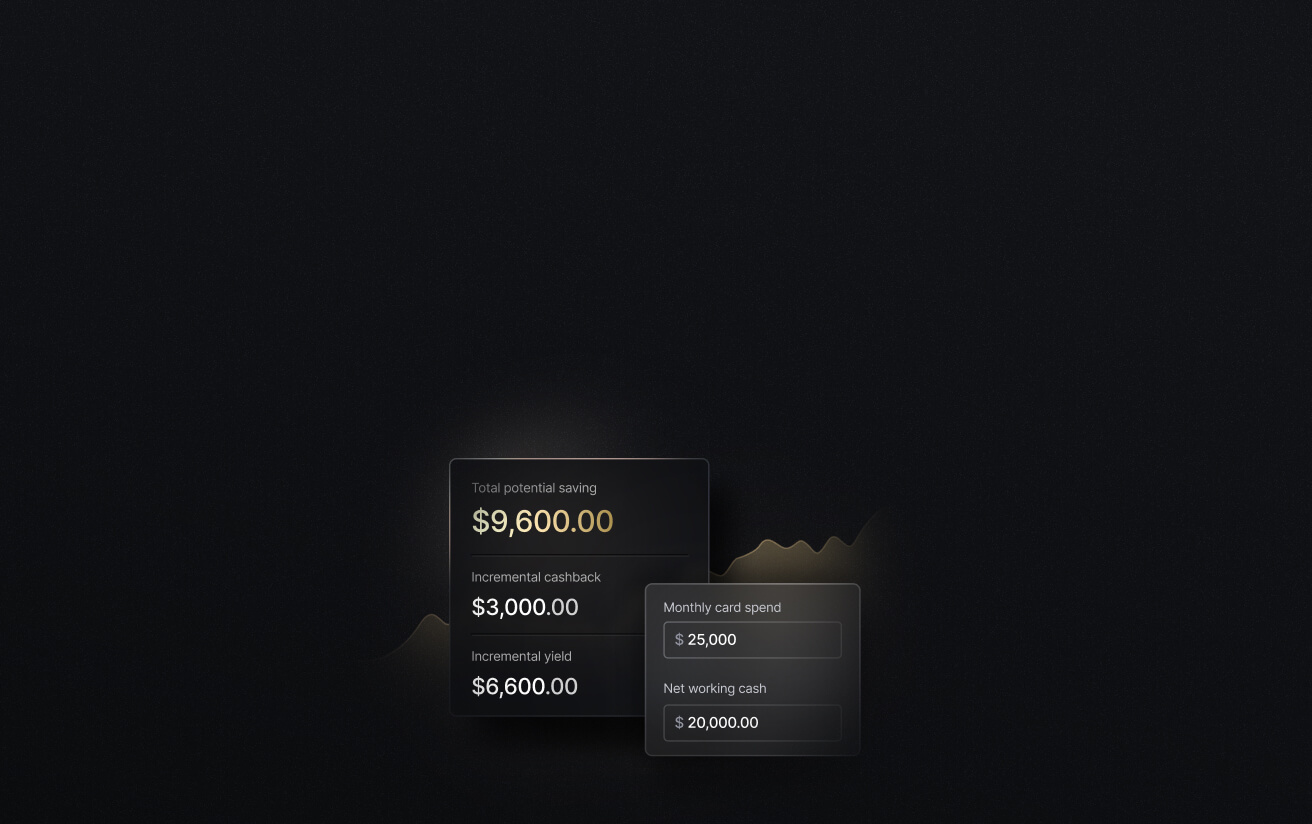
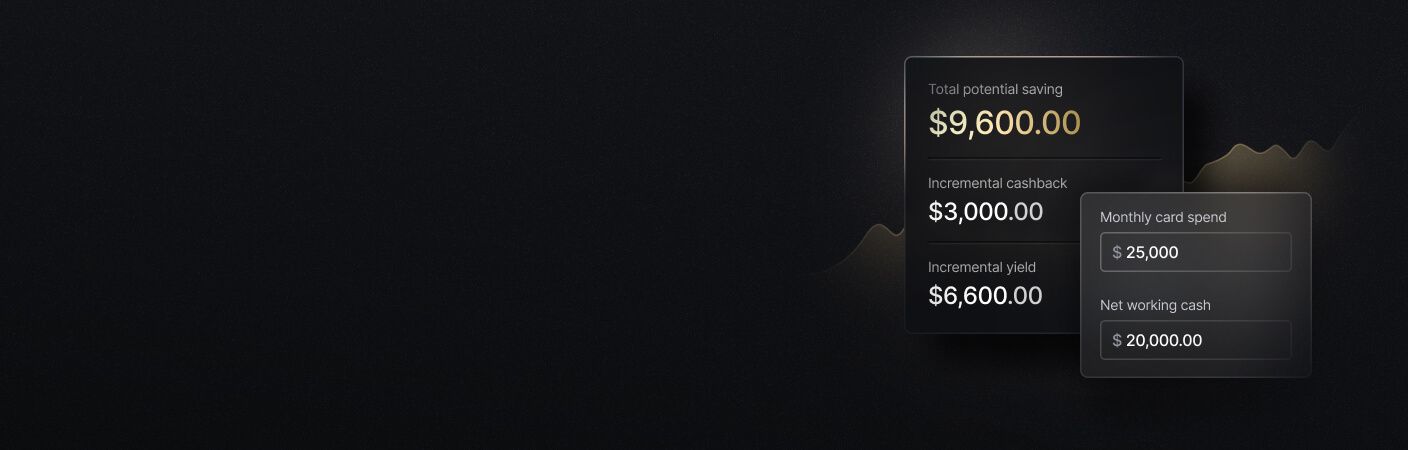
See the ROI behind your spend
Use this calculator to understand impact, then manage and track it all in Slash.
And then there's Slash
Every platform in this conversation has to make the math work, Slash included. Ours just has a less to pay for. Slash punches above our weight: a 90-person team against fintechs with 1,000+ employees. Every way we save on overhead gets passed to our customers. Here’s how we stack up:
Rewards: The Slash Visa Platinum card earns up to 2% cashback on eligible spend, uncapped, with no categories, blackout dates or redemption tables.
Pricing: Slash Pro is $25 a month for your whole team, whether that team is two people or 200. The same 20-person team paying $300 a month on Ramp Plus, or $240 on Brex Premium, pays $25 on Slash. Hiring shouldn't come with a surcharge.
Eligibility: There's no minimum balance to open a Slash account and no minimum to start earning yield. The Slash Global Account is available to businesses in 130+ countries with their local registration.
Treasury: Slash charges 0.60% on Treasury balances under $500,000 and nothing at all above that.
Up to 2% cashback with Slash Pro, treasury with no minimum, and one price for your whole team. Get started below.
Apply in less than 10 minutes today
Join the 10,000+ businesses already using Slash.


