

Currency Volatility: What It Is and How It Works
Through most global payment rails, financial transfers can take several business days to complete. Not only can this delay frustrate the recipient, but it can actually lead to the cost of a transaction changing between when it's approved and when it settles. A supplier invoice denominated in euros might be budgeted at one rate and paid at another, and a contract priced in US dollars for a customer paying in Japanese yen can produce a different margin in each quarter. This variance depends entirely on where currency exchange rates happen to land.
Currency volatility is often discussed in the context of trading and financial markets. But for businesses managing international suppliers or cross-border revenue, it's an issue that affects cash flow, budgeting, and vendor relationships. This article covers what currency volatility is, what causes it, how it's measured, how it affects businesses, and what practical management approaches look like. We’ll also take a look at Slash, a neobank that can help businesses centralize cross-border payment operations and maintain stronger financial oversight.¹ Slash also comes with native stablecoin support, which may help reduce some of the delays associated with traditional international payment methods.⁴
The standard in finance
Slash goes above with better controls, better rewards, and better support for your business.


What Is Currency Volatility?
Currency volatility refers to the degree to which exchange rates between two currencies fluctuate over a given period. When a currency pair like USD/EUR moves unpredictably or experiences large swings in a short time, that pair is considered volatile. When rates move in a narrow range with relatively predictable patterns, their volatility is low.
The terms currency volatility and forex volatility are often used interchangeably. The distinction depends on the context; forex volatility is more commonly associated with trading and market analysis, while currency volatility is the term more typically used in operational and international business discussions. Either way, you’re describing the unpredictable movement of exchange rates between currency pairs.
High volatility means the direction and magnitude of movement are less predictable, but it doesn't mean that a currency is weakening or strengthening in one particular direction. A highly volatile currency might rise and fall sharply in alternating periods, while a low-volatility currency might trend steadily in one direction thanks to inflation or stay still in one spot. For businesses looking to make a transfer, it’s okay if an exchange rate is moving as long as price changes are predictable and possible to plan around.
What Causes Currency Volatility?
Exchange rates are set continuously by the supply and demand that naturally occurs across our geopolitical market. Multiple factors drive that supply and demand, including:
Interest Rates and Monetary Policy
Bank interest rates are the percentage charged by a lender for borrowing money or the percentage paid by a bank to you for depositing money. When a central bank raises interest rates, it typically makes that country's currency more attractive to foreign investors seeking higher returns on bonds and savings. Demand for the currency increases and its value is pushed up. However, when a central bank cuts rates, the reverse tends to occur. Whether value moves up or down, unexpected interest rate changes are a common cause of sharp, short-term currency movements.
Inflation and Economic Conditions
When a country experiences high inflation, the purchasing power of its currency suffers relative to countries with lower inflation. This tends to put downward pressure on its exchange rate over time. More broadly, the overall health of an economy affects how attractive its currency is to foreign investors and trading partners. Factors that indicate economic health can include GDP growth, employment levels, trade balances, and consumer confidence.
Countries that import significantly more than they export may see persistent depreciation pressure on their currencies, because they must continuously sell their own currency to buy foreign goods. Countries that export more than they import usually have a stronger currency and won’t face this pressure.
Political and Geopolitical Events
Political instability, elections with uncertain outcomes, policy shifts, sanctions, or conflicts can all lead to volatile markets. An election result that markets didn't anticipate, or a geopolitical event that raises risk perception in a region, can produce significant currency moves in hours. Sometimes the anticipation of an event itself causes market conditions to change, even if that event never comes to fruition.
Market Speculation and Capital Flows
The forex market processes over $7 trillion in daily transactions, the vast majority of which are speculative rather than tied to underlying trade or investment. Institutions like hedge funds, asset managers, and banks trading currencies for profit can amplify moves that begin with fundamental economic factors. When everyone watching a currency pair expects a certain outcome, an unexpected event can trigger a rapid jump in the opposite direction. This can produce sharp, short-term volatility disproportionate to the actual economic change.
Slash business banking
Works with cards, crypto, plus cards, crypto, accounting, and more.
How Currency Volatility Affects Businesses
While both traders and businesses are impacted by high volatility in the forex market, only one of the two has to balance fluctuation against their bottom line. Here’s how volatility can affect companies:
Supplier and Purchasing Costs
For businesses that pay suppliers in foreign currencies, exchange rate movements directly affect the cost of transfers. A US manufacturer sourcing components from Germany pays in euros. If the dollar weakens against the euro between when the contract is signed and when the invoice is due, the effective cost in dollars increases, even if the euro price was unchanged. For businesses with tight margins or long contract terms, a 5% currency move can have a meaningful impact on liquidity.
This exposure often hurts budgeting processes that plan for a stable exchange rate. For example, a supply chain model might be built on the assumption that the GBP/JPY relationship is 1:213. If that rate moves to 1:200 or 1:230 over a fiscal year, a company’s budget can gradually take a big hit.
Revenue and Pricing Pressure
Businesses that earn revenue in foreign currencies face the opposite dynamic. A UK software company earning revenue in US dollars sees its sterling-denominated revenue fluctuate with the GBP/USD rate. When sterling strengthens, the same dollar revenue translates to less sterling. It’s effectively a revenue decrease with no change in the underlying business. The company may also face pricing pressure in markets where its product has become more expensive in local currency terms, creating a competitive disadvantage that has nothing to do with the product itself.
Companies with customers across multiple currency regions have to manage pricing that remains competitive in each market while maintaining target margins in the business's base currency. Ultimately, this requires understanding and accounting for FX exposure at the product and market level. The best approach is to manage this proactively with pricing strategies that account for currency variability, though that’s easier said than done.
Long-Term Operating Exposure
The most complex form of currency exposure for businesses may be operating exposure, which is the long-term effect of exchange rate changes on the competitive position and cash flow of the business. A company that manufactures in one currency and sells primarily in another carries an FX exposure that affects every aspect of its economics. If the manufacturing currency strengthens significantly and permanently, the business ends up facing a cost disadvantage relative to competitors who manufacture in weaker-currency markets. This kind of exposure can be difficult to hedge against, possibly requiring strategic responses like diversifying manufacturing locations or repricing products.
How Currency Volatility Is Measured and Monitored
Volatility is measured by quantifying how much an exchange rate fluctuates over a defined time period. The most common statistical measure is standard deviation, which is a calculation of how much individual exchange rate observations deviate from the average over a set window. A high standard deviation indicates large, irregular swings, while a low standard deviation indicates movement in a tighter, more predictable range.
Historical volatility (sometimes called realized volatility) measures how much a currency pair has actually moved over a past period, typically under 90 days. Financial institutions and treasury teams use historical volatility to benchmark whether current conditions represent elevated or subdued risk relative to a currency pair's normal behavior.
Implied volatility, which is derived from options pricing on currency pairs, represents what the market expects future volatility to be. When options on a currency pair are expensive relative to historical norms, it signals that market participants are paying up for protection against large moves. This is probably a sign of elevated risk coming down the pipe.
Currency pairs vary significantly in their typical volatility profiles. Major pairs like EUR/USD and USD/JPY tend to be more liquid and not too volatile. Pairs involving emerging market currencies like the Turkish lira or South African rand tend to be more susceptible to sharp moves driven by domestic economic or political events.
How Businesses Can Manage Currency Volatility
While there isn’t a way to fully eliminate currency volatility, businesses can manage their exposure to it in ways that improve the predictability of costs, revenue, and cash flow. Effective strategies include:
Hedging and Rate Protection Strategies
Hedging involves using financial instruments or contractual arrangements to reduce the impact of exchange rate movements. Here are three techniques businesses can take advantage of:
- Forward contracts lock in an exchange rate for a future transaction at a defined date. A business expecting to pay a supplier invoice in euros in 90 days can buy a forward contract today at the current 90-day forward rate, eliminating the uncertainty of what the rate will be at settlement. The trade-off is that if the rate moves favorably, the business doesn't benefit from the improvement.
- Options give the holder the right, but not the obligation, to exchange currency at a specified rate before a specified date. They cost more than forward contracts, but preserve the ability to benefit from favorable rate movements while limiting adverse effects.
- Natural hedges are strategies rather than tools, and can vary based on your situation. A good tip is to structure costs and revenues in the same currency wherever possible, so that FX movements affect both sides of the equation simultaneously. A business that earns significant euro revenue and also has euro-denominated costs has a natural hedge that can reduce uncertainty.
Stablecoin Utilization
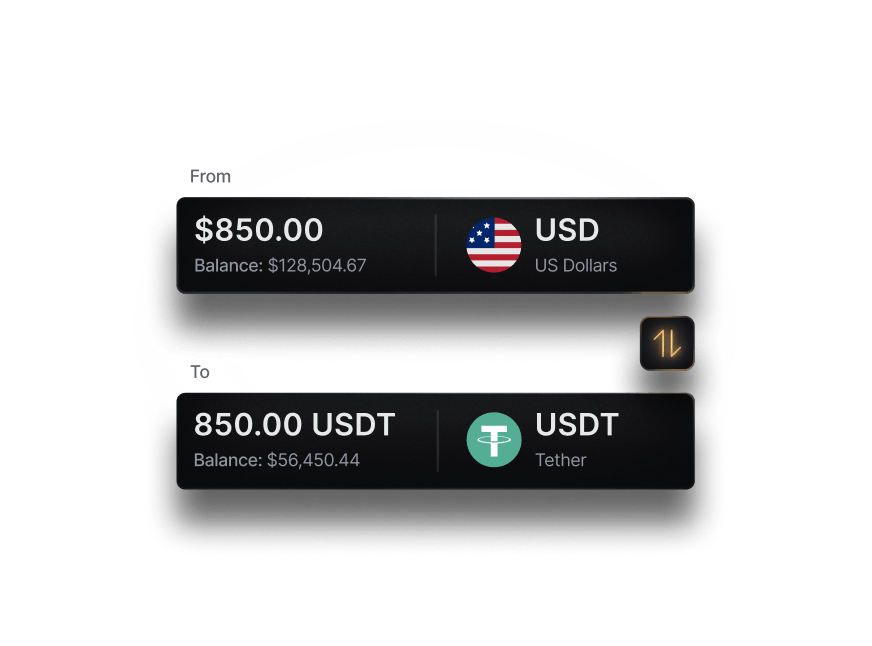
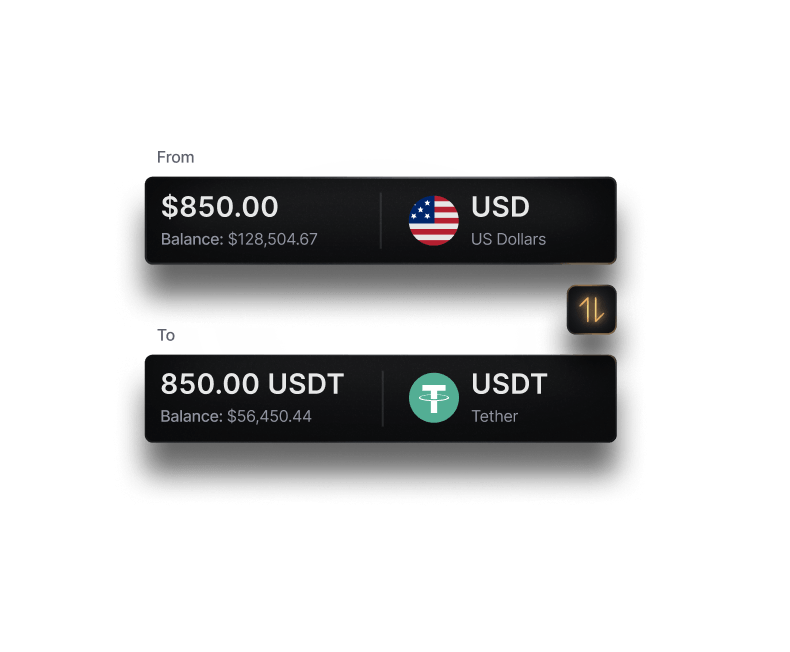
When sending payments through traditional rails like international wire, up to five business days can pass between initiation and settlement. That length of time allows for quite a lot of market volatility. Stablecoins are an alternative payment method that works separately from volatile markets and settles in minutes, meaning there’s almost no risk of value fluctuations.
Most stablecoins, including USDC and USDT, are pegged 1:1 to the US dollar. This means they come with the reliability of fiat while enjoying the benefits of decentralized governance. Business banking platforms like Slash offer built-in stablecoin on/off ramps, allowing users to withdraw their funds with conversion fees less than 1% (minimum $0.40).
Payment Planning and Exposure Management
Before implementing hedging strategies, businesses benefit from understanding where their currency exposure actually exists. This requires mapping which transactions, contracts, and cash flows are denominated in which currencies, and when the economic impact of any rate movement will be felt. Without this in mind, hedging decisions may be made without clear visibility into what's actually being hedged.
It’s always smart to keep payment timing in mind. For instance, if a business has visibility into upcoming foreign-currency payment obligations, it can time conversions to favorable rate windows rather than converting at whatever rate is available the moment a bill is due. As long as you know what payments are coming, when, and in which currencies, this approach can be very helpful.
Maintaining visibility into your business’s currency exposure is key. Determine which suppliers are invoiced in which currencies, which customers pay in which currencies, and what the net exposure is in each period. Without that visibility, hedging and payment timing decisions might be made without the right context.
Manage International Payments with Slash
While businesses can't control price changes in the forex market, they can improve how they manage, time, and track the international payment flows that are affected by those movements. The problems that currency volatility creates are most manageable when international payment workflows are centralized rather than scattered across multiple banking relationships, FX providers, and accounting tools. This is what Slash looks to solve.
Slash is a business banking platform that helps businesses manage international payments in the same spot as the rest of their operations. On one dashboard, users can access AP automation tools, corporate cards, treasury accounts, detailed analytics, and much more.⁶
Our platform supports both traditional payment rails and stablecoin transfers, giving businesses options for international transactions where speed and conversion costs matter. With global payment capabilities working alongside business banking and integrated accounting solutions, you won’t have to struggle with the fragmentation that makes cross-border payment visibility difficult to maintain.
Other helpful Slash features include:
- Accounting & ERP integrations: Sync transaction data with QuickBooks Online, Xero, or Sage Intacct to streamline reconciliation, reporting, and month-end close.
- AI-powered finance: Our platform comes with Twin, a built-in AI agent that can be prompted with natural language to complete complex tasks. Users can ask it to create cards, pay invoices, review your cash flow, and much more.
- Slash Visa® Platinum Card: The Slash Card allows you to set customizable spending controls and issue unlimited virtual cards for handling team expenses, vendor payments, subscriptions, and more. Users can also earn up to 2% cash back on business purchases.
- Working capital financing: Access short-term financing with flexible 30-, 60-, or 90-day repayment terms to help bridge liquidity gaps.⁵
- Global USD: The Slash Global USD Account is designed as an alternative for foreign founders who want access to USD without forming a US entity.³ Balances are held in USDC on Base, a stablecoin designed to maintain a one-to-one value with the U.S. dollar.
Slash isn't a forex platform or a hedging provider. It's a neobank that keeps international payment workflows organized and visible enough to make informed decisions about timing, routing, and currency management. Contact us today to see how Slash supports international payment operations for growing businesses.
Apply in less than 10 minutes today
Join the 10,000+ businesses already using Slash.
Frequently Asked Questions
Why are emerging market currencies often more volatile?
Emerging currencies can experience higher market volatility because they are highly susceptible to global economic shocks, sudden capital outflows, and weaker domestic institutions. Because their developing economies rely heavily on external factors, their currency values experience wider, more unpredictable swings than developed market currencies.
Discover How Multi-Currency Business Accounts Work: Benefits and Top Alternatives

Does currency volatility affect domestic businesses?
High volatility can affect domestic businesses by causing price changes to occur among foreign vendors and suppliers. Even if a business works purely within their own country's borders, market volatility can affect its foreign competition and make imports cheaper for local consumers.
International Business Payments: Methods, Fees, and Best Options
What is a stop-loss?
A stop-loss is an automated risk-management tool used in trading and investing. It's a trading strategy that instructs your broker to automatically sell a security when its price drops to a specific predetermined level. In the context of volatile forex markets, traders can use stop-losses to protect their liquidity against uncertainty surrounding market sentiments.
What's the Volatility Index (VIX)?
The Volatility Index (VIX) is a real-time market indicator created by the Chicago Board Options Exchange (CBOE) that measures expected market volatility for the next 30 days. Traders can keep an eye on the Volatility Index to gauge market sentiment and price changes.
In the context of forex markets, what's standard deviation?
Standard deviation is a statistical measurement of market volatility. It calculates how much an asset's price fluctuates from its average over a given period. A high standard deviation means wild price swings and high risk, while a low standard deviation points to a calm, narrow trading range.
Read more from us


