

How Long Does a SWIFT Transfer Take? Speed, Delays, and Factors
When businesses send or receive money internationally, the first question is almost always the same: "How long am I going to wait for this to settle?". Whether you’re receiving a financial transfer or sending one, timing can have a real effect on cash flow and business decisions. While companies can’t exactly speed these payments up, they can predict when the funds are going to settle and plan around it. To do this, they should know how SWIFT transfers work.
SWIFT transfers are one of the most common methods for cross-border payments, used by banks and businesses in more than 200 countries. However, SWIFT transfers aren’t usually “swift”, and their timing isn’t always predictable. SWIFT transfers move through a network of institutions, each with its own processing windows, compliance requirements, and cut-off times. As a result, you can end up with a range of possible timelines instead of a scheduled due date.
This guide breaks down typical SWIFT transfer timelines, explains what causes delays, and offers practical ways businesses can plan around them. Companies looking for a wider array of cross-border payment options should consider Slash, a business banking platform that offers SWIFT transfers to 180+ countries and global ACH capabilities.¹ We’ll also examine Slash’s cryptocurrency payment rails and how stablecoins can help businesses bypass the SWIFT waiting period entirely.⁴
The standard in finance
Slash goes above with better controls, better rewards, and better support for your business.

SWIFT Transfer Meaning: Key Concepts and How It Works
A SWIFT (Society for Worldwide Interbank Financial Telecommunication) transfer is a type of international transfer that moves money between banks across countries using the SWIFT network. Established in 1973, SWIFT is a global infrastructure that allows financial institutions to exchange payment instructions securely and in a standardized format.
Unlike ACH or RTP/FedNow, SWIFT itself is not a payment rail. It’s an interbank messaging network that sends payment messages between banks using unique SWIFT codes, telling banks how to process payments between institutions. The actual movement of money happens separately through a system of mirror accounts maintained between banks.
When initiating a SWIFT payment, your bank sends a SWIFT message to the recipient's bank that contains details about the sender, the amount being transferred, and the destination’s account number. Banks that participate in the SWIFT network carry Bank Identifier Codes (BICs) that act as unique addresses. The steps to a SWIFT transfer are as follows:
- Payment initiation: The sender instructs their bank to transfer funds to a recipient at a foreign bank. They may need the recipient’s name, bank name, address, international bank account number (IBAN), and SWIFT code, as well as details about the transfer amount. Slash makes this process easier by saving and organizing your recipients’ banking information, allowing you to “set and forget” their account details for future transactions.
- SWIFT message sent: The sending bank generates a SWIFT payment message that travels across the network towards the receiving bank.
- Routing through banks: If the sending and receiving banks have a direct relationship, the message simply travels from point A to point B. If not, it passes through one or more intermediary banks that bridge the gap. The SWIFT network can involve up to six member banks in a single money transfer.
- Settlement between banks: Banks hold “nostro” and “vostro” accounts, which are correspondent accounts that facilitate cross-border transactions. Settlement happens between these two accounts.
- Funds credited to the recipient: Once the receiving bank processes the message and the settlement clears in the recipient's vostro account, the funds are credited.
SWIFT Processing: What Affects How Fast Your Transfer Arrives
SWIFT transfers can take anywhere from 1-5 business days, which is quite a wide range. The timing spread exists because several variables can influence how quickly the transfer moves through the payment chain, including:
Number of Intermediary Banks
When the sending and receiving banks have a direct relationship, funds move on a single path. When they don’t, the payment is routed through one or more intermediary banks. Each of these banks adds its own processing time; a transfer that involves several intermediaries may take four or five days, while a direct route will often only take one or two.
Over 70% of SWIFT transfers involve at least one intermediary bank, per data collected in 2023. Whether your transfer travels through intermediaries may depend on what you’re sending and where it's traveling to. Major banks that exchange popular currencies like euros and USD often support direct connections. If you’re making a payment between smaller regional banks with a less common currency, you may expect at least a couple intermediary banks.
Compliance and Security Checks
SWIFT payments go through a rigorous set of compliance and security checks, often involving anti-money laundering (AML) regulations, international OFAC sanctions, and fraud detection. This process can take extra time with high-value transfers or payments to certain regions with extra regulations.
Before transactions reach this step, they’re usually verified by the bank’s own system. This is often where errors are detected. If you misspelled the recipient’s name or left a number out of their IBAN, your bank may give you a chance to correct the error by sending you a query for clarification.
Time Zones and Banking Hours
SWIFT transfers can only be processed during banking hours, which means time zone differences can cause their own sorts of delays. Imagine this: you initiate a transfer from New York on June 21st at 9 AM ET to a bank in Singapore that’s 12 hours ahead. Even without intermediary banks, that payment may not settle in the recipient’s account until June 23rd or 24th, as New York’s working hours are Singapore’s night hours. It’s important to keep time zone misalignment in mind and consider the recipient’s banking hours as well as your own.
Currency Conversion
Many international transfers involve an extra processing step for currency conversion. If a transfer is initiated from the United States in USD and sent to Tokyo, it will settle as yen. The exchange rate between the two will be applied, and an additional intermediary bank may be called upon depending on which currencies are involved.
Currency conversion also introduces foreign exchange (FX) risk for transfers that take multiple days to settle, which can be significant when dealing with large sums of money. Exchange rates can fluctuate during the several-day gap between initiation and settlement, meaning the recipient can end up with a slightly different total. While it’s nearly impossible to eliminate FX risk, Slash makes the hidden costs of SWIFT payments more transparent. When you initiate a cross-border transaction, our platform shows the exchange rate, converted amount, and corresponding fees before you hit confirm.
Weekends and Holidays
Banks don’t process SWIFT transfers on weekends or public holidays. A transfer sent on Friday afternoon may not actually begin moving until Monday morning, which means two days have effectively been added to the total travel time. National holidays can also affect payment timing in both the sender’s and recipient’s country. When planning around a high-value B2B transfer, it’s wise to double-check your business partner’s local calendar, as they may be in the middle of a holiday you weren’t aware of.
Bank Processing Speed
One of the hardest factors to plan for is the speed at which banks themselves process SWIFT transfers. The size of the institutions, their intermediary connections, and their processing method (batch vs individual) can all affect transfer timing. These differences won’t often be drastic, but a slower processing time can end up adding an extra day to the journey. While you can’t predict a bank’s speed overall, you may find that larger, more reliable institutions pass payments along more quickly than smaller banks can.
Slash business banking
Works with cards, crypto, plus cards, crypto, accounting, and more.
SWIFT Transfer vs. Other Payment Methods
While SWIFT is global, reliable, and deeply embedded in the international banking system, it isn’t always the fastest or most cost-efficient option. Here’s how SWIFT compares to the other methods most commonly used for cross-border and domestic transactions:
International Money Order
International money orders are a bit different than SWIFT transfers, as they’re often used in private person-to-person transactions and travel through services like Western Union. These money orders are prepaid paper payments used to send money across borders. It’s a more secure option than sending cash, and is often initiated through brick-and-mortar locations. Similarly to SWIFT, international money orders typically cost $35-50 USD and can take 1-5 business days.
Global ACH Payments
Instead of connecting individual bank accounts, global ACH payments send funds to the recipient country’s equivalent clearing network. These transfers are processed in batches rather than individually, which means the network can handle large volumes of requests quickly and efficiently. Global ACH payments can take anywhere from 1-5 business days to complete, and typically come with fees of around $5, depending on the bank.
Cryptocurrency
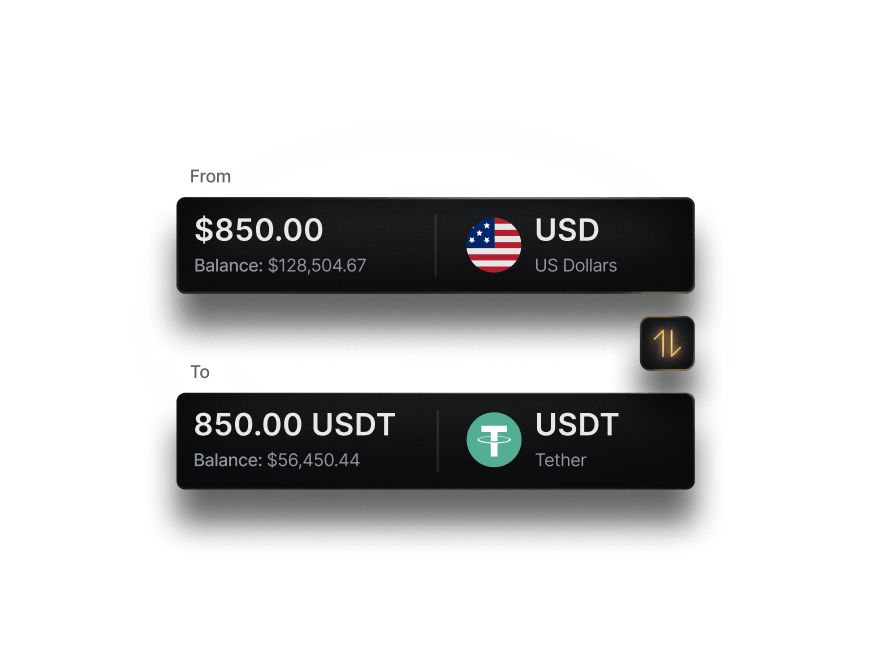
Some companies are beginning to add cryptocurrency transfers to their stack of payment methods, as crypto offers high speeds and low costs that traditional methods may have a hard time competing with. International crypto payments can settle in minutes and cost less than $1.
B2B crypto payments often utilize stablecoins, which are pegged 1:1 to fiat currency and eliminate the volatility associated with digital assets like Bitcoin. Converting crypto into your local currency isn’t always easy, which is why Slash offers built-in crypto on/off ramps that allow you to make the switch with the click of a button. Slash enables users to send popular stablecoins like USDC and USDT across nine different blockchain networks from the same platform they use to manage their banking and corporate cards.
Here’s a handy breakdown of the international payment options you may decide between:
How to Speed Up a SWIFT Payment
While there’s no magic spell that a business can cast to shorten SWIFT processing times, there are some steps that can be taken to reduce delays:
- Double-check recipient details: A mistyped account number, SWIFT code, or recipient name usually causes payments to be delayed or returned. When a transfer is initiated with incorrect information, it may be kicked back to the sender or fail altogether, which adds days to the timeline and can incur extra fees. It’s smart to verify each field before sending a payment.
- Send before your bank’s cut-off time: Most banks establish a daily cut-off time that determines which business day a transfer begins processing. If your bank’s time is 3 PM, a transfer initiated at 3:10 won’t begin until the following day. Institutions can come with a variety of cut-off times, so be sure to learn yours before sending a time-sensitive payment in the afternoon.
- Avoid initiating transfers before weekends or holidays: Similarly, an international transfer sent on a Friday afternoon before a Monday holiday can sit unprocessed for three calendar days before it officially begins traveling. It’s smart to make morning transfers a habit, as they'll consistently begin processing the same day you initiate them.
- Use major currencies and banks when possible: Widely traded currencies like USD and GBP flow through more established correspondent banking relationships and are often converted with less friction. Additionally, major financial institutions may be able to connect directly without having to rely on intermediary banks. Your recipients and their payment terms may not allow you too much wiggle room, but if you do get to choose, mainstream banks and currencies tend to offer faster speeds.
Bring Your International Payments into One System with Slash
While the SWIFT transfer is one of the most popular ways to send money across borders, it’s far from the only option. Slash offers a wide variety of payment rails with a deeper level of transparency and flexibility than you’ll find with traditional banks.
Slash is a neobank that gives businesses of all sizes access to:
- SWIFT transfers
- ACH transfers (standard, same-day, and global)
- Real-time payments (FedNow and RTP)
- Domestic wire transfers
- Cryptocurrency transactions
- Corporate card payments
You won’t be stuck with one international payment option, and you won’t have to juggle fractured financial platforms to accommodate multiple. Our platform allows businesses to select the payment rail of their choice based on transaction characteristics rather than system limitations. Finance teams can use Slash to monitor payment statuses and track settlement times on one integrated dashboard, resulting in an organized cash flow, clear audit trails, and easy reconciliation.
Businesses looking for extra payment flexibility may also be interested in:
- The Slash Visa® Platinum Card: Slash users get a corporate charge card that earns up to 2% cash back on company spend, with configurable spending rules, granular controls, and unlimited virtual cards.
- Accounting integrations: Slash integrates with QuickBooks Online, Xero, and Sage Intacct, helping finance teams work faster and with greater accuracy. Streamline your reconciliation with automated workflows for expense reporting, tax preparation, and more using financial data from your Slash account.
- Connected AI agents: Users can now automate more financial processes by connecting AI agents directly to their business finances. Create cards, send payments, manage invoices, and query your transaction data, all through Claude, ChatGPT, and other MCP-compatible agents.
- High-yield treasury accounts: Earn up to 3.82% annualized yield on idle funds through money market investments backed by BlackRock and Morgan Stanley.⁶
Worried your SWIFT transfer might take too long? Use a platform that lets you pick from all the other options. Try Slash today.
Apply in less than 10 minutes today
Join the 10,000+ businesses already using Slash.
Frequently asked questions
Are there limits on how much you can send via SWIFT?
While SWIFT transfers themselves don't have a limit, banks often impose their own restrictions on the amount you can send to a recipient in a day via international wire transfer. These banking system limits can be as low as $5,000 and as high as $500,000.
Can a SWIFT payment be recalled after it's sent?
Thanks to the Dodd-Frank Act of 2010, the SWIFT network allows free cancellations after 30 minutes. International transfers may also be recalled in situations of fraud, though this can vary on a case-by-case basis.
Is there a difference between an international wire transfer and a SWIFT transfer?
"International wire transfer" is a broader term for any international transfer that travels to a recipient across a wire-based network. While SWIFT is technically just a messaging system, it’s the main method people use to send wire transfers across borders, so some people conflate the two terms.
SWIFT Cross-Border Payments: How They Work and Key Uses

What is an international bank account number (IBAN)?
An international bank account number is a standardized, unique code of up to 34 alphanumeric characters used to identify individual bank accounts across borders, primarily in Europe, the Middle East, and the Caribbean. Almost 90 countries use IBANs to support interbank communication, but the rest of the world's countries do not use this code.
What is an IBAN Number, and How Do You Find It?

Do real-time international money transfers exist?
Real-time international transfers don't currently exist, but you can send money internationally near-instantly with the help of crypto transfers.
Read more from us


