

What Is a Disbursement? Everything Business Owners Need to Know
If you’re a business owner trying to figure out what a “disbursement” is, you might be surprised to learn that you make them all the time. Each vendor you pay, dividend you issue, paycheck you send, and repayment you make on a loan is a disbursement made to another party.
It might seem pretty simple, but there’s often confusion when distinguishing between disbursements and payments. Even finance professionals that know how reimbursements work might call them all payments as a blanket term. When it comes to accounting, however, you’ll want to know the difference between the two in order to treat them correctly on your balance sheet and follow the right tax rules at the end of the year.
In this guide, we’ll explain what disbursements are, the steps involved in processing them, how to account for them, and some best practices for managing them within your business. One of the key parts of mastering disbursements is making sure you can use as many methods as possible to actually send money from one place to the next. This is where Slash can help. Slash is a financial platform that supports same-day ACH, domestic and international wire, RTP/FedNow, virtual cards, and stablecoins, meaning you can make disbursements through just about any rail you’d like.¹, ⁴
What is a Disbursement?
A disbursement is any release of money from a dedicated fund or account to a designated recipient. The transaction is officially recorded as a debit by the payer and as a credit by the recipient, therefore creating a clear documented trail. Disbursements typically flow through a company’s accounts payable department, whether they’re vendor invoices, payroll, loan repayments, or operating expenses.
You’ll also hear this team used to refer to certain types of fund transfers in some specific industries. For example, when a bank funds a loan, a university financial aid office sends scholarship money to a student's account, or a law firm pays court costs on behalf of a client, they’re all primarily known as disbursements. No matter the context, it always involves money released from a defined fund in order to be given to another party.
Difference Between a Disbursement, a Payment, and a Reimbursement
Understanding the difference between disbursements, payments, and reimbursements can be difficult. After all, they all include money traveling from one person to another. Let’s take a look at the technicalities that separate the three of them:
- A payment is any transfer of money to cover costs a business incurred for its own goods or services. When you buy office supplies and tap your corporate card at the register, that's a payment that comes from a checking or expense account. You’re also making a payment when you wire money overseas to a foreign contractor. All disbursements are payments, but not all payments are disbursements. Payments that aren’t disbursements include direct deposits from one business to another from a checking account rather than a dedicated fund. These usually come in the form of simple purchases or payments connected to a sticker price.
- A disbursement is a subset of payments with a specific characteristic: funds released from a specific account or on behalf of another party. A wire payment to a vendor is a disbursement, but an office chair purchase isn’t. On the accounting side, it’s important to note that a disbursement isn't always an expense. Repaying a loan is a payment that decreases a liability, so it doesn't appear as an expense in the books.
- Areimbursement is a much narrower term than the other two. Any time an employee pays out of pocket for a business expense and the company pays them back, that return payment is a reimbursement. In short, it’s the act of paying someone or something back for out-of-pocket expenses they covered.
Disbursement Examples
Here are some examples of outflows of money that are considered disbursements, not exclusively payments or reimbursements:
- Payroll and employee wages
- Rent for office or warehouse space
- Payments to vendors and suppliers for goods or services
- Utility bills (electricity, water, internet)
- Loan repayments to lenders
- Tax payments to federal, state, or local authorities
- Cash dividends distributed to shareholders
- Legal disbursements paid by attorneys on behalf of clients
There’s some wiggle room with a few of these, depending on the context. If you buy a simple item from a supplier and pay from your checking, it can technically be a payment and not a disbursement. Some small businesses also pay their utility bills from a generic account, especially if they’re low-cost. Here’s an easier way to think about it that doesn’t involve a dictionary definition: if your accounts payable department doesn’t handle it, it’s likely not a disbursement.
The Disbursement Process
Since disbursements involve more than tapping your card or exchanging cash, there's a structured process that finance teams should get to know. These steps run from the moment a liability is identified to when it's settled and recorded. Overall, a standard disbursement workflow moves through the following stages:
- Invoice or payment request received: A vendor sends an invoice, payroll is processed, or an employee submits an expense report.
- Verification: The finance team confirms the invoice is accurate, matches any purchase order, and connects it to a known obligation. At this step, you can catch duplicate invoices and unauthorized charges.
- Approval: Depending on the amount and category, the disbursement routes to the appropriate approver. Larger disbursements may require a few different approvers to give the green light, while routine ones can often pass through one person.
- Payment scheduling: Once approved, the disbursement is scheduled according to payment terms and cash flow considerations. Sometimes, you might unlock a discount if you pay early, such as 2/10 net 30 (a 2% discount if an invoice is paid within 10 days).
- Payment execution: The disbursement is sent via whichever rail the payer and payee agree upon. If they both use a platform like Slash, they have a wide variety of payment methods to choose from, including same-day ACH and crypto.
- Recording: Finally, the transaction is posted to the general ledger, with the account on the payer’s side debited and the account on the payee’s side credited.
Common Methods of Disbursement
A large part of managing disbursements is choosing the method through which you’ll send your money. Since some scenarios call for certain rails, it’s wise to have access to a range of different methods so you can be ready for whatever your recipient requests. Here are some of the most common disbursement methods:
- Checks create a paper trail and are widely accepted, but processing them can be pretty slow. While they’re reliable for some small businesses, you’ll probably need to leave them behind as your business begins to scale. There’s also the concern of fraud: according to the Association for Financial Professionals, 58% of businesses reported that their checks were subject to fraud in 2025.
- ACH transfers are faster, carry lower fraud risk, and can be automated. ACH is a good fit for recurring payments like payroll and vendor disbursements, since processing typically takes one to two business days.
- Wire transfers work both domestically and internationally and are an overall reliable, traditional option. However, their fees are higher than the ones ACH charges, and wires are generally irreversible once sent.
While some payment rails can be better than others on a case-by-case basis, one thing is almost always true: automation can be a big help. With electronic disbursements, the steps of matching invoices, routing approvals, scheduling payments, and syncing to the general ledger no longer have to be done manually. When you use Slash to automate these steps, you’ll also get an easy-to-follow audit trail along the way.
How to Account for Disbursements
Let’s talk accounting. In order to account for disbursements accurately, you should understand where these transactions live in your books and what records they generate.
In double-entry accounting, every disbursement creates at least two entries. When money goes out, the account is debited to reflect the reduction. The offsetting credit goes to whichever account the disbursement belongs to. It could be an expense account for a machinery repair, an accounts payable account to clear an outstanding vendor invoice, or a liability account when a loan payment is made. In any case, the debits and credits need to balance.
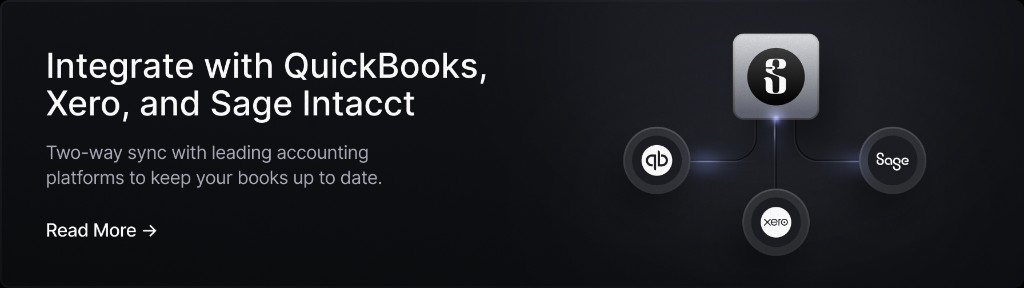
The primary record for disbursements is the cash disbursement journal. This is an itemized log of every cash payment the business makes, including the date, payee, amount, rail, and account coding for each transaction. Accounting software can maintain this journal automatically and post it to the general ledger monthly. With connections to QuickBooks Online, Xero, NetSuite, and Sage Intacct, Slash users can connect their banking to their accounting solutions in order to keep their cash disbursement journal updated with live data.
Disbursements also directly affect your cash flow statement. To figure out whether your business is gaining or losing money in a certain period, you have to measure the timing of outflows against when revenue or liabilities were recorded. If disbursements are going out at a quicker pace than inflows are arriving, you might be profitable on paper while struggling with low liquidity. Getting a hang of all of this is important for cash flow management.
Disbursement Management Best Practices
Clean financial management is nearly impossible if you don’t have control over your disbursements. After all, they likely make up a good portion of your daily expenditures. Here are a few tips for managing your disbursements responsibly:
Put Policies in Place
76% of businesses experienced attempted or actual payment fraud in 2025. A good disbursement policy can help fight those attempts. These policies are designed to lay out the rules for how disbursements get made, including required documentation, approved expense categories, payment terms for different vendors, and the timeline for recording each payment. Without a written policy, you may get inconsistencies that leave your payment processes vulnerable to mistakes and fraud.
Set Up Controls and Approvals
After establishing a policy, you’ll want to segregate duties. The person who authorizes a payment shouldn’t be the same person who executes it, since mistakes could be made without a second set of eyes. Plus, no matter how much you trust your employees, it’s a fraud risk.
It’s wise to designate your approval workflows by amount and category. Routine disbursements under an everyday threshold can be approved by a manager, while larger payments may route to finance leaders or require dual sign-off. Some accounting solutions can automate these workflows alongside three-way matching, where every vendor invoice is checked against a purchase order and a delivery receipt before payment. These kinds of controls can vastly improve security.
Automate Payments
If you’re still trying to handle your company’s disbursements manually, you’re almost guaranteed to make mistakes here and there. Whether they come in the form of typos in a spreadsheet, duplicate invoices, or missed payments altogether, relying on human inputs for large-scale, tedious processes is impractical. That’s why you should automate them.
While accounting solutions can automate three-way matching and approval routing, they can’t always execute payments natively. If you have to jump in yourself and send a disbursement, you’re losing some of the convenience those tools were meant to provide. To remedy this, platforms like Slash allow users to automatically send payments according to preconfigured rules after their integrated accounting solution handles the data. A disbursement can travel from creation to settlement with hardly any human input from the sender’s side.
Stay on Top of Your Disbursements With Slash
No matter your company’s size or industry, disbursements are virtually always a key part of doing business. Managing them well often requires a clear policy, customizable controls, accurate records, and payment workflows that aren’t overly complex or tough to remember. We built Slash for this exact reason.
Slash is a business banking platform designed to make sending and tracking disbursements much easier. Payments can be tracked on the Slash dashboard with live labels including, “Pending”, “Settled”, “Scheduled”, and “Declined”. As these disbursements travel, their statuses are reflected in your integrated accounting system.
With support for real-time networks, wire transfers, RTP/FedNow, standard and same-day ACH, corporate cards, and stablecoins, Slash allows you to send disbursements through the rail of your choice. We can also help with the other kind of “bursement”: you can submit, review, and approve reimbursements directly inside your dashboard. Just connect your bank account, upload your receipt, and let Slash capture the details.
Along with these features, Slash users also get access to:
- The Slash Visa® Platinum Card: The Slash Card is a corporate charge card that allows you to set customizable spending controls and issue unlimited virtual cards for handling team expenses, vendor payments, subscriptions, and more. Users can also earn up to 2% cash back on business purchases.
- Multi-entity support: Slash offers multi-entity account management tools without separate logins, allowing businesses to track spending, manage accounts, and download statements across all subsidiaries in one place.
- Working capital financing: Access short-term financing with flexible 30-, 60-, or 90-day repayment terms to help bridge cash flow gaps.⁵
- High-yield treasury: Earn up to 3.83% annualized yield on idle funds with money market investments from BlackRock and Morgan Stanley, managed directly within your Slash account.⁶
- Global USD: The Slash Global USD Account is designed as an alternative for foreign founders who want access to USD without forming a US entity.³ Balances are held in USDC on Base, a stablecoin designed to maintain a one-to-one value with the U.S. dollar.
Whether you’re making a disbursement, reimbursement, or everyday payment, Slash can help you make it efficiently and track it from point A to point B.
Apply in less than 10 minutes today
Join the 10,000+ businesses already using Slash.
Frequently Asked Questions
Are disbursements recorded as expenses?
Usually, but not always. Some disbursements affect expenses, while others reduce liabilities or change asset values. Paying a vendor invoice for services is an expense, but repaying a bank loan reduces a liability on the balance sheet, meaning it’s not recorded as an expense.
The Employer’s Guide to Employee Expense Reimbursement

What is controlled disbursement?
Controlled disbursement is a banking service that lets companies see a daily total of all checks and payments clearing that day before the funds are debited. This can give your team a window to move funds from interest-bearing accounts in order to cover outflows. It's not actually a “type” of disbursement, per se, in the same way that an electronic or cash disbursement is.
How should I account for and record disbursements?
First and foremost, you should use double-entry accounting to ensure every disbursement has equal and opposite entries (debits and credits). You should also maintain a cash disbursement journal that logs date, payee, amount, payment rail, and coding. Accounting software can often automatically maintain this journal and sync it with your general ledger.
Year-End Accounting Checklist: 12 Steps for Success


